
Reviewed · COMMUNISM TOURS
Contrasts of Communism – Small Group Walking Tour in Bucharest
Bucharest’s communist past is not locked inside a museum. It is written across Revolution Square, in the broad boulevards, in gray apartment blocks, and in the personal stories connected to the 1989 uprising. This small-group tour of up to eight people follows that story on foot, by public transport, and through quiet places most visitors would miss.
I like two things right away. First, Elena uses old photographs to show how places looked before and after communism. Second, the tour connects grand political events with everyday life, including shortages, propaganda, family memories, and the way Romania still talks about its past. The main consideration is physical: three hours includes plenty of walking, stairs, and public transportation, so eat breakfast and wear comfortable shoes.
In This Review
- Key points at a glance
- Why Bucharest’s communist story works best on foot
- Revolution Square and the last speech
- University’s Square and Romania’s freedom of speech
- A working-class neighborhood by metro and bus
- The Memorial Cemetery and the cost of 1989
- Carol Park and the monument to communist leaders
- The Palace of Parliament and Ceausescu’s final whim
- Unirii Boulevard and the view of power
- Elena’s guiding style and the value of a small group
- Is $42.05 a fair price?
- Who should book this Bucharest tour?
- Should you book Contrasts of Communism?
- FAQ
- How long does Contrasts of Communism last?
- Where does the tour begin?
- Where does the tour end?
- What language is the tour offered in?
- How many people can join the tour?
- Is admission to the stops included?
- Does the tour use public transportation?
- How physically demanding is the experience?
- Can I cancel for a full refund?
- What happens if bad weather cancels the tour?
Key points at a glance
- Revolution Square in 30 minutes: Begin where Nicolae Ceausescu gave his last speech in 1989.
- Public transport beyond central Bucharest: Ride through a working-class district and see communist housing blocks being reshaped by street art.
- A quiet cemetery visit: Hear the personal stories of people killed during the 1989 revolution.
- Carol Park’s hilltop view: See the monument built under communism to honor party leaders.
- The Palace of Parliament: Finish the political story in front of Ceausescu’s enormous final building project.
- A genuinely small group: With no more than eight people, you can ask questions and keep the pace personal.
Why Bucharest’s communist story works best on foot
A bus tour can point at a block and announce its date. This experience asks you to stop, look, and connect the building to the people who lived through the period. That difference matters in Bucharest, where the communist era is not ancient history. It shaped the streets you walk through today.
The focus is Nicolae Ceausescu’s dictatorship and the revolution that ended it in December 1989. You also hear about the years before and after communism, so the tour is not simply a parade of grim buildings. It explains how the regime worked, how people adapted, and why its effects still appear in Romania’s political life.
Elena is the central strength of the experience. She studied political science and brings a clear grasp of the subject, but her approach is conversational rather than stiff. You can ask about the cult of personality, daily life, political change, or the experience of ordinary families. She also shares personal family connections, including the difficulties her mother faced during the communist years.
That personal angle gives the tour warmth. It also calls for a thoughtful attitude. The subject includes death, repression, shortages, and political violence. If you want only cheerful sightseeing, choose another morning. If you want to understand Bucharest, this is useful groundwork.
More communism-era tours in Bucharest:
- The Real tour of Communism
★ 5.0 · 666 reviews - Life under Communism
★ 5.0 · 358 reviews - 3-Hour Guided Tour of Communist Bucharest
★ 4.9 · 303 reviews
Revolution Square and the last speech
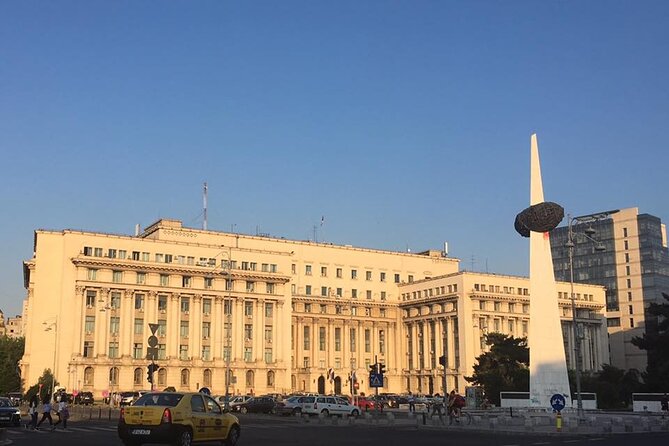
The tour begins at Boteca 13, at Strada Boteanu 3, near the center of Bucharest. From there, you reach Revolution Square, where Ceausescu delivered his final public speech in 1989.
This is the right place to start because the square captures the sudden collapse of a regime that had seemed firmly in control. Ceausescu expected the crowd to respond as it had many times before. Instead, his speech broke apart in front of him. The moment became one of the clearest public signs that authority was slipping away.
You spend about 30 minutes here. That may sound brief, but the stop is about setting the frame for everything that follows. Elena explains the rise of Romanian communism, the nature of Ceausescu’s rule, and the events that led to the revolution.
Look beyond the obvious monuments. The square is also a place of competing memories, official symbols, and reminders of how public space can change meaning. Elena’s photographs help you picture the crowds and buildings as they appeared during the upheaval.
University’s Square and Romania’s freedom of speech
The next stop is University’s Square, described as KM0 of Romanian freedom of speech. Here, on December 21, 1989, the first heroes of Bucharest’s uprising died for liberty.
The name can sound abstract until you stand in the place and hear what happened there. This square links the revolution to the right to speak openly, gather in public, and challenge political power. Elena also uses the stop to discuss Romania’s current political climate, showing that 1989 is not merely a finished chapter.
You spend another 30 minutes here. The pace allows room for questions, which is important because the revolution can be confusing. Events moved quickly, public information was unreliable, and later accounts often competed with one another. A guide who can explain the sequence without turning it into a memorized speech makes a real difference.
I especially like this part for visitors who know the broad outline of the fall of communism but not the Romanian version. Romania’s revolution had its own violent and complicated path. University’s Square gives you a physical reference point for that story.
A working-class neighborhood by metro and bus
The tour then leaves the familiar center. You use public transportation to reach Eroii Revolutiei and a typical working-class district. This is one of the most useful parts of the experience because it moves beyond monuments and government buildings.
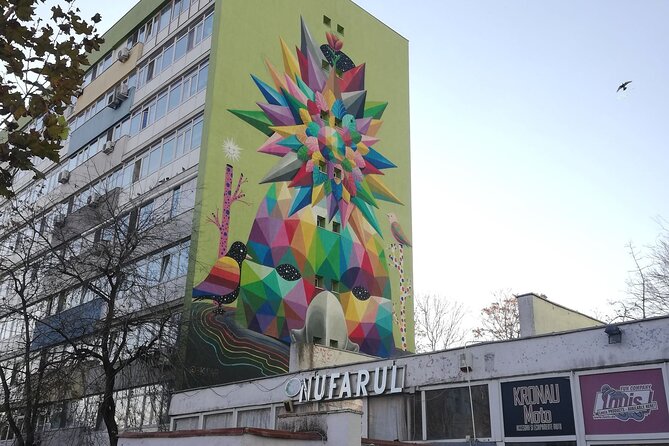
You see the gray communist blocks of the 1970s, along with colorful street art that is changing their appearance. The contrast is not presented as a simple before-and-after success story. Instead, it shows how older neighborhoods continue to be used and reinterpreted.
The stop itself lasts about 15 minutes, but the transport adds a slice of ordinary city life. You are not sealed inside a sightseeing vehicle. You move through Bucharest as residents do, and the journey helps you understand the scale of the city.
Public transportation also adds a practical note. You should be comfortable getting on and off a metro or bus and walking between stops. The experience requires moderate physical fitness, and it is not designed for someone who wants to remain seated throughout.
Still, I find the transport worthwhile. It turns the tour into a city lesson rather than a string of famous addresses. You get a glimpse of Bucharest away from the grand central avenues, where the legacy of communist construction is more immediate.
More walking tours in Bucharest:
- Bucharest: City Highlights Guided Walking Tour
★ 4.9 · 1,482 reviews - Bucharest Highlights Walking Tour
★ 5.0 · 469 reviews - Free walking tour of Brasov in English
★ 4.9 · 302 reviews - Bucharest: Ghost Stories & Romanian Mythology Walking Tour
★ 4.9 · 287 reviews
The Memorial Cemetery and the cost of 1989
At Cimitirul Eroilor Revolutiei, the mood changes. The cemetery is quiet, with paths dedicated to the people killed during the 1989 revolution. You spend roughly 30 minutes walking through the grounds and hearing personal stories.
This stop keeps the revolution from becoming a dramatic political anecdote. The end of Ceausescu’s regime involved real people, families, and losses. In a cemetery, the human cost is harder to brush aside.
The setting also gives the tour breathing room. Much of the morning deals with crowds, speeches, streets, and powerful leaders. Here, the attention shifts to individuals. Elena’s stories help put names and lives behind the phrase heroes of the revolution.
You should expect a reflective visit, not an entertainment stop. That is part of its value. If you are trying to understand why December 1989 remains emotionally important in Romania, this is one of the most direct places on the route.
Carol Park and the monument to communist leaders
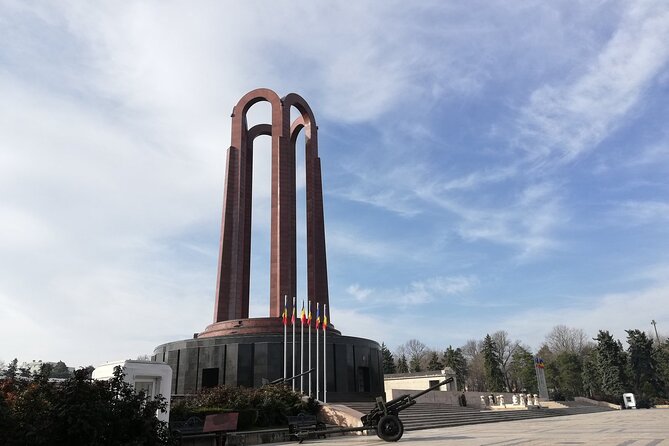
From the cemetery, the route continues to Parcul Carol I. You get a view from one of Bucharest’s higher hills and see the Monument of the Heroes for the Freedom of the Motherland.
The monument was built to honor communist party leaders. Its location creates an interesting contrast with the cemetery visited earlier. One place remembers people who died seeking freedom. The other reflects the official ideals and power structure of the regime they opposed.
You spend about 30 minutes in the park. The open setting gives your legs a break from dense streets, while the hill offers a different view of Bucharest. It also helps you understand how monuments were used to shape public memory.
This is a good place to ask about symbols. Communist monuments were not only decorative. They presented a political message about sacrifice, progress, loyalty, and the state. After 1989, their meaning became more contested, and some visitors may find that tension more interesting than the monument’s appearance alone.
The Palace of Parliament and Ceausescu’s final whim
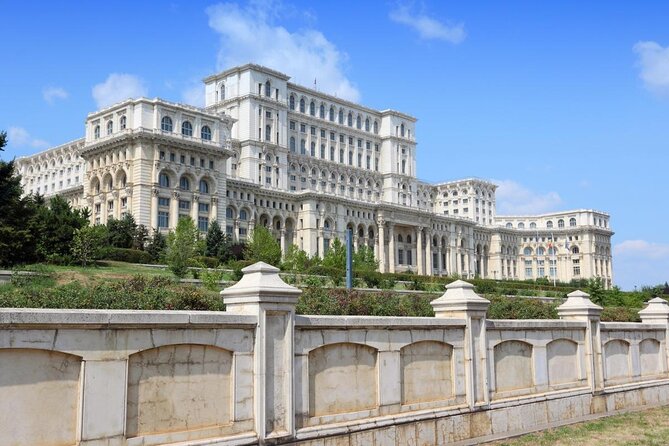
The route returns toward the center and stops outside the Palace of Parliament. You do not receive admission to the building as part of this experience, but the exterior visit gives you the essential context.
The Palace of Parliament is one of the world’s largest administrative buildings and the most famous physical expression of Ceausescu’s grand ambitions. Its size is difficult to absorb from photographs. Standing in front of it, you can discuss the resources, labor, and urban change required to build such a structure.
The building also raises a hard question: what does a government communicate when it spends enormous sums on a palace while ordinary people face restrictions and shortages? That contrast is central to understanding Ceausescu’s cult of personality.
You spend about 30 minutes here. The stop is valuable even without an interior visit because the tour is focused on political meaning rather than architectural access. If you want to tour the inside, you would need to arrange that separately.
For many visitors, this is the most recognizable stop. I would not treat it as the main reason to book, though. The Palace becomes more interesting after you have heard about Revolution Square, the cemetery, and the ordinary neighborhoods. Without that context, it can be just a very large building.
Unirii Boulevard and the view of power
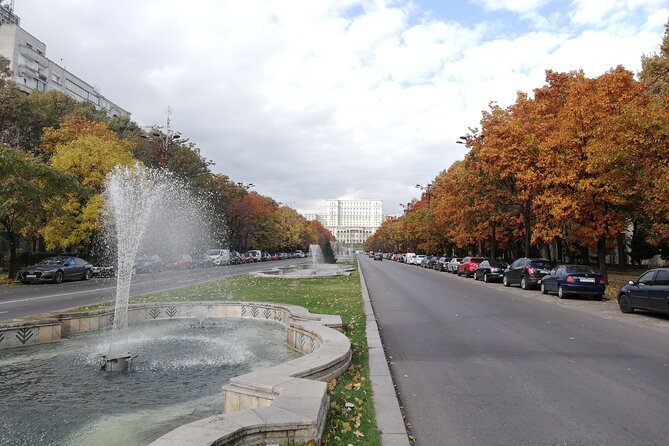
The final stop is Bulevardul Unirii, near the dancing fountains. The boulevard was designed as a grand approach to the Palace of Parliament, with the scale intended to impress visiting world leaders and reinforce the state’s power.
The boulevard’s width and formal layout make sense after the earlier discussion of Ceausescu’s urban projects. It was not simply a road improvement. It was part of a larger attempt to reshape Bucharest around the regime’s image.
The tour ends near number 25 on Unirii Boulevard, close to the Palace and Bucharest’s Old Town. That is convenient. You can continue sightseeing, find food, or return to your accommodation without crossing the city again.
The ending also leaves you with a useful contrast. At the beginning, you stand where Ceausescu lost control of a public crowd. At the end, you stand on a boulevard built to display his control. The route has a clear arc without feeling like a classroom lecture.
Elena’s guiding style and the value of a small group
The strongest pattern in the experience is the guide’s personal approach. Elena explains difficult material in clear English and welcomes questions. She uses old photographs, which are especially helpful when today’s buildings look orderly and detached from the dramatic events that took place around them.
You are not limited to a fixed script. The tour can move into family life, political ideas, the cult of personality, and the continuing effects of communism. That makes the experience useful for curious visitors who want more than dates and names.
The group limit of eight is a major advantage. A small group lets you hear the guide without fighting traffic noise or a loudspeaker. It also makes it easier to stop for questions and adjust the pace.
There is one detail to keep in mind: the experience information identifies Elena as the guide, while one account refers to Martha. If having a specific guide matters to you, confirm the arrangement when booking.
Elena also offers practical local help during the experience, including restaurant suggestions and general Bucharest advice. That is a useful bonus, especially if you are visiting alone or arriving early in your stay.
Is $42.05 a fair price?
At $42.05 per person, the price is reasonable for a three-hour small-group experience that includes a guide, several central and residential areas, and public transportation as part of the route. You are paying for interpretation and access to places you might not connect on your own, not for admission tickets to major attractions.
All listed stops are free, apart from the fact that entry to the Palace of Parliament is not included. The tour is therefore strongest for people who value explanation, local perspective, and a thoughtfully arranged route.
The small group also affects the value. An inexpensive large tour may cover the same central sights, but it is less likely to offer the same chance for personal questions or a flexible conversation. You should choose this experience if that interaction matters to you.
The route is less suitable if you want a relaxed café morning. Three hours can include substantial walking, and public transport adds movement between locations. Have breakfast first, wear shoes with good support, and carry water.
Free cancellation is available if you cancel at least 24 hours before the start time. The experience depends on good weather, so poor conditions may lead to a new date or a full refund.
Who should book this Bucharest tour?
I would recommend it to first-time visitors who want a clear introduction to Romania’s recent past. It also suits anyone interested in the 1989 revolutions in Eastern Europe, political memory, architecture, or the daily effects of dictatorship.
Solo visitors should find the small format comfortable, especially because the guide offers a friendly, conversational setting. The tour also works well for couples and families with older teenagers who can engage with serious historical material.
You may want to skip it if you have limited mobility, dislike public transportation, or want a tour centered on medieval, royal, or traditional Romanian culture. This is specifically a communist-history experience, and some stops are emotionally heavy.
I would book it early in a Bucharest visit. The route gives you context for the Palace of Parliament, the wide central boulevards, the revolution memorials, and the city’s changing neighborhoods. It is also booked around 17 days ahead on average, so last-minute availability may not be dependable.
Should you book Contrasts of Communism?
Yes, if you want Bucharest to make more sense. The tour’s best feature is not one monument. It is the way Elena links public squares, a cemetery, housing blocks, street art, parks, and grand government buildings into one human story.
Book it for the guide’s personal explanations, the old photographs, the small group, and the public-transit ride beyond the center. Skip it only if you want a purely light sightseeing walk or cannot manage three hours of movement.
For a modest price, you get a serious introduction to the city’s communist past and the revolution that ended it. That context will likely change the way you see Bucharest for the rest of your stay.
FAQ
How long does Contrasts of Communism last?
The experience lasts approximately three hours.
Where does the tour begin?
It begins at Boteca 13, Strada Boteanu 3, București 010027, Romania.
Where does the tour end?
It ends at Bulevardul Unirii 25, near the Palace of Parliament and Bucharest’s Old Town.
What language is the tour offered in?
The tour is offered in English.
How many people can join the tour?
The maximum group size is eight travelers.
Is admission to the stops included?
The listed stops are free. Admission to the Palace of Parliament is not included.
Does the tour use public transportation?
Yes. The route includes public transportation to reach Eroii Revolutiei and a working-class neighborhood.
How physically demanding is the experience?
Participants should have a moderate level of physical fitness. The experience includes walking and public transportation, so comfortable shoes are advisable.
Can I cancel for a full refund?
Yes. You can receive a full refund if you cancel at least 24 hours before the experience start time.
What happens if bad weather cancels the tour?
If poor weather causes a cancellation, you will be offered another date or a full refund.
Recently added around Bucharest
- 6h Communism Tour in Bucharest with Ceausescu Mansion★ 4.5 · 6 reviews
- From Bucharest : Day Trip to Peles, Dracula’s Castle, Brasov★ 4.7 · 6 reviews
- Bears Sanctuary, Dracula Castle and Brasov City – Full Day Trip from Bucharest★ 5.0 · 6 reviews
- Dracula Private Tour★ 5.0 · 6 reviews
- Transfagarasan Road Private Day Trip from Bucharest / The Best Road in the World★ 5.0 · 6 reviews
- Bucharest : Wednesday, Dracula & Peles 3 Castles Tour 1 Day★ 4.7 · 6 reviews
- Hiking thought the best mountain villages in Romania-Private tour from Brasov★ 5.0 · 6 reviews
- Bucovina Painted Monasteries & Transylvania Tour: 4-Day Private★ 5.0 · 6 reviews
Communism Tours, compared.
Bucharest Essential Tour: Old Town, Calea Victoriei & Communism
Read our review →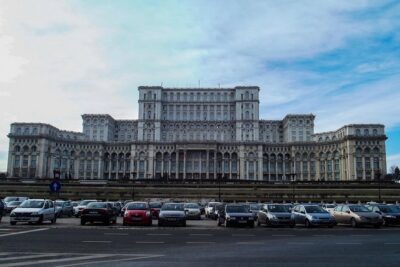
Communism in Bucharest – Landmarks, Museum & Communist Appetizers
Read our review →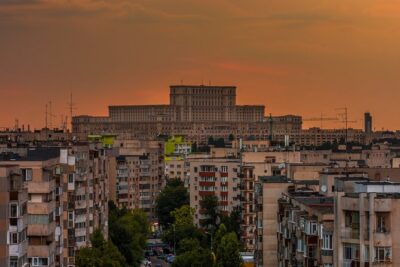

Museum of Communism Ticket with Communist Coffee
Read our review →Browse the lists this tour appears in