
Reviewed · COMMUNISM TOURS
Bucharest: The “Last Days of Communism” Tour
The most striking part of this Bucharest tour is the sharp contrast between Ceausescu’s grand building projects and the personal story of the people who lived through them. You’ll see the balcony linked to his final speech, the enormous Parliament Palace, and the former home of the presidential couple. I like that the tour connects famous sights to Romania’s 1989 revolution, and I like the hotel pickup, which saves you from sorting out transport across a spread-out city. The main drawback is that entrance fees are extra, and weekend access to Parliament Palace is limited for small groups.
I also like the mix of wide city views and intimate details. One stop shows the scale of the communist state, while Primaverii Palace gives you a closer look at how Romania’s rulers lived. Guide Boogie is praised for being passionate and generous with time, though your assigned guide may differ.
In This Review
- Key points to know before booking
- Bucharest through the communist years
- Starting with Free Press Square and the northern boulevards
- Victoriei Square and Calea Victoriei
- Revolution Square and Ceausescu’s final speech
- Parliament Palace, the former House of the People
- Primaverii Palace and the presidential household
- The central squares seen from the car
- What the guide adds to the experience
- Is $69 a fair price?
- Timing, group rules, and what to bring
- Who should book this Bucharest tour?
- Should you book it?
- FAQ
- How long does the Bucharest communist tour last?
- What sights are included on the route?
- Does the tour include Parliament Palace admission?
- Is hotel pickup included?
- What language is the tour offered in?
- What identification should you bring?
- Is Parliament Palace guaranteed to be open?
- What happens if the minimum group size is not reached?
Key points to know before booking
- Revolution Square tells the turning-point story: See the balcony connected with Ceausescu’s last speech and the Revolution Memorial.
- Parliament Palace is the tour’s grandest stop: The former House of the People shows the scale and cost of communist ambition.
- Primaverii Palace adds a personal angle: Visit the former residence of Nicolae and Elena Ceausescu.
- You see far more than two buildings: The route can include Free Press Square, the Arch of Triumph, Victoriei Square, Union Square, University Square, Romana Square, and Charles de Gaulle Square.
- Hotel pickup makes the morning simple: Transport is by car or minibus with an English-speaking guide and driver.
- Check your date carefully: Parliament Palace visits on weekends require groups of 10 or more, and both interiors can close for official meetings.
Bucharest through the communist years
Romania lived under communist rule from 1948 until December 1989. Nicolae Ceausescu became head of the Romanian Communist Party in 1965 and president of the Socialist Republic of Romania in 1974. Fifteen years later, a violent revolution removed him from power, and he was executed with Elena Ceausescu.
That basic timeline matters because this is not only an architecture tour. The boulevards, squares, and government buildings reveal how the state wanted Bucharest to look and how ordinary people were expected to live. You’ll hear about the official language of the period, including the supposed achievements of the golden era, while also learning about the human cost behind those projects.
I would book this tour early in your Bucharest visit if you want a framework for the city. After five hours in these places, the huge avenues and stern public buildings make more sense. You’ll also be better prepared to spot the difference between the old communist center and the city’s older streets.
More communism-era tours in Bucharest:
- The Real tour of Communism
★ 5.0 · 666 reviews - Life under Communism
★ 5.0 · 358 reviews - 3-Hour Guided Tour of Communist Bucharest
★ 4.9 · 303 reviews
Starting with Free Press Square and the northern boulevards
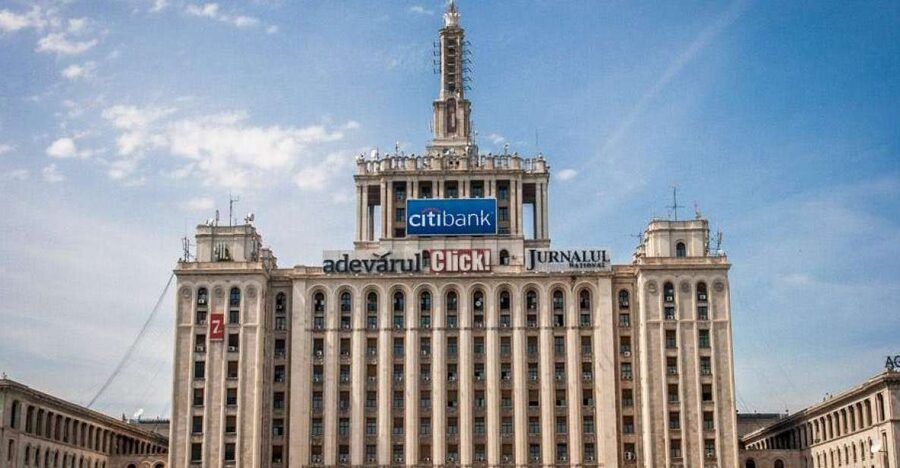
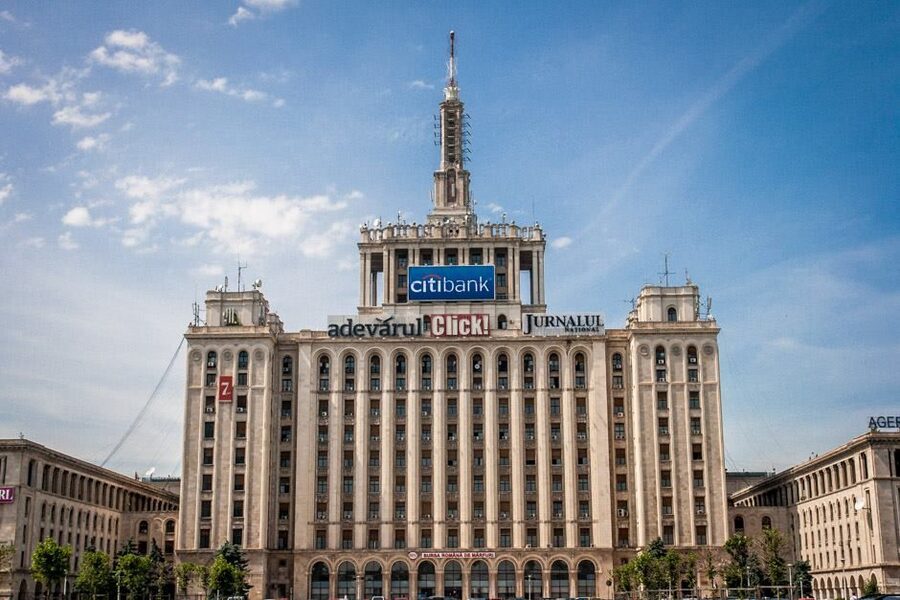
The exact route depends on your hotel, but the tour can begin with Free Press Square, or Piata Presei Libere. This area is linked to the communist press and to the first communist building in Bucharest, making it a useful opening chapter.
The square helps explain how the government shaped public information. It is not simply a photo stop. Your guide can place the building within the system of newspapers, official messaging, and public control that defined daily life under the regime.
From here, the route may continue past the Arch of Triumph. This gives you a change of scale and mood. The arch is a familiar Bucharest landmark, while the communist-era sights nearby show how the city’s older identity was placed beside newer state projects.
You may also pass Charles de Gaulle Square and nearby northern avenues. These stops are seen from the vehicle, so do not expect a long independent visit at every location. Their value is in helping you understand the city plan and the broad routes used to connect government districts.
Victoriei Square and Calea Victoriei
Victoriei Square is another important point on the route. It links major avenues and government areas, so it helps you see Bucharest as a working capital rather than a collection of isolated monuments.
The tour may also follow Calea Victoriei toward Revolution Square. This is one of the city’s best-known streets, and the contrast between historic buildings and communist-era political sites gives the drive more texture. You are not looking at a single, preserved communist zone. Instead, the past appears in layers.
For me, this part of the tour is most useful when the guide explains what was changed, what was demolished, and what remained. The information provided confirms that the route is designed to reveal the so-called achievements of the period while also telling the story of the people who built them. That balance is important. You should expect a political and social explanation, not just dates and building names.
Revolution Square and Ceausescu’s final speech
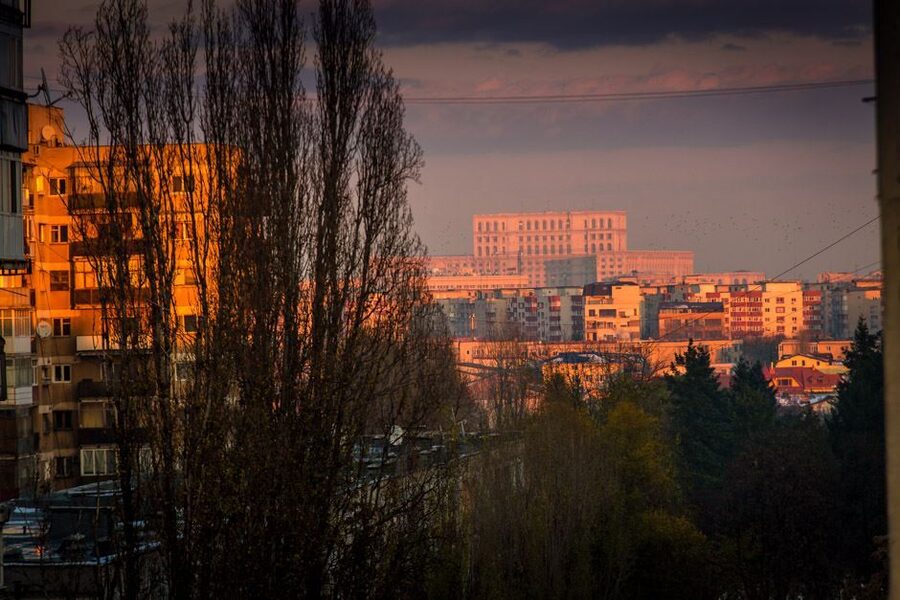
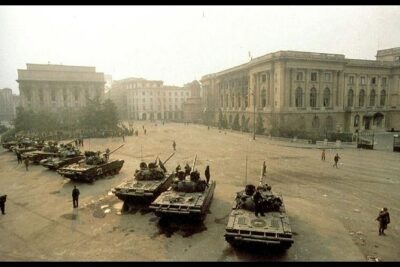
Revolution Square is the emotional center of the tour. Here you can see the balcony where Ceausescu gave his last public speech before the regime collapsed. The location connects directly to the events of December 1989.
You’ll also see the Revolution Memorial. Its modern design has prompted debate, so your guide may give you a useful sense of how Romanians remember the uprising and the people who died. This is one place where the tour’s subject becomes personal. The story is no longer only about official buildings. It is about fear, protest, confusion, and the sudden end of a government that had ruled for more than 40 years.
I recommend taking a moment here before moving on. If you rush through the square, it can look like another central plaza. With the context, it becomes the place where the old order visibly lost control.
The Romanian Atheneum is also part of the Revolution Square area. It gives you a reminder that Bucharest’s cultural identity was not created by communism, even though the regime tried to frame the capital through its own architecture and ceremonies.
A few more Bucharest tours worth a look
- Bucharest: Dracula’s Castle, Peles Castle, & Brasov Old Town
★ 4.5 · 17,858 reviews - Bucharest: Dracula Castle, Peles Castle & Brasov Old Town
★ 4.6 · 10,891 reviews - Bucharest: Dracula’s Castle, Peleș Castle & Brașov Day Trip
★ 4.5 · 5,919 reviews - Bucharest: Palace of Parliament Tickets and Guide
★ 4.3 · 3,182 reviews
Parliament Palace, the former House of the People
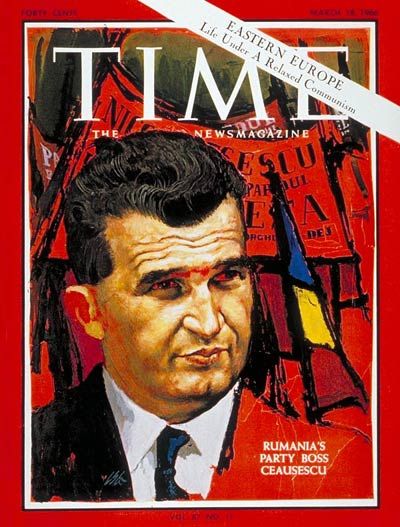
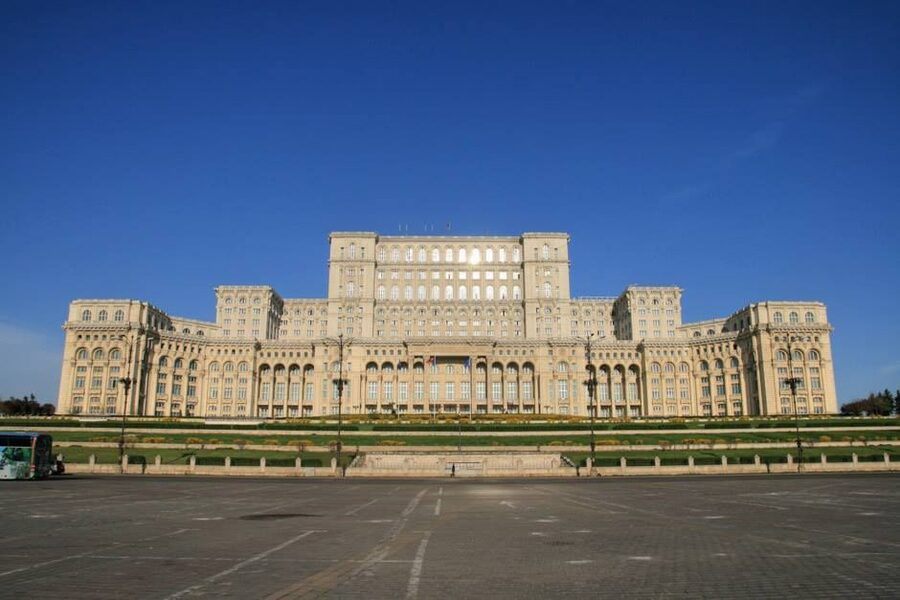
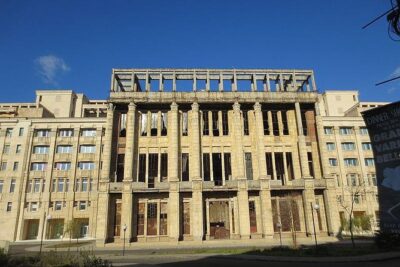
The Palace of Parliament is the tour’s largest and most dramatic sight. During the communist period it was known as the House of the People, a name that now feels loaded with irony. The building represents Ceausescu’s desire for monumental power and the enormous urban changes made in central Bucharest.
Inside, you’ll see the scale of that ambition more clearly than from the road. The visit is included in the planned route, but the entrance fee is not included in the $69 tour price. You should also bring your original passport or ID card, since identification is required for the visit.
The building is impressive, but I would not treat it as a simple architectural triumph. Its size and formal interiors are inseparable from the sacrifices demanded to create it. Entire areas of the city were reshaped for the project, and the building became a symbol of state power at a time when many Romanians faced strict limits in everyday life.
That is why a guide adds real value here. Without explanation, you may notice grand rooms, heavy materials, and long corridors. With context, you can ask why the building was created, who it was meant to impress, and what the project said about the relationship between the government and its people.
Access is not guaranteed. Official meetings and conferences can close the institution, and weekend visits are available only for groups of 10 or more. For a smaller weekend group, the palace is replaced by another attraction or a guided walk in the Old Town. If Parliament Palace is your main reason for booking, confirm the operating conditions before you commit to a date.
Primaverii Palace and the presidential household
Primaverii Palace changes the tone completely. This was the former residence of Nicolae and Elena Ceausescu, so the visit focuses less on monumental public power and more on private life at the top of the regime.
The contrast is revealing. Parliament Palace tells you how the state presented itself to the public. Primaverii Palace shows the kind of private setting used by the presidential couple. You can compare the official image of sacrifice and equality with the comforts reserved for the country’s leaders.
This stop is one of the strongest reasons to choose the tour rather than simply taking photographs outside major buildings. Interiors can show habits, taste, and daily routines in a way that a facade cannot. The visit also gives you a more human scale after the vastness of Parliament Palace.
Entrance to Primaverii Palace is extra, just like Parliament Palace. The institution can also close for meetings or other official reasons, so both interior visits remain subject to availability.
The central squares seen from the car
The route can include Union Square, University Square, and Romana Square, along with another pass through Victoriei Square. These locations are not all promised as lengthy stops, and you should think of them as part of a guided city circuit.
Union Square helps connect the central districts to the broad redevelopment associated with the communist period. University Square is especially useful in a tour about the final days of communism because it is one of the city’s major public spaces. Romana Square and Victoriei Square add more context about how the avenues fit together.
Transport by car or minibus keeps the itinerary practical. Bucharest is spread out, and walking between all these places would take much longer than five hours. You’ll spend part of the tour on the road, but that travel time lets the guide connect one area to the next.
The tradeoff is that you have less freedom to linger. If you want long photo sessions at every square, this may feel fast. If you want a clear overview without negotiating taxis or public transport, the vehicle is a strong advantage.
What the guide adds to the experience
This tour depends heavily on the guide. The subject includes political facts, personal stories, architecture, and painful memories. A flat narration would make the buildings feel remote, while a thoughtful guide can show why they still matter.
Boogie is specifically praised for passion, strong knowledge of communist and modern Romania, and a willingness to spend time on individual interests. One account describes the guide going beyond the basic plan to make sure the visitor saw and understood what mattered to them. You cannot assume Boogie will lead every departure, but the experience clearly benefits from a guide who treats the tour as a conversation rather than a script.
The language listed is English. You should feel free to ask for clarification when a date, building, or political term goes by quickly. This is the kind of tour where questions can turn a general city drive into a more personal lesson about Romania.
Is $69 a fair price?
At $69 per person, the tour sits in a reasonable range for a five-hour private-style city outing with hotel pickup, a vehicle, and an English-speaking guide. The value depends on what you want from the day.
If you tried to visit the sites independently, you would still need to arrange transport between northern Bucharest, the central squares, Parliament Palace, and Primaverii Palace. You would also need to work out the history yourself. The tour price pays for that structure and for the guide’s explanation.
The important catch is that entrance fees are not included. Add those costs to your budget before deciding. The price also does not guarantee access to either interior, since institutional closures can change the plan.
I think the tour is good value if you want the communist period explained in one organized morning. It is less attractive if you only want exterior photographs or if you prefer to spend a whole day inside Parliament Palace and at each square.
Timing, group rules, and what to bring
The advertised duration is five hours, with a listed itinerary of roughly four hours of sightseeing and transport. Morning hotel pickup is included, and the start time depends on availability.
Seasonal minimum group rules apply. From March through October and from December 16 through January 6, the tour requires at least four people. From January 7 through February 29 and from November 1 through December 15, the minimum is two people. If the minimum is not reached, you are offered another date or a full refund.
Bring your original passport or national ID card. A copy may not be enough for entry to the institutions. Pets are not allowed.
You can cancel up to 24 hours ahead for a full refund, and the reserve-now, pay-later option keeps your plans flexible. Still, I would contact the operator with your hotel details as soon as you book and ask about the current status of the two palace visits, especially for a weekend.
Who should book this Bucharest tour?
I would recommend it to first-time visitors who want a guided introduction to Romania’s communist past, couples or families who prefer door-to-door transport, and anyone interested in the link between architecture and political power.
It also suits visitors with limited time in Bucharest. In five hours, you cover several districts and see the main sites tied to the communist period and the 1989 revolution.
I would choose another format if your main interest is medieval or nineteenth-century Bucharest, since the tour stays focused on modern political history. I would also think twice if you need guaranteed entry to Parliament Palace on a weekend with fewer than 10 people.
Should you book it?
Book this tour if you want the big picture, clear political context, and visits to both Parliament Palace and Primaverii Palace when they are open. The strongest features are the hotel pickup, the wide route through Bucharest, and the contrast between a huge public monument and a former presidential home.
Before paying, check three things: the entrance fees, the group minimum for your travel dates, and the chance of weekend access to Parliament Palace. If those conditions work for you, $69 buys a useful and well-organized look at the final decades of communist Romania, not just a parade of oversized buildings.
FAQ
How long does the Bucharest communist tour last?
The activity lasts five hours. The sightseeing plan itself is described as roughly four hours, with the remaining time used for transport and hotel pickup arrangements.
What sights are included on the route?
The route can include Free Press Square, the Arch of Triumph, Victoriei Square, Calea Victoriei, Revolution Square, Parliament Palace, Union Square, University Square, Romana Square, and Charles de Gaulle Square. The exact route depends on your hotel’s location.
Does the tour include Parliament Palace admission?
No. Entrance fees to Parliament Palace and Primaverii Palace are not included in the tour price.
Is hotel pickup included?
Yes. Pickup from your hotel in Bucharest is included. You need to provide your hotel details when booking.
What language is the tour offered in?
The tour is offered in English with a live English-speaking guide and driver.
What identification should you bring?
Bring your original passport or ID card. You need it for the institutional visits.
Is Parliament Palace guaranteed to be open?
No. Parliament Palace and the other institutions can close for meetings and conferences. Weekend visits to Parliament Palace are available only for groups of 10 or more. Smaller weekend groups receive an alternative attraction or a guided Old Town walk instead.
What happens if the minimum group size is not reached?
You will be offered an alternative date or a full refund. The minimum is four people from March through October and December 16 through January 6, and two people from January 7 through February 29 and November 1 through December 15.
Recently added around Bucharest
- 6h Communism Tour in Bucharest with Ceausescu Mansion★ 4.5 · 6 reviews
- From Bucharest : Day Trip to Peles, Dracula’s Castle, Brasov★ 4.7 · 6 reviews
- Bears Sanctuary, Dracula Castle and Brasov City – Full Day Trip from Bucharest★ 5.0 · 6 reviews
- Dracula Private Tour★ 5.0 · 6 reviews
- Transfagarasan Road Private Day Trip from Bucharest / The Best Road in the World★ 5.0 · 6 reviews
- Hiking thought the best mountain villages in Romania-Private tour from Brasov★ 5.0 · 6 reviews
- Bucovina Painted Monasteries & Transylvania Tour: 4-Day Private★ 5.0 · 6 reviews
- Bucharest : Wednesday, Dracula & Peles 3 Castles Tour 1 Day★ 4.7 · 6 reviews
Communism Tours, compared.
Bucharest Essential Tour: Old Town, Calea Victoriei & Communism
Read our review →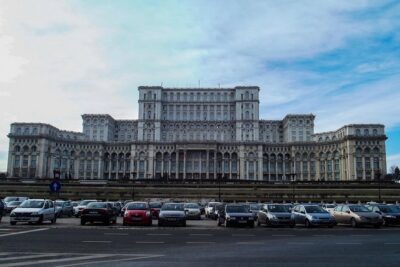
Communism in Bucharest – Landmarks, Museum & Communist Appetizers
Read our review →

Museum of Communism Ticket with Communist Coffee
Read our review →Browse the lists this tour appears in