
Reviewed · POENARI & SNAGOV
Snagov Monastery, Ceaușescu Mansion, & Village Museum – 6h
Snagov Monastery is the surprise here: a small religious site on an island about 40 minutes from Bucharest, linked by tradition to the tomb of Dracula. In one six-hour outing, you move from medieval legend to communist power, then into the wooden houses and village churches of rural Romania.
I like the private car and guide, which let you adjust the day for your group instead of following a fixed bus schedule. I also like the sharp contrast between the modest homes at the Village Museum and the lavish world of the Ceaușescu family mansion. The main drawback is time: the listed stops add up to more than six hours if visited at their full suggested lengths, so you should confirm the final pacing before booking.
In This Review
- Key points to know
- From rural village life to Ceaușescu’s private world
- The Village Museum puts rural Romania in one place
- Snagov Monastery and the Dracula connection
- Inside the Ceaușescu family mansion
- Calea Victoriei shows Bucharest’s contradictions
- Revolution Square and the fall of the regime
- The Athenaeum and CEC Palace
- The Palace of the Parliament closes the city section
- What the $254 price really covers
- Who should book this six-hour route
- Practical details before you go
- Should you book it?
- FAQ
- How long is the tour?
- Is Snagov Monastery outside Bucharest?
- Is the monastery connected with Dracula?
- Is transportation private?
- Which languages can the guide speak?
- Are entrance fees included?
- Can I cancel the booking?
Key points to know
- Snagov Monastery sits on an island, giving the outing a quiet change of scene outside Bucharest.
- The Ceaușescu mansion shows private life behind a public ideology, with the family residence enlarged between 1970 and 1972.
- The Village Museum brings rural Romania into one city park, with houses built from wood, adobe, stone, and other local materials.
- Calea Victoriei links royal, communist, religious, and commercial Bucharest in one central walk.
- The private format suits families and small groups, with fuel, parking, tolls, and hotel pickup included.
- Entrance fees cost about 17 euros per person extra, and food and drinks are not included.
From rural village life to Ceaușescu’s private world
This is not a single-theme sightseeing trip. It is a fast-moving introduction to several Romanias: traditional village life, Orthodox religion, royal Bucharest, communist rule, and the city’s post-1989 memory.
You begin with a pickup in Bucharest and travel in a private tourism car or minibus. Your guide can speak Romanian, English, Italian, French, Spanish, or German. The driver-guide stays with you throughout, and the company allows changes to the daily plan even after the tour begins.
That flexibility matters. If your group wants more time at the mansion and less shopping on Calea Victoriei, you can ask. If Snagov captures your attention, the private setup gives you a better chance of adjusting the pace than a large group tour would.
The day is packed, though. The planned schedule includes the Village Museum, Snagov Monastery, the Ceaușescu mansion, Calea Victoriei, Revolution Square, the Romanian Athenaeum, CEC Palace, the Palace of the Parliament, and additional Bucharest sightseeing. Since the stated stop times total more than six hours, treat the schedule as a route outline rather than a promise of a full visit at every location.
More Poenari and Snagov trips:
- Small Group Tour to Mogosoaia Palace & Snagov Monastery
★ 4.4 · 41 reviews - Sacred Monasteries Private Tour: Snagov, Țigănești & Căldărușani
★ 5.0 · 32 reviews - Private Half Day Trip to Snagov Monastery & Mogosoaia
★ 4.1 · 29 reviews
The Village Museum puts rural Romania in one place
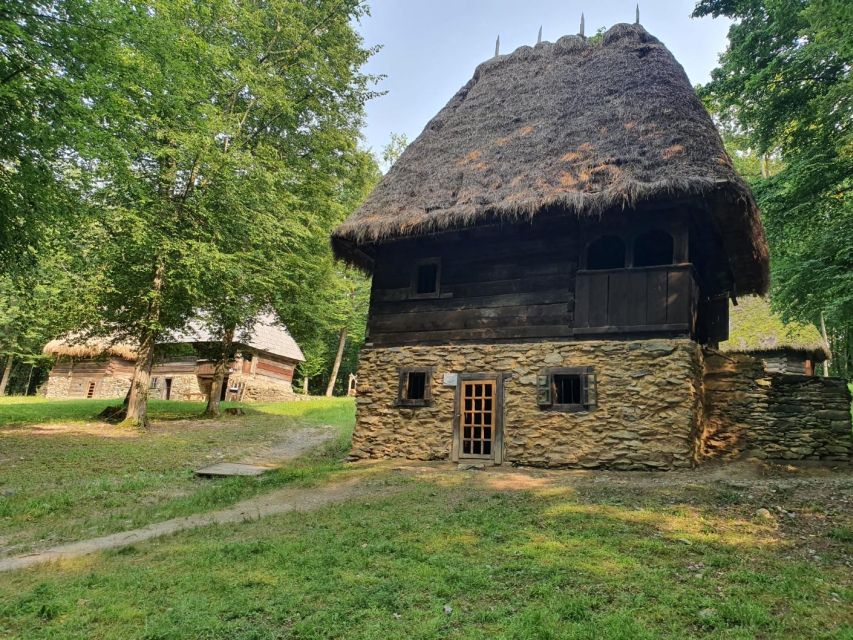
The Dimitrie Gusti National Village Museum is a useful first stop because it gives you a visual framework for the rest of the day. Instead of visiting a distant rural region, you walk among traditional houses gathered from different parts of Romania.
The buildings use wood, adobe, stone, and other local materials. You can see small and large homes, mills, and wooden churches. The setting explains how Romanian villagers organized daily life around local resources, family spaces, farming, work, and worship.
I like this stop for its sense of scale. Romanian history can seem grand when presented through palaces and political buildings. Here, the focus shifts to ordinary homes and practical construction. You get a clearer idea of how people lived before modern city life took over.
The museum also presents village communities as carefully connected to their surroundings. The tour description places emphasis on ecological and sustainable habits, though you should expect an open-air museum visit rather than a working village. The point is not simply to admire old buildings. It is to notice how architecture, local materials, religious life, and social customs fit together.
Plan for about an hour. Wear comfortable shoes, since this stop involves walking between buildings. The amount of time you have inside individual houses or churches will depend on the day’s traffic and how much time your group gives to the later stops.
Snagov Monastery and the Dracula connection
After the Village Museum, the route heads about 40 minutes outside Bucharest to Snagov Monastery. The monastery sits on an island, which gives the visit a pleasant sense of separation from the capital.
The setting is part of the appeal. You leave behind Bucharest’s avenues and heavy buildings and arrive at water, trees, and a smaller religious site. It is an effective change of pace, especially after the city museum.
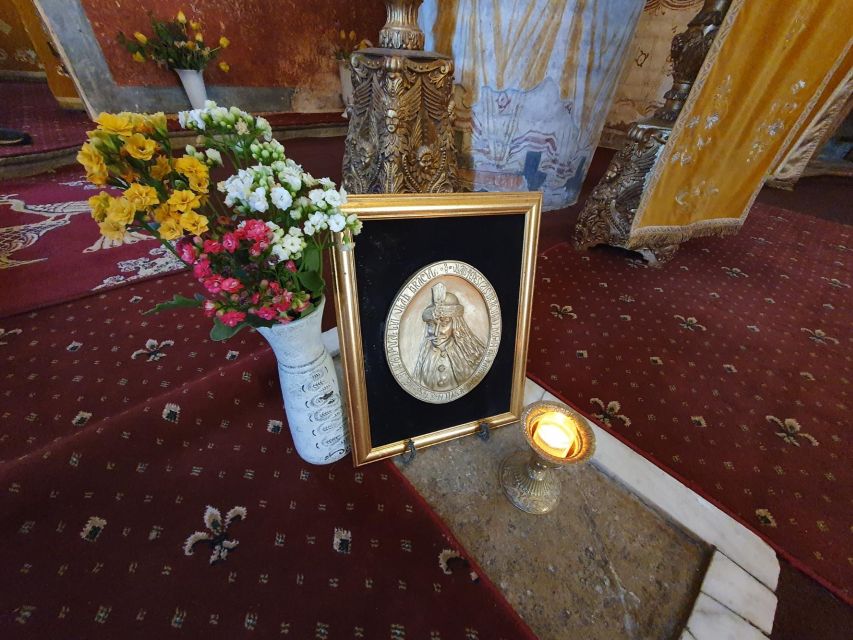
The monastery is associated with the tomb of Dracula. More precisely, the site is presented as the burial place of Vlad the Impaler, the historical figure connected with the Dracula story. The Dracula label will attract attention, but the place itself is also worth seeing as an Orthodox religious monument with a long connection to Romanian history.
The itinerary allows roughly an hour for a visit, guided explanation, sightseeing, and photographs. Ask your guide to explain what is known, what is tradition, and how the Dracula story became attached to the site. That distinction makes the visit more interesting than treating it as a quick legend stop.
The island setting can also affect the practical rhythm of the visit. You should expect a short transfer from the city and time on foot once you arrive. Since the tour includes a private vehicle, you avoid arranging separate transport to Snagov, which is one reason this outing can be useful if you have limited time in Bucharest.
Inside the Ceaușescu family mansion
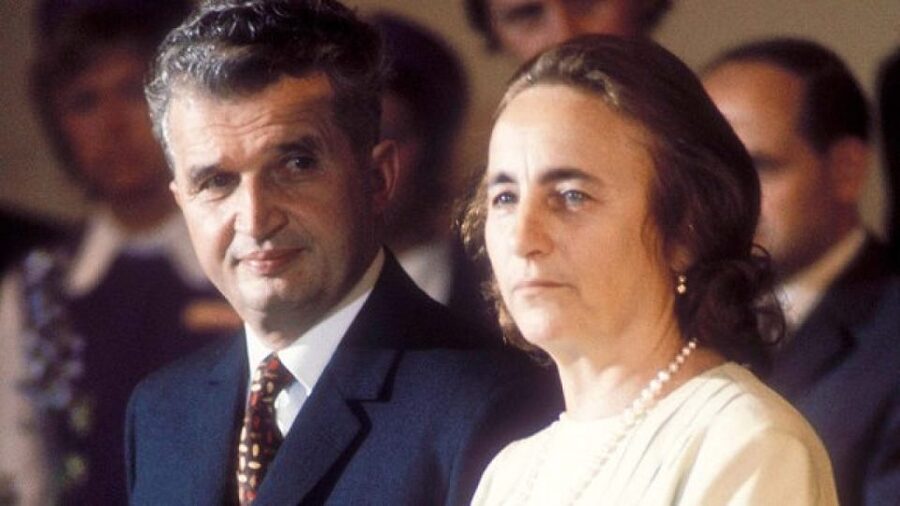
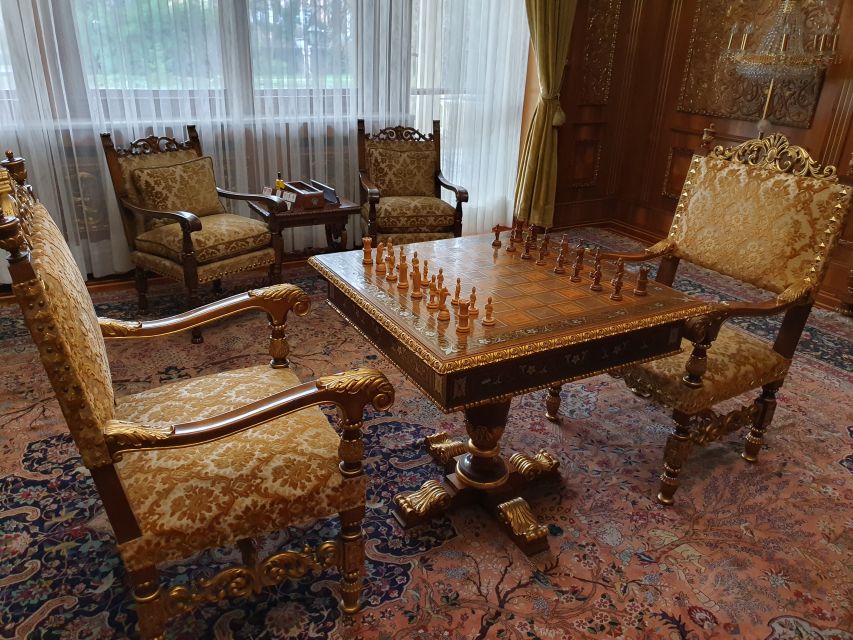
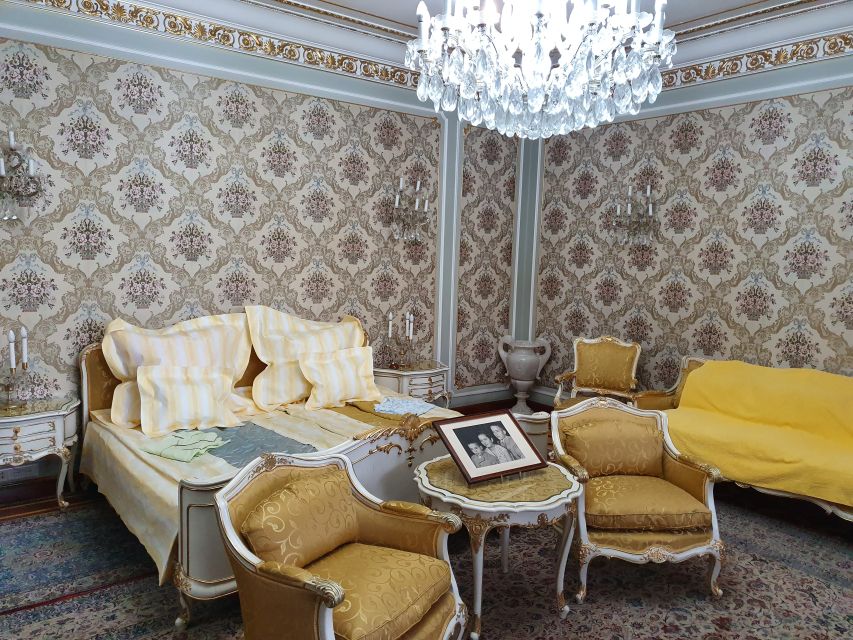
The House of Ceaușescu was the private residence of Nicolae and Elena Ceaușescu and their children, Nicu, Zoia, and Valentin, for about 25 years, from 1965 to 1989.
The building was constructed in the mid-1960s and was known at the time as the Spring Palace. It was enlarged between 1970 and 1972. The design was associated with architect Aron Grimberg-Solari, while architect Robert Woll worked on the grounds and furniture.
That background helps explain what you are seeing. This was not a government office or a public ceremonial palace. It was a family home used by Romania’s ruling household during the communist period. The contrast between official ideas of equality and the private setting of the country’s leaders is hard to miss.
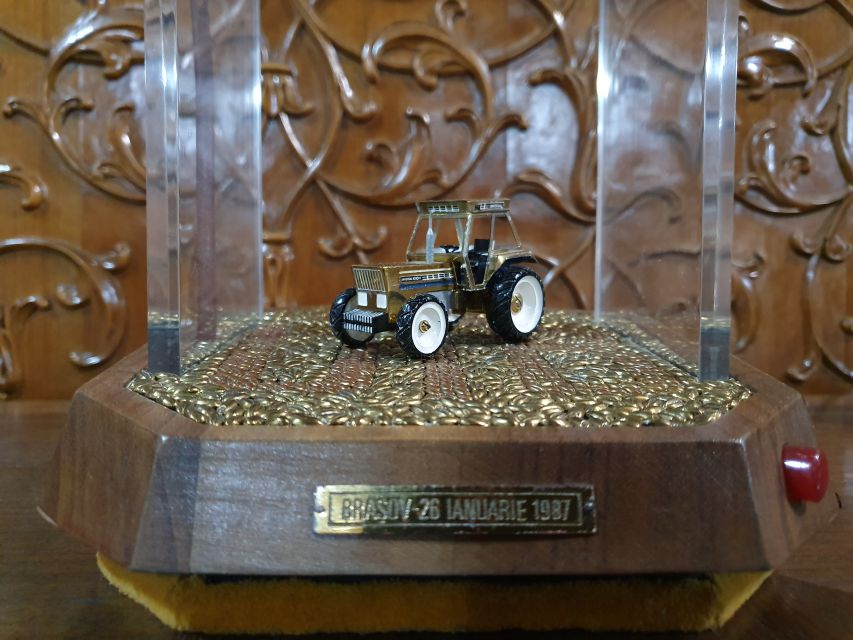
You will walk through the residence with your guide and see the architecture, interiors, and grounds. The tour description draws attention to the family’s private lifestyle, but it does not promise access to every room or a specific museum display, so the exact visit can depend on opening arrangements.
I find this stop valuable because it puts political history into domestic terms. Revolution Square tells you how the regime fell. The mansion helps you understand how the ruling family lived before that fall.
Allow about an hour in the stated plan. The visit is especially worthwhile if you are interested in 20th-century history, architecture, interior design, or the gap between public slogans and private privilege. It may be less compelling if your main interest is medieval Bucharest or art museums.
More Village Museum visits:
- Palace of the Parliament, Village Museum & Ceaușescu Mansion
★ 4.9 · 31 reviews - Traditions in Bucharest: Village Museum and Wine Tasting Tour
★ 5.0 · 27 reviews - Private Bucharest city tour visit the Palace of the Parliament & Village Museum
★ 4.5 · 21 reviews - Traditions in Bucharest: Village Museum and Wine Tasting
★ 5.0 · 8 reviews
Calea Victoriei shows Bucharest’s contradictions
Calea Victoriei is the city’s great central avenue and one of the strongest parts of the urban portion of this tour. Here, your guide points out a mixture of royal buildings, communist landmarks, churches, museums, restaurants, shops, theaters, and older architectural styles.
The route includes the Royal Palace on one side and the former Central Committee of the Romanian Communist Party near Revolution Square. That physical contrast gives the avenue its meaning. You are not just looking at attractive buildings. You are reading the city through competing periods of power.
The avenue also offers a change from formal sightseeing. Depending on how your group uses the time, you can stop for photographs, browse shops, look for souvenirs, or pause at a café or tea shop. The itinerary allows about an hour and a half for Calea Victoriei, the longest city segment.
You may also see old Orthodox churches, the National History Museum, the Romanian Athenaeum, and the CEC Palace during the central Bucharest portion. Not every building will receive a full interior visit, so listen for your guide’s explanation of which stops are photo breaks and which are guided visits.
This is where the tour’s private format is most helpful. A guide can adjust the walk for your interests, but the number of landmarks means you should not expect a detailed museum tour of every building.
Revolution Square and the fall of the regime
Revolution Square is the key political stop. This is where the December 1989 uprising began and where Nicolae Ceaușescu’s power collapsed.
The former Central Committee building is central to the story. From there, Ceaușescu fled by helicopter as protests overwhelmed the regime. The tour also connects the square with the Senate Palace and the events that removed him from power after years of communist rule.
Your guide can help you read the square as a place of memory rather than just another open space. The buildings around it carry the marks of royal government, communist administration, and the dramatic change of 1989.
The suggested visit lasts about 30 minutes. That is enough for an introduction and photographs, but not a full political history lesson. If this period matters to you, tell your guide early in the day. You may prefer to give up some shopping time for more explanation here.
The stop works particularly well after the Ceaușescu mansion. First you see the private world of the ruling family. Then you see the public space where that rule ended. That pairing gives the day a strong narrative line.
The Athenaeum and CEC Palace
The Romanian Athenaeum is one of Bucharest’s major architectural landmarks. The itinerary includes a guided visit and walk, with about 30 minutes set aside.
The Athenaeum provides a cultural counterpoint to the political sites. Instead of focusing on dictatorship or revolution, it points to Bucharest’s musical and civic life. Your guide can place the building within the city’s broader architectural story and explain why it is one of the capital’s best-known landmarks.
The CEC Palace offers another quick architectural stop. The plan includes a break, photographs, a visit, guided sightseeing, and free time, with about 15 minutes listed.
Fifteen minutes is enough to admire the exterior and take photos, but it is a short window. Think of this as a compact introduction, not a long interior tour. The value comes from seeing the building as part of Calea Victoriei’s mix of historic institutions and public spaces.
The Palace of the Parliament closes the city section

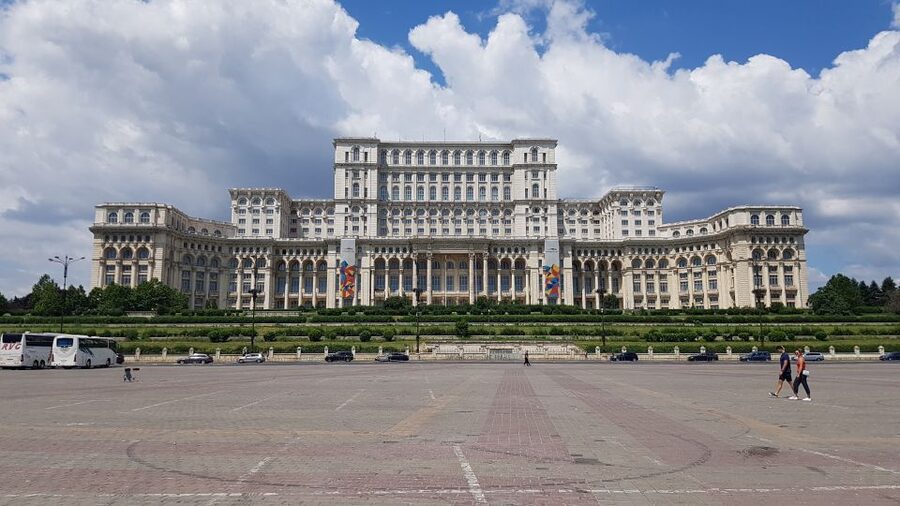
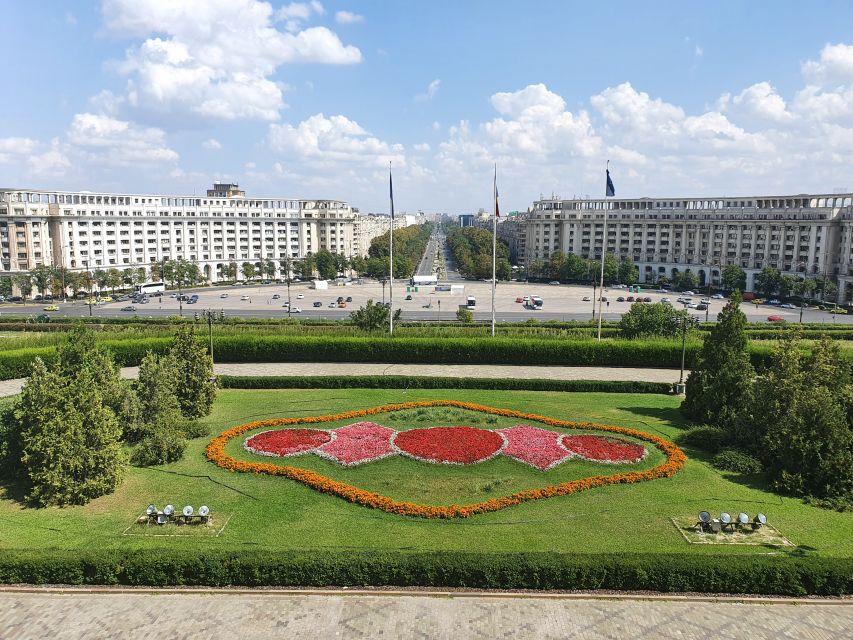
The Palace of the Parliament is another major Bucharest landmark included on the route. The stop allows about 30 minutes for a break, photographs, a visit, and guided sightseeing.
The building is important because it expresses the scale and ambition of Ceaușescu’s political project. Even without a long interior visit, its size gives you a clear sense of the regime’s priorities and the urban transformation carried out under communist rule.
As with the other city landmarks, confirm what kind of access is planned. The supplied schedule lists a visit, but the overall six-hour limit means your time may be focused on the exterior and surrounding views rather than a full building tour.
The final portion returns you to Bucharest, with up to 45 minutes for additional sightseeing, free time, shopping, and photographs before drop-off. This flexible ending is useful if you want souvenirs or a final look at central Bucharest, but it is also the part most likely to shrink if earlier stops run long.
What the $254 price really covers
At $254 per person, this is not a budget sightseeing outing. The price makes more sense for a private group that values convenience, a dedicated guide, and a route reaching outside Bucharest.
You are paying for a private car or minibus, fuel, parking, road tolls, pickup, and a licensed guide-driver. Those costs would otherwise be divided among separate transfers or taxis, especially for Snagov. The ability to request changes during the day adds real value for families and groups with different interests.
Entrance fees are extra, at about 17 euros per person. Food and drinks are also excluded. You should budget for those costs rather than treating the advertised price as the final amount.
For one person or a couple, the price may feel high compared with joining a larger group. For a family or group of friends, the calculation improves because the private vehicle and guide serve everyone together. The strongest value comes when you want both Snagov and several Bucharest sights in one day without arranging transport yourself.
Who should book this six-hour route
I would recommend this tour to you if you want a broad first look at Bucharest and have limited time. It suits people who enjoy connecting buildings and places to political events, rather than spending a whole day in one museum.
It is also a good match for families and private groups. The car reduces the strain of moving between city sights and an out-of-town monastery. The multilingual guide option is helpful if English is not your preferred language.
History-minded visitors will get the most from the combination of the mansion, Revolution Square, and the Parliament Palace. Architecture fans will appreciate the Athenaeum, CEC Palace, village houses, churches, and the changing styles along Calea Victoriei.
I would hesitate if you want a slow day with long museum visits. The route covers a lot, and some stops are brief. You should also ask for a precise timing plan because the listed stop durations exceed the advertised six hours.
The tour has a perfect 5 rating from three confirmed bookings, with short comments describing the day as well organized, perfect, and full of contrasts. One French-language comment specifically praised the mix of communist buildings, Art Deco and Baroque city architecture, the lake setting, and the Dracula tomb, along with the guide’s cultural range. That combination captures the tour’s appeal: it is broad, contrasting, and guided by the story of Bucharest rather than by one monument.
Practical details before you go
Pickup is in Bucharest, and the driver holds a sign with your last name. The guide and driver remain available during the tour, and the languages offered are Romanian, English, Italian, French, Spanish, and German.
The tour offers free cancellation up to 24 hours before departure and allows you to reserve while paying later. Check the available starting times when booking, since the exact departure schedule is not fixed here.
Entrance fees are not included. Food and drinks are not included either, so plan for both. Since the day includes several walks and outdoor sightseeing, comfortable shoes are sensible.
Most important, confirm the balance between the out-of-town stop and the central Bucharest landmarks. Ask whether the Palace of the Parliament and other major buildings are exterior photo stops or interior visits on your chosen date. That one question will tell you whether the pace matches your expectations.
Should you book it?
Book this tour if you want maximum variety in a private setting: village traditions, an island monastery, Dracula lore, communist history, royal Bucharest, and major city architecture. It is an efficient choice for a first visit or a short stay.
Skip it if you prefer depth over range, or if you want to spend several hours inside one museum or palace. The price is fair for a private vehicle and multilingual guide, but only if your group values the convenience and accepts a quick pace.
Before paying, confirm the exact timing and which buildings include interior access. If those details suit you, this is a strong way to connect Bucharest’s many layers in one well-packed day.
FAQ
How long is the tour?
The advertised duration is six hours, including pickup and return in Bucharest.
Is Snagov Monastery outside Bucharest?
Yes. Snagov Monastery is about 40 minutes outside Bucharest and sits on an island.
Is the monastery connected with Dracula?
Yes. The site is presented as the location of Dracula’s tomb, associated with Vlad the Impaler.
Is transportation private?
Yes. You travel by private car or minibus reserved for your group, friends, or family.
Which languages can the guide speak?
The guide can speak Romanian, English, Italian, French, Spanish, or German.
Are entrance fees included?
No. Entrance fees are extra and are estimated at about 17 euros per person.
Can I cancel the booking?
Yes. You can cancel up to 24 hours in advance for a full refund. You can also reserve now and pay later.
More Monastery Tours around Bucharest
- 3-Castle: Peles,Bran,Rasnov,Sinaia Monastery from Brasov w pickup
★ 5.0 · 274 reviews - Peles Castle, Bran Castle, Rasnov Fortress and Sinaia Monastery Tour from Brasov
★ 5.0 · 55 reviews - Princely Court of Târgoviște and Curtea de Argeș Monastery
★ 4.5 · 50 reviews - Brasov: Transfagarasan Highway, Balea Lake & Carta Monastery
★ 4.6 · 29 reviews
More Communism-Era Tours in Bucharest
- The Real tour of Communism
★ 5.0 · 666 reviews - Life under Communism
★ 5.0 · 358 reviews - 3-Hour Guided Tour of Communist Bucharest
★ 4.9 · 303 reviews - Bucharest Essential Tour: Old Town, Calea Victoriei & Communism
★ 5.0 · 142 reviews
Recently added around Bucharest
- From Bucharest: Discovery at Europe’s Largest Salt Mine★ 5.0 · 3 reviews
- RiverCruise Exclusive – Private Transfer from or to Giurgiu Port/Bucharest Hotel★ 3.5 · 3 reviews
- Cluj Napoca: Climbing or Hiking Experience in Turda Canion★ 5.0 · 3 reviews
- Private-Red Patrol Bucharest Flea Market Tour with a Romanian car★ 5.0 · 3 reviews
- Bucharest: City Highlights Guided Walking Tour★ 5.0 · 3 reviews
- Probably the Best Restaurant and Wine Cellar near Bucharest★ 4.5 · 3 reviews
- Private 8 Day Romania UNESCO Tour★ 5.0 · 3 reviews
- Bucharest in a nutshell – half day private walking tour★ 5.0 · 3 reviews
Poenari & Snagov, compared.
Small Group Tour to Mogosoaia Palace & Snagov Monastery
Read our review →
Sacred Monasteries Private Tour: Snagov, Țigănești & Căldărușani
Read our review →
Private Half Day Trip to Snagov Monastery & Mogosoaia
Read our review →
Hike to Poenari Fortress, Vidraru Dam, Argeș Monastery – Private
Read our review →
Small Group Tour to Mogosoaia Palace and Snagov Monastery
Read our review →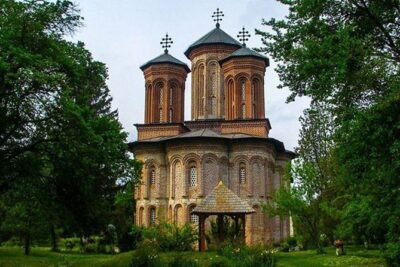
Mogosoaia Palace & Snagov Monastery: Private tour from Bucharest
Read our review →
Private Half Day Trip to Snagov Monastery and Mogosoaia Palace from Bucharest
Read our review →
Private Half Day trip to Slanic Salt Mine and Snagov Monastery
Read our review →Browse the lists this tour appears in