
Reviewed · HISTORICAL TOURS
SB02-Half day Surroundings of Sibiu:Saxon Heritage &Villages
The big draw here is the Transfăgărășan Road, a spectacular mountain route leading to Bâlea Lake, followed by two very different Saxon churches. In one outing, you get high Carpathian scenery, medieval architecture, and a look at villages shaped by Transylvanian Saxon communities.
I like the useful mix of nature and culture, and I like that the guide does more than recite dates. Past guides including Mihai, Ilie, Alex, and Marius have been praised for explaining everything from medieval history and hydropower to rural life and Romania’s current economy. The main consideration is the timing: the advertised four-hour duration does not match the schedule shown, which runs from 9:00 until about 16:00. Clarify the actual length before booking.
In This Review
- Key points to know before you book
- From Sibiu to the high road
- Bâlea Waterfall and Bâlea Lake
- Cisnădie and its unusual clock tower
- Cisnădioara’s hilltop Romanesque church
- What the guides add to the drive
- Is $88 a fair price?
- Timing, comfort, and practical limits
- Who should choose this outing?
- Should you book the Saxon villages tour?
- FAQ
- Where does the tour begin?
- How long does the tour last?
- Which places does the tour visit?
- When does the tour operate?
- Is an English-speaking guide included?
- Is transportation included?
- Are entrance fees included?
- Can a solo traveler book?
- What should I bring?
Key points to know before you book
- Bâlea Lake is the scenic centerpiece: Reach this glacial lake by the famous Transfăgărășan mountain road, with time for photos and a walk.
- Two churches, two settings: Cisnădie offers a fortified town church with a notable clock tower, while Cisnădioara sits on a hill above the surrounding countryside.
- The guide makes the difference: Expect English explanations about Saxon heritage, Romanian history, village life, nature, and local economic issues.
- Private group format: The experience is described as a private group tour, but at least two participants are needed for a guaranteed departure.
- Seasonal operation: Departures are scheduled on Monday, Wednesday, Friday, and Saturday from June through October.
- Good value for a full outing: At $88 per person, transport, a guide-driver, parking taxes, road taxes, and a Romania map are included, but entrance fees, food, and drinks are extra.
From Sibiu to the high road
The day begins at 9:00 in the parking area by Sala Thalia Hall in Sibiu. You travel in a modern air-conditioned car or van with an English-speaking guide who also drives. Parking taxes and road taxes are covered, so you are not left sorting out small transport charges along the way.
The first part of the outing is a scenic drive toward the Făgăraș Mountains. The Transfăgărășan, also called DN7C, cuts through Romania’s highest mountain range in the Carpathians. It was built in the 1970s as a strategic military road under Nicolae Ceaușescu. Today, it is best known for its sweeping bends, mountain views, and access to Bâlea Waterfall and Bâlea Lake.
I like starting with the road rather than saving the scenery for the end. You get a strong sense of Romania’s scale early in the day, then spend the later hours looking at smaller details in the Saxon villages. The route also gives your guide plenty of time to explain the area instead of limiting the outing to quick stops and photographs.
The road is often described as one of the world’s great driving routes, but that does not mean you should expect a thrill ride. The appeal is the setting and the changing views, not speed. Your experience depends heavily on weather and road conditions. One October outing took place in wintry conditions, yet the mountain visit still worked well because the guide adjusted to the conditions and explained what was visible.
A few more Sibiu tours worth a look
- SB11 : A Taste of History & Gastronomical Local Experiences
★ 4.1 · 14 reviews - Bucharest: 3-Hour Dark History Tour with a Local
★ 4.9 · 301 reviews - Bucharest: Small Group History, Art & Secrets Tour
★ 4.7 · 152 reviews
Bâlea Waterfall and Bâlea Lake
The Transfăgărășan stop is scheduled for about an hour and a half, including Bâlea Waterfall and Bâlea Lake. You get free time at the lake, which is the most natural moment to step out, stretch your legs, take photographs, and enjoy the alpine setting without a lecture running constantly in the background.
Bâlea Lake is a glacial lake surrounded by the Făgăraș peaks. Its appeal is immediate: mountain water, high peaks, and a road that has carried you into a very different part of Romania within a few hours of Sibiu. Outdoor activities are associated with the lake, although this tour does not promise a particular activity beyond sightseeing and free time.
Bring your passport or ID card, as requested for the tour. Also bring suitable clothing for changing mountain weather. The supplied information does not specify a required clothing list, but the wintery October conditions reported on one departure are a useful warning: even a scheduled summer-to-autumn outing can feel cold at altitude.
Food and drinks are not included. You should plan accordingly, especially if you are used to a full lunch on a day trip. The tour information does not promise a restaurant stop or a meal, so consider carrying water and a snack if you need them.
The mountain section is also the part most affected by conditions. The tour operates from June through October, but the fact that it is seasonal should not be ignored. Ask for a current road and weather update if your date is near the edge of the operating period.
Cisnădie and its unusual clock tower
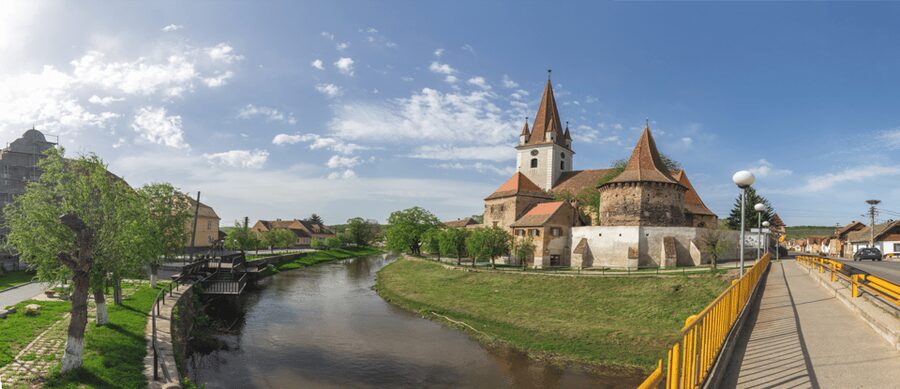
After the mountain stop, the route continues to Cisnădie for about an hour. The fortified church here began as a Romanesque basilica in the 12th century and was fortified in the 15th century. That change tells you something important about medieval Transylvania: a church could serve both as a place of worship and as a refuge for the surrounding community.
The church is known for its defensive towers and clock tower. It also has one of the first mechanical clocks in Transylvania, installed in the 14th century. That detail gives the visit a sharper focus than simply admiring old stonework. You can look at the church as a religious building, a defensive structure, and a sign of the technical life of a medieval community.
Cisnădie is a useful stop for understanding Saxon settlement in the region. The Saxons helped shape the towns and villages around Sibiu, leaving behind fortified churches, distinctive building traditions, and a cultural identity that still matters in Transylvania.
This is where a good guide adds real value. The descriptions from this experience point to explanations not only about church architecture, but also about environmental protection, Romanian society, rural life, and the economy. Ilie, for example, was praised for making subjects such as hydropower and the lives of Roma communities accessible rather than dry. That kind of broader discussion can turn a short church visit into a better understanding of the region.
Allow about an hour here, though the time available may depend on the day’s road conditions and the actual departure schedule. Since entrance fees are not included, check the current admission arrangements before you go. The supplied details do not give a set entrance price.
Cisnădioara’s hilltop Romanesque church
The final major stop is Cisnădioara, also known as Michelsberg. The visit lasts about 30 minutes, making this a quicker stop than Cisnădie, but the setting gives it a different character.
The fortified church was built in the 12th century and is one of the oldest Romanesque-style churches in Transylvania. It is made of stone, with plain, sturdy walls and a simple design. Compared with the more developed fortified complex at Cisnădie, Cisnădioara feels quieter and more stripped back.
The church’s hilltop position is part of its appeal. It offers commanding views over the surrounding area and helps you understand why this was a useful defensive site. You are not just looking at an old building in isolation. You are seeing how the church related to the settlement, the roads, and the countryside around it.
The half-hour stop is enough for a quick visit and photographs, but it is not generous if you want a long architectural inspection or a slow walk around the site. I would treat it as a concise final chapter rather than the main event. The contrast with Cisnădie is what makes the pairing work: one church helps explain defensive urban life and technology, while the other gives you age, simplicity, and an impressive hilltop setting.
A different side of the city, same short trip:
- Sibiu: Daily Sightseeing Guided Tour
★ 4.7 · 247 reviews - From Sibiu: Day Tour to Brasov and Dracula’s Castle
★ 4.7 · 120 reviews - SB01 – City Tour Sibiu: Exploring the Heart of Transylvania
★ 4.8 · 99 reviews - Sibiu Old Town Exploration Game and Self-Guided Tour
★ 4.5 · 82 reviews
What the guides add to the drive
The experience is sold with a specialized English-speaking guide and driver. That matters because the route covers subjects that are hard to grasp from photographs alone. The Saxon churches are easier to understand when someone explains why communities fortified religious buildings, and the mountain road becomes more interesting when you know why it was built.
Several guide names are associated with especially strong feedback for this experience: Mihai, Ilie, Alex, and Marius. Mihai was praised for adapting to difficult weather and for covering nature, culture, environmental protection, history, monuments, the economy, and society in clear English. Ilie was noted for a relaxed driving style, humor, and thoughtful answers about both the past and present.
Alex led a private outing during a quieter February period, while Marius was praised for pointing out small details and sharing stories about older Romanian life. One particularly memorable element connected with Marius was a meal at a local home, but that is not listed as a standard inclusion, so do not book expecting it.
The practical lesson is simple: ask who is guiding your departure if that matters to you. The tour is in English, but the style may vary by guide. The strongest experiences seem to come from guides who treat the drive as part of the tour rather than dead time between monuments.
Is $88 a fair price?
At $88 per person, the price is reasonable if you want a private, guided outing that combines a major mountain route with two historic churches. You are paying for transport from Sibiu, an English-speaking guide-driver, parking taxes, road taxes, and the convenience of not having to navigate the Transfăgărășan yourself.
The value is strongest for visitors with only a few days in Sibiu. One past customer had three days in town and found that a guide helped reveal details that would have been easy to miss alone. That is a fair point. The churches are not difficult to photograph, but their purpose and history are much clearer with explanation.
The price does not cover entrance fees, food, drinks, photo fees, or personal purchases. Those exclusions are ordinary, but they mean the final cost will be above $88 if both churches charge admission or if you buy refreshments along the way.
The private group format is another reason the price may make sense. You are not joining a large coach tour, and the guide can respond to your interests. Still, the minimum of two participants is important. A solo booking is not guaranteed, so contact the provider first if you are traveling alone.
Timing, comfort, and practical limits
There is a clear timing issue to sort out. The activity is described as lasting four hours, yet the detailed schedule gives a 9:00 departure, visits from roughly 11:00 to 15:30, and a return to Sibiu around 16:00. That is closer to seven hours, not four.
The route itself supports a longer outing, especially since Bâlea Lake is far beyond Sibiu and the tour includes two church visits. I would plan your day around the longer schedule and confirm the exact duration before paying. Do not book a late afternoon appointment in Sibiu unless the provider has clarified the timetable.
The vehicle is a modern air-conditioned car or van. Smoking is not allowed, and alcohol and drugs are prohibited. The experience is not suitable for people over 95, according to the supplied restrictions.
The tour runs Monday, Wednesday, Friday, and Saturday from June through October. It is described as a private group experience with a live English guide. You can cancel up to 24 hours before departure for a full refund, and reserve now while paying later, which helps if your mountain plans depend on the weather.
Who should choose this outing?
I would choose this tour if you want to see beyond Sibiu without spending a full day on a single city or castle. It suits you if mountain scenery matters as much as architecture, and if you prefer a guide who can connect buildings to modern Romanian life.
It is also a good fit for first-time visitors who do not want to rent a car for the Transfăgărășan. The route is more enjoyable when someone else handles the driving and fills in the historical background.
You may want a different plan if you want long hikes, a leisurely meal, or extended time inside each church. The schedule is packed, Bâlea Lake is primarily a sightseeing stop, and the Cisnădioara visit is brief. It is also less suitable if your plans cannot tolerate a timetable that may change with mountain conditions.
Should you book the Saxon villages tour?
Book it if you want a compact but varied introduction to the area around Sibiu. The combination is strong: a famous Carpathian road, a glacial lake, a medieval church with an early mechanical clock, and a hilltop Romanesque church tied to Saxon history.
The best reason to go is the guide-led context. Mihai, Ilie, Alex, and Marius have each been associated with clear English, careful driving, humor, and explanations that reach beyond dates and monuments. Before booking, confirm the real duration, ask about current road conditions, and check which entrance fees you will need to pay.
If you are comfortable with a long day despite the advertised four-hour label, $88 is a sensible price for transport and personal guiding. If you want a slow, unhurried church tour, this route may feel too brisk.
FAQ
Where does the tour begin?
The meeting point is the Sala Thalia Hall parking area in Sibiu. Departure is scheduled for 9:00 AM.
How long does the tour last?
The activity is advertised as four hours, but the detailed schedule runs from 9:00 AM to about 4:00 PM. Confirm the actual duration with the provider before booking.
Which places does the tour visit?
The route includes the Transfăgărășan Road, Bâlea Waterfall, Bâlea Lake, Cisnădie Fortified Church, and Cisnădioara Fortified Church.
When does the tour operate?
Departures are scheduled on Monday, Wednesday, Friday, and Saturday from June through October.
Is an English-speaking guide included?
Yes. The tour includes a live English-speaking guide who also serves as the driver.
Is transportation included?
Yes. Transport is provided in a modern air-conditioned car or van. Parking taxes and road taxes are included as well.
Are entrance fees included?
No. Entrance fees, photo fees, food, drinks, souvenirs, and other personal costs are not included.
Can a solo traveler book?
Solo travelers are encouraged to contact the provider for availability. A minimum of two participants is required for a guaranteed departure.
What should I bring?
Bring a passport or ID card. The tour also takes you into mountain areas, so clothing suitable for changing conditions is a sensible choice.
Recently added around Sibiu
- Tour of Sibiu – Church in Cristian – Village of Sibiel★ 5.0 · 7 reviews
- Exclusive tour: Sighisoara, Medias and Biertan tour from Sibiu★ 5.0 · 9 reviews
- Tour to Corvin Castle in Hunedoara & Alba Iulia★ 4.5 · 9 reviews
- Exclusive Tour on Transfagarasan, Balea Lake, Balea and Capra Waterfalls★ 5.0 · 9 reviews
- City Tour Sibiu in English★ 4.5 · 12 reviews
- Private tour Transylvania: UNESCO Gems and Legend of Dracula★ 4.9 · 13 reviews
- Exclusive Tour: Bran Castle, Brasov and Rasnov fortress from Sibiu★ 5.0 · 13 reviews
- SB11 : A Taste of History & Gastronomical Local Experiences★ 4.1 · 14 reviews
Historical Tours, compared.
Bucharest Jewish Heritage | Holocaust Memorial | Private Car Tour
Read our review →
Private Bucharest: History & Food with Traditional Meal
Read our review →Historic Gems Sighișoara, Rupea and Viscri Day Tour
Read our review →
Browse the lists this tour appears in