
Reviewed · WALKING TOURS
Guided Walking Tour of Historical Bucharest
Bucharest makes the most sense when you walk through its sharp contrasts: medieval ruins beside communist boulevards, Orthodox churches beside grand banks, and elegant avenues scarred by the Ceaușescu years. This private tour links those pieces into one long city lesson, from Manuc’s Inn to the 1989 Revolution memorials.
I like the route for two clear reasons. First, you see far more than the Old Town’s cafés, including the Old Princely Court, Parliament Square, and University Square. Second, guides such as Alina bring in personal memories of communist Romania, which gives the political history a human edge. The main catch is the amount of walking: a brisk outing can reach 17,000 steps, and some explanations may reflect the guide’s strong political views.
In This Review
- Key points to know before you book
- Starting at Manuc’s Inn in the Old Town
- Vlad the Impaler at the Old Princely Court
- Unirii Square and the grand socialist boulevard
- Parliament Square and Ceaușescu’s city
- Churches, banks, and the old center
- University Square and the city’s public life
- Revolution Square and the end of communist rule
- What the guide does best
- Walking effort, timing, and private-tour value
- Is $30.77 a fair price?
- Who should book this Bucharest walk?
- FAQ
- How long does the Guided Walking Tour of Historical Bucharest last?
- Where does the tour start?
- Where does the tour finish?
- Is the Palace of Parliament visited inside?
- Is this a private tour?
- Is the tour offered in English?
- How much walking is involved?
- Can I cancel for a full refund?
Key points to know before you book
- Begin at Manuc’s Inn: The meeting point puts you in one of Bucharest’s oldest and most atmospheric settings before the walking starts.
- Cover the city’s major eras: The route connects medieval Wallachia, royal Romania, communist planning, and the 1989 Revolution.
- See Parliament from the outside: Palace of Parliament and Constitution Square offer some of the tour’s best photographs, but this is not an interior visit.
- Expect a serious history lesson: The focus leans toward buildings, rulers, dictatorship, religion, and political change rather than food or nightlife.
- Prepare for a long walk: The advertised time is about three hours, though the route can run longer and may feel like half a day.
- Private touring adds flexibility: Only your group takes part, and hotel pickup is offered, but confirm the exact pickup and return plan when booking.
Starting at Manuc’s Inn in the Old Town
The walk begins outside the main entrance of Manuc’s Inn, at 62 Strada Franceză. This is a smart starting point. The old inn is more than a place to meet. It introduces you to Bucharest’s past as a trading city, where travelers, merchants, and local life once mixed under one roof.
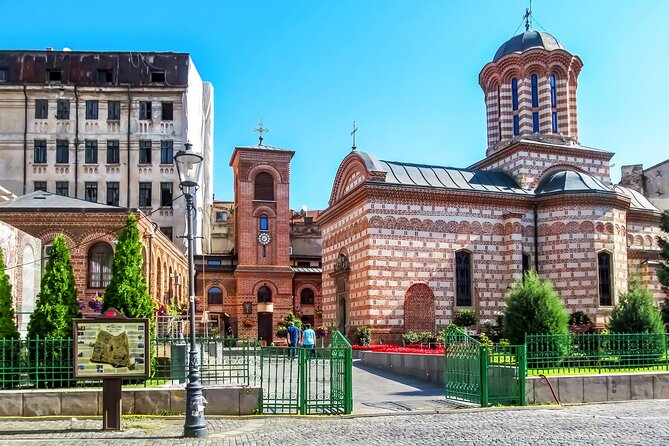
From there, you learn about the inn’s long story and move toward St. Anton Orthodox Church. St. Anton served as the coronation church for Wallachian rulers and sits in the heart of the old center. It is an early reminder that Bucharest’s history is not just a parade of grand state buildings. Religion, rulers, trade, and daily life all overlap here.
The guide may also point out an old church built in 1724. The route includes several religious sites, so you get a sense of how Orthodox Christianity shaped the city’s streets and public life. If churches are a special interest, tell your guide early. A private tour gives you a better chance to ask for extra detail.
A few more Bucharest tours worth a look
- Bucharest: 3-Hour Dark History Tour with a Local
★ 4.9 · 301 reviews - Bucharest: Small Group History, Art & Secrets Tour
★ 4.7 · 152 reviews - Bucharest Jewish Heritage | Holocaust Memorial | Private Car Tour
★ 5.0 · 38 reviews
Vlad the Impaler at the Old Princely Court
The first major stop is the Old Princely Court, where ruins mark one of Bucharest’s oldest sites. The court was used by Wallachian rulers and was once linked with Vlad the Impaler, the medieval prince whose name later fed the Dracula legend.
Do not expect a complete palace rising above the street. You are seeing remains, not a restored royal complex. That is part of the point. The ruins provide a physical link to Bucharest’s early political center, while the surrounding Old Town shows how much the city has changed.
The stop is listed at about five minutes, but the value comes from the explanation. A short look at old stone walls can feel thin without context. With a guide, you can connect the court to Wallachian rule, the city’s early growth, and the later layers built around it.
Unirii Square and the grand socialist boulevard
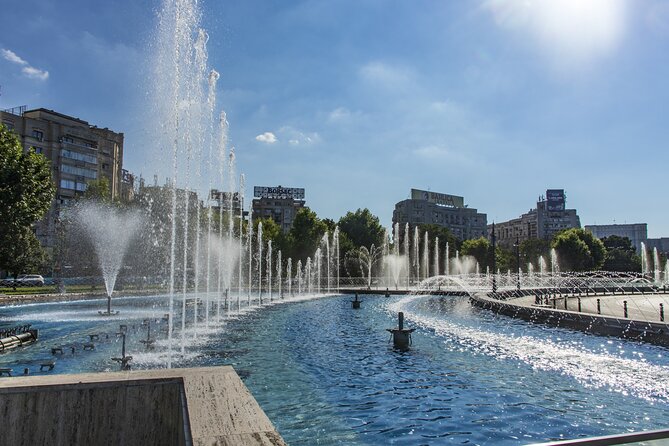
Piata Unirii is the next major urban pause. Its refurbished fountains create a broad open space and a useful photo stop. More important, the square shows how Bucharest was reshaped on a huge scale during the communist period.
From here, the tour follows Bulevardul Unirii, once called the Boulevard of Socialist Victory. It was designed to project state power, with a broad axis leading toward the Palace of Parliament. Calling it Romania’s Champs-Élysées gives you a quick idea of the intended grandeur, though the comparison is more about scale and symbolism than atmosphere.
This is where the tour’s architectural focus becomes clear. You are not simply crossing a square. You are reading the city plan as political messaging. The wide boulevard, long views, and oversized buildings were built to make the state look permanent and commanding.
The drawback is that the scale can make walking feel exposed, especially in hot weather. Carry water, and do not dress as if you are taking a short Old Town stroll. The route may be easy underfoot in places, but the distance adds up quickly.
Parliament Square and Ceaușescu’s city
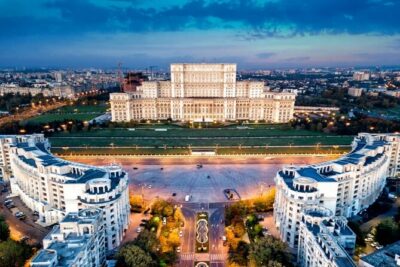
At the top of Unirii Boulevard, you reach Constitution Square, directly in front of the Palace of Parliament. This is one of the tour’s strongest visual moments. The building dominates the area, and the open space gives you room to understand its size.
The tour does not include an interior visit, so you should book separately if you want to go inside the Parliament building. Here, the focus is on the building’s role in Ceaușescu’s dictatorship and on the vast urban changes made around it.
The guide explains how the communist government altered Bucharest, including the destruction and displacement tied to the new civic center. This is not a polished royal story. It is a difficult lesson in what happens when a government remakes a capital to fit one leader’s vision.
You also hear about the Cold War and the way Ceaușescu’s rule affected ordinary life. Guides may add memories from growing up in Romania, which can make the period easier to grasp than a string of dates. Alina, in particular, is described as energetic and personal in her presentation, while Elena is also named as a possible guide.
A note for you: the political material is central, not incidental. If you prefer a tour that stays neutral and brief on modern politics, this may not be your best match. The guide’s own views can enter the discussion, and one account describes this as uncomfortable. Another found the personal perspective useful. Go in ready for a strongly voiced interpretation, and ask questions when you want to separate established history from opinion.
More walking tours in Bucharest:
- Bucharest: City Highlights Guided Walking Tour
★ 4.9 · 1,482 reviews - Bucharest Highlights Walking Tour
★ 5.0 · 469 reviews - Free walking tour of Brasov in English
★ 4.9 · 302 reviews - Bucharest: Ghost Stories & Romanian Mythology Walking Tour
★ 4.9 · 287 reviews
Churches, banks, and the old center
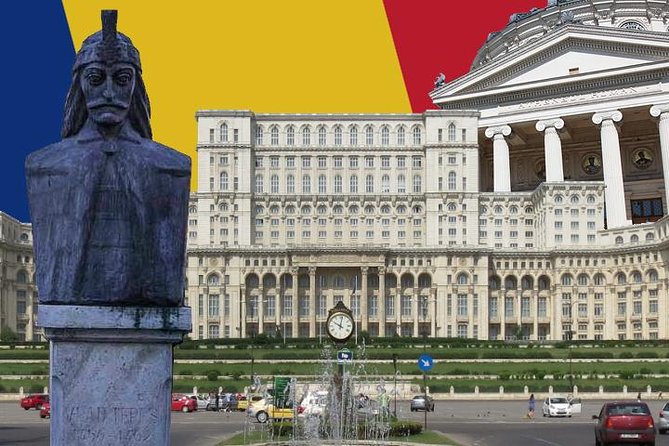
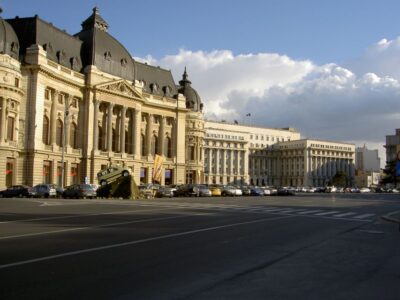
After Constitution Square, the route turns back into the older core. Along the way, you hear about another historic church and the CEC Palace. The CEC building is one of Bucharest’s most recognizable bank buildings, with a grand exterior that reflects the city’s taste for European-style architecture.
You then walk along part of Calea Victoriei, or Victoria Avenue, lined with shops and important buildings. This street helps explain why Bucharest earned its old nickname as the Little Paris, though the city’s appearance is more mixed and less tidy than that label suggests. Here, elegant façades sit near traces of neglect, restoration, and later construction.
The walk enters the old center, an area with more than five centuries of urban history. You pass through Macca and Villacrosse passages, two atmospheric covered lanes with cafés and distinctive architecture. These passages are smaller and more intimate than Parliament Square, so they offer a welcome change of scale.
You also see the National Bank of Romania and hear about its history. The bank, CEC Palace, churches, old inns, and government buildings create the tour’s main theme: Bucharest is a city of borrowed styles and changing rulers. Ottoman, Orthodox, French-inspired, royal, communist, and modern influences appear within a fairly compact area.
University Square and the city’s public life
University Square brings the walk into another important part of central Bucharest. You see the University of Bucharest, founded in 1864 under Alexandru Ioan Cuza, and the nearby Sutu Palace, now associated with the history museum of Bucharest.
The square has a strong public and political role. It is also near Colțea Hospital and Church, an important central complex, and the National Theatre of Bucharest. The theatre has gone through several design changes, making it another useful example of how Bucharest’s public buildings have been altered over time.
This part of the tour is good for understanding the city as a working capital rather than a collection of monuments. Universities, hospitals, theatres, banks, churches, and government sites sit close together. You get to see where civic life happens, not just where photographs are taken.
The pace can be quick. One guide is praised for moving fast enough to cover nearly everything, but that same pace may leave you wanting more time at individual buildings. If you prefer a slow architectural study, say so. On a private tour, you may be able to adjust the balance, though the route has many planned stops.
Revolution Square and the end of communist rule
The most emotionally charged section comes at Revolution Square. Here, the guide explains the events of December 1989, when protests helped bring down Ceaușescu’s regime.
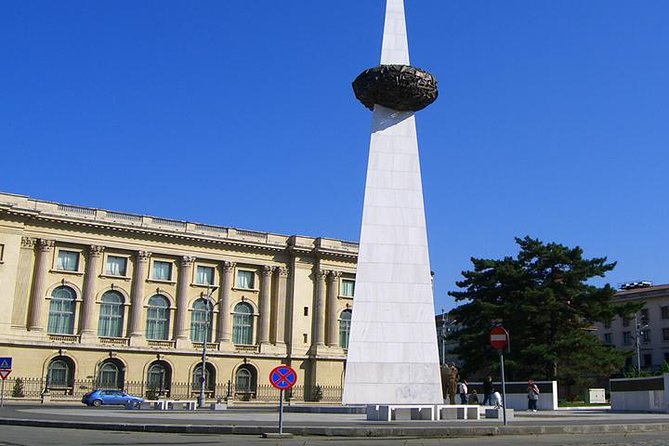
You see the balcony connected with Ceaușescu’s final speech, the former Communist Party headquarters, the University Library, King Carol I’s equestrian statue, and the Monument of Rebirth. The 25-meter memorial honors the struggle and victims of the Romanian Revolution.
The memorial has become a debated landmark, and that makes the guide’s explanation especially useful. You are not just looking at a tall structure in a public square. You are considering how a country remembers a violent political break and how public symbols can be received in different ways.
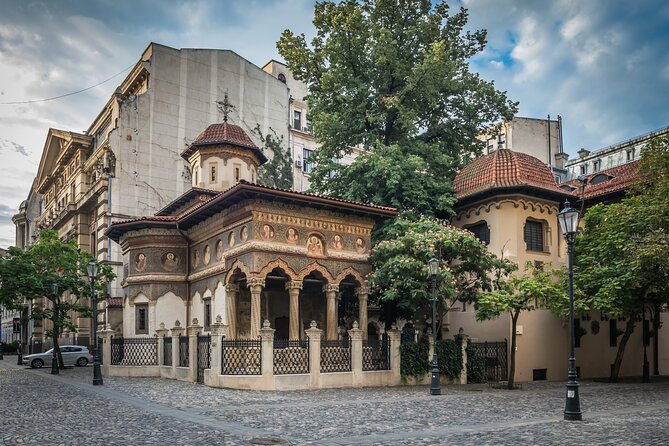
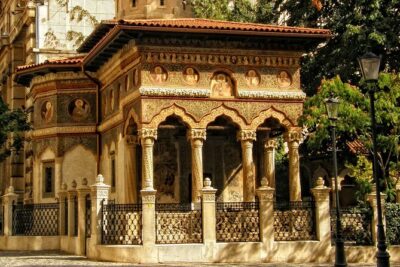
Biserica Kretzulescu is also included in this stretch. Its ornate Orthodox exterior offers a striking contrast to the political buildings and memorials around it. The nearby Military Circle and Sărindar Fountains add more grand civic architecture before the route returns toward the meeting area.
The final stop is a historic building and garden created for the people of Bucharest more than a century ago. The supplied route does not name it clearly, so you should ask the guide to identify it on the day. That small uncertainty aside, the ending gives you one more look at the city’s older public spaces before returning to Manuc’s Inn.
What the guide does best
The strongest part of this experience is the guide-led storytelling. Alina is repeatedly described as animated, humorous, and deeply familiar with Romanian history, architecture, society, and daily life. Her personal experience of growing up under communism can add something a book cannot.
That style will suit you if you enjoy a guide who talks freely and connects Bucharest with Romania, the Balkans, Eastern Europe, Russia, Western Europe, and the United States. You may leave with a broader sense of how Romania was shaped by outside powers and changing political ideas.
The English is usually workable, but one account found the guide difficult to understand at times. If you need very clear, slow English, say this at the start. Ask the guide to repeat names and dates, especially when discussing rulers, churches, or political groups.
The tone can also be personal. The historical subject naturally includes government, dictatorship, elections, and ideology. Most of the supplied accounts valued the guide’s energy and background, but one raised concerns about conspiracy theories and aggressive gestures. That is a serious warning, even though it appears to be an isolated experience among many positive ones. You should book this tour for its strong point of view, not for a carefully scripted, politically neutral lecture.
Walking effort, timing, and private-tour value
The advertised duration is about three hours, but you should allow extra time. The route covers a large portion of central Bucharest, and one outing lasted at least an additional hour because the guide continued explaining sites and added less expected stops.
The walking is not a token stretch between monuments. A previous participant recorded more than 17,000 steps, despite a pace that was not described as fast. That figure may vary, but it tells you to wear comfortable shoes and bring water. Summer heat can be demanding, while winter conditions can make a long outdoor walk tiring.
Because the tour is private, only your group participates. That is a real advantage at $30.77 per person, especially if you are traveling with another person or a small group. You can ask questions, request more detail on churches or communism, and possibly slow the pace without waiting for a large crowd.
Hotel pickup is offered, and the tour is also advertised with hotel drop-off. The stated meeting point is outside Manuc’s Inn, and the activity is described as ending back there. Confirm the exact pickup and return arrangements before setting out, particularly if you plan to catch a bus or make a timed reservation afterward.
The tour is offered in English and uses a mobile ticket. Children must be with an adult, service animals are allowed, and you should have moderate physical fitness. It is not designed for someone who wants a short, seated introduction.
Is $30.77 a fair price?
At $30.77 per person, the value is good if you want orientation, history, and a long list of central sights in one outing. You see major landmarks that would be difficult to connect on your own, especially the Old Princely Court, Parliament Square, Calea Victoriei, Macca and Villacrosse, University Square, and Revolution Square.
The price is less attractive if you want paid entries or a slow museum visit. Admission is listed as free at the named stops, and the Palace of Parliament is viewed from outside. You are paying mainly for the guide’s time, interpretation, route planning, and the convenience of a private group.
I would schedule it early in your Bucharest stay. It gives you a mental map of the center and helps you choose where to return for a meal, museum, church visit, or evening walk. One guide also offers suggestions for lunch, dinner, and drinks, which can make the first day easier.
Free cancellation is available until 24 hours before the start time. Changes or cancellations inside that window are not accepted for a refund. Since the walk requires good weather, a poor-weather cancellation brings a different date or full refund.
Who should book this Bucharest walk?
Book it if you want the city’s story told through streets and buildings. It is especially useful for first-time visitors, history fans, architecture enthusiasts, and anyone curious about how Ceaușescu’s dictatorship and the Cold War changed Bucharest.
You should also book it if you like personal guides who speak with enthusiasm and are willing to discuss difficult subjects. The private format gives you room to ask direct questions and shape the conversation.
Think twice if you dislike long walks, strong political opinions, or tours that cover many places at a brisk pace. You may prefer a shorter Old Town walk or a museum visit with a more tightly controlled presentation.
For most fit visitors with three to four hours free, I consider this a strong introduction to Bucharest. Its best quality is not any single monument. It is the connection between medieval Wallachia, royal ambition, communist power, religious life, and the 1989 Revolution. Once you see those links, the city’s odd mix of beauty and rough edges becomes easier to read.
FAQ
How long does the Guided Walking Tour of Historical Bucharest last?
The advertised duration is approximately three hours, but it may run longer depending on the guide and the pace of the group. You should allow extra time beyond the stated three hours.
Where does the tour start?
The meeting point is outside the main entrance of Manuc’s Inn, Hanul lui Manuc, at 62 Strada Franceză in Bucharest’s Old Town.
Where does the tour finish?
The activity is described as ending back at the meeting point. Hotel pickup and drop-off are also offered, so confirm the exact arrangement when booking.
Is the Palace of Parliament visited inside?
The route includes views and photo opportunities at the Palace of Parliament and Constitution Square. An interior visit is not included in the supplied tour details.
Is this a private tour?
Yes. Only your group participates in the activity.
Is the tour offered in English?
Yes. The tour is offered in English and uses a mobile ticket.
How much walking is involved?
A substantial amount of walking is involved. You should have moderate physical fitness, wear comfortable shoes, and carry water, especially in hot weather.
Can I cancel for a full refund?
You can cancel up to 24 hours before the experience starts for a full refund. Cancellations or changes made less than 24 hours before the start time are not refunded, while a weather cancellation offers another date or a full refund.
Recently added around Bucharest
- 6h Communism Tour in Bucharest with Ceausescu Mansion★ 4.5 · 6 reviews
- From Bucharest : Day Trip to Peles, Dracula’s Castle, Brasov★ 4.7 · 6 reviews
- Bears Sanctuary, Dracula Castle and Brasov City – Full Day Trip from Bucharest★ 5.0 · 6 reviews
- Dracula Private Tour★ 5.0 · 6 reviews
- Transfagarasan Road Private Day Trip from Bucharest / The Best Road in the World★ 5.0 · 6 reviews
- Bucovina Painted Monasteries & Transylvania Tour: 4-Day Private★ 5.0 · 6 reviews
- Bucharest : Wednesday, Dracula & Peles 3 Castles Tour 1 Day★ 4.7 · 6 reviews
- Hiking thought the best mountain villages in Romania-Private tour from Brasov★ 5.0 · 6 reviews
Walking Tours, compared.
Ghost Stories & Romanian Mythology Walking Tour
Read our review →
4h Bucharest Private Tour (2h by Car and 2h Walking in Old Town)
Read our review →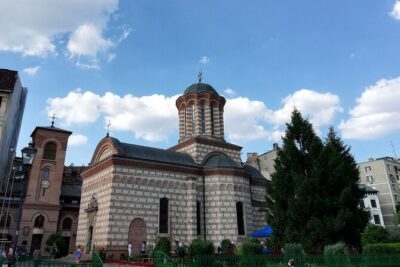
Browse the lists this tour appears in