Reviewed · GUIDED
Explore Bucharest Step by Step With A Local Guide
Bucharest makes the most sense when you connect its political past with its old streets. This walk takes you from Revolution Square, where Nicolae Ceaușescu’s final speech helped trigger the 1989 uprising, through grand Calea Victoriei and the Old Town, ending in front of the huge Palace of Parliament.
I like the small maximum of 10 people, which gives the guide room to answer questions. I also like the route’s variety: you get churches, passages, old inns, university buildings, and major public squares rather than one long march past similar facades. The main consideration is that the tour moves through central streets on foot, so comfortable shoes and reasonable walking stamina matter.
In This Review
- Key points
- Starting at Revolution Square and the end of communism
- Following Calea Victoriei, Bucharest’s historic avenue
- The University of Bucharest in a 10-minute stop
- Macca-Villacrosse Passage and the Old Town’s grand arcade
- Stavropoleos Church, a quiet Orthodox pause
- Hanul cu Tei and Bucharest’s old commercial life
- Manuc’s Inn, the oldest operating hotel building
- Constitution Square and the Palace of Parliament
- What the guide adds to a low-cost walk
- Timing, walking, and who should book
- Booking value and cancellation terms
- Should you book Explore Bucharest Step by Step?
- FAQ
- Where does the tour begin?
- Where does the tour end?
- What time does the tour start?
- How long does the experience last?
- Is the tour offered in English?
- How many people can join the tour?
Key points
- Revolution Square begins the story in 1989, giving the walk a clear political starting point.
- Calea Victoriei links old Bucharest with its grand civic architecture, including the University of Bucharest.
- The Old Town stops are compact and atmospheric, especially Macca-Villacrosse Passage and Stavropoleos Church.
- Historic inns reveal Bucharest’s trading past, with stops at Hanul cu Tei and Manuc’s Inn.
- The walk ends at Constitution Square, with a broad view toward the Palace of Parliament.
- A small group and an English-speaking local guide make this a useful first orientation to the city.
Starting at Revolution Square and the end of communism
Meet at Revolution Square at 10:00 in the morning. This is an effective place to begin because Bucharest’s recent past is not treated as a footnote. It is the first chapter.
On December 21, 1989, Ceaușescu addressed a large crowd here. The speech began as a familiar display of communist authority, but the crowd turned against him. The revolt that followed helped end Romania’s communist regime. Your guide can place the square’s buildings and open space into that tense moment, making the political change easier to understand than it would be from a museum label alone.
I find this opening especially useful if you know little about Romania before arriving. The stop gives context for the rest of the walk. Bucharest has grand nineteenth-century buildings, Ottoman-era commercial traces, Orthodox churches, and oversized communist projects. Revolution Square reminds you that the city’s story did not end with its older architecture.
The scheduled visit is about 20 minutes, with no admission charge. That keeps the beginning focused. You should not expect a lengthy museum visit here, since the experience is an outdoor city walk rather than an indoor tour.
A few more Bucharest tours worth a look
- Bucharest: Dracula’s Castle, Peles Castle, & Brasov Old Town
★ 4.5 · 17,858 reviews - Bucharest: Dracula Castle, Peles Castle & Brasov Old Town
★ 4.6 · 10,891 reviews - Bucharest: Dracula’s Castle, Peleș Castle & Brașov Day Trip
★ 4.5 · 5,919 reviews
Following Calea Victoriei, Bucharest’s historic avenue
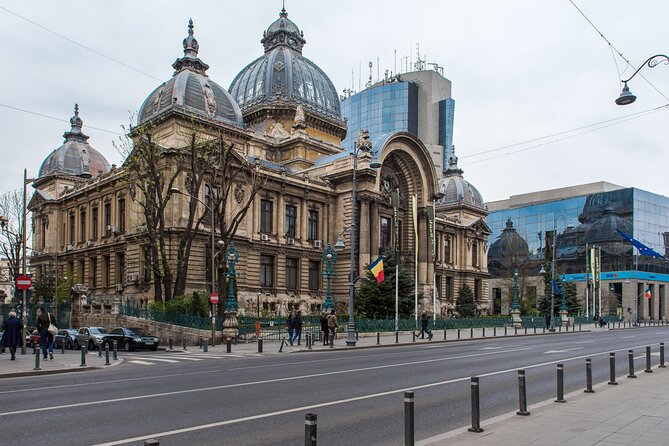
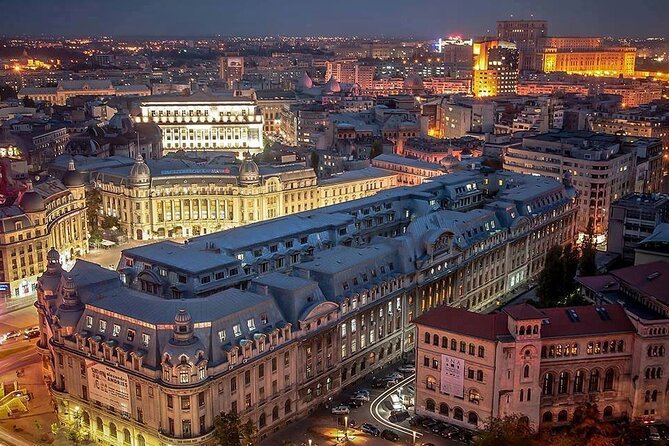
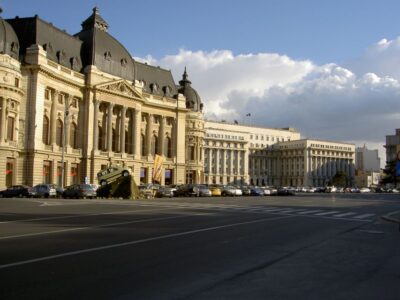
From Revolution Square, the route continues along Calea Victoriei, one of Bucharest’s oldest roads and one of its most important avenues today. This is where the tour shifts from political memory to the city’s urban character.
A particularly striking detail is the avenue’s early nighttime lighting. Calea Victoriei was the first street in Bucharest lit with candles at night, beginning in July 1814. That small fact says a lot about the street’s former importance. It was not simply a route through town. It was a showcase avenue, a place where Bucharest presented its ambitions and modern habits.
The guide spends about 20 minutes here. I would use this time to look above street level. The tour information does not promise entry into specific buildings, but Calea Victoriei is best understood by noticing the mix of facades, civic buildings, and changing street activity around you.
This section also helps you get your bearings. You begin to see how the newer central city connects with the Old Town. Since the walk has no admission fees at its stops, the value comes from explanation and orientation. You are paying for a local voice that links separate sights into one story.
The University of Bucharest in a 10-minute stop
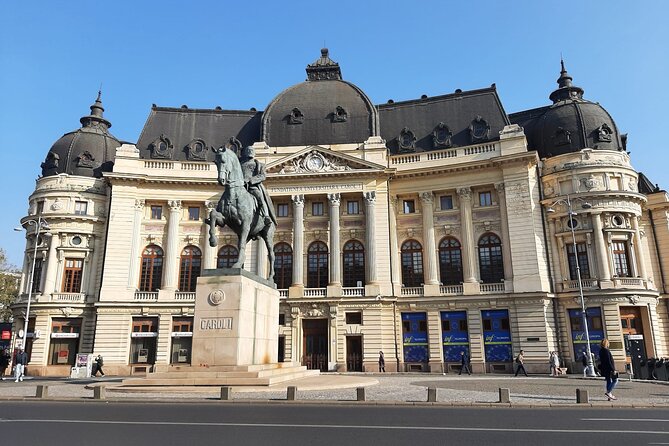
The University of Bucharest is next, with about 10 minutes devoted to its emblematic building. The stop is short, but it adds an important piece of the city’s public identity.
A university building may not sound as immediately exciting as a church or old inn. I still like its place on this route. It shows Bucharest as a center of education and civic life, not only as a collection of tourist sights. The guide can also point out how this building fits into the larger central district.
Because no admission is included or needed for this outdoor stop, you should think of it as a close look and explanation rather than a campus tour. The quick timing keeps the walk moving, though anyone hoping to enter major buildings should plan separate visits.
Macca-Villacrosse Passage and the Old Town’s grand arcade
The route then reaches Macca-Villacrosse Passage, a covered passage in the Old Town often compared with Milan’s Galleria Vittorio Emanuele II. The comparison is not meant to suggest equal size. This is a much smaller space, but its glass-covered design and decorative feel give it a distinct place in Bucharest.
The passage takes about 10 minutes. That is enough to look up, take in the details, and hear how it fits into the city’s commercial past. I like this stop because it breaks up the larger avenues with a more intimate interior street.
It is also a practical place to pause. The walk moves through central areas where cafes and businesses are nearby, though the tour does not include food or drink. One guide, Doina, is described as having useful local connections with shop and restaurant owners, including help locating a restroom when needed. That can matter if you are walking with a child or simply prefer not to spend time searching.
A different side of the city, same short trip:
- Bucharest: Palace of Parliament Tickets and Guide
★ 4.3 · 3,182 reviews - Bucharest: Day Trip to Dracula Castle, Peles Castle & Brașov
★ 4.4 · 3,049 reviews - Bucharest to Dracula Castle, Peles Castle and Brasov Guided Tour
★ 4.5 · 2,933 reviews - Bucharest: Palace of Parliament Tickets and Guided Tour
★ 4.4 · 1,877 reviews
Stavropoleos Church, a quiet Orthodox pause
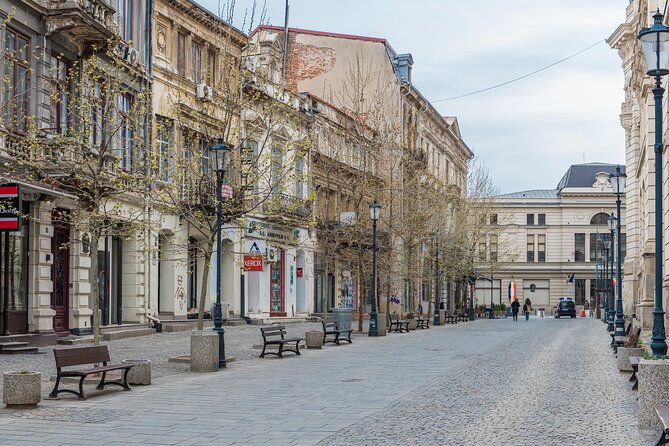
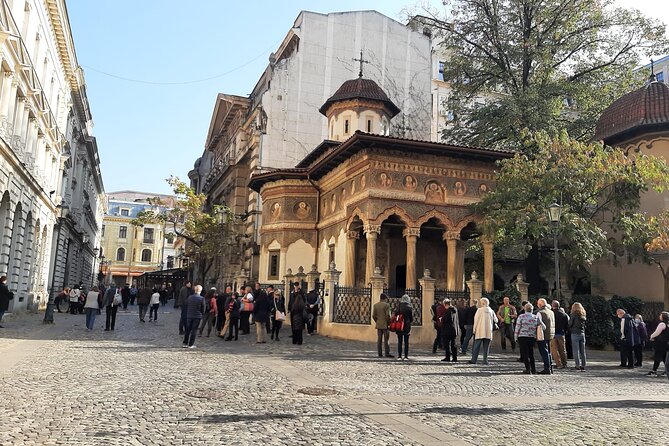
Stavropoleos Church, also called Stavropoleos Monastery, receives about 15 minutes. The Eastern Orthodox monastery was built in the eighteenth century by a Greek monk, giving the stop a clear link to Bucharest’s religious and cultural past.
This is one of the route’s most memorable changes of mood. After the political weight of Revolution Square and the urban scale of Calea Victoriei, a small historic church offers a quieter setting. Your guide can explain what you are seeing and why the monastery matters within the Old Town.
The admission cost listed for the stop is free. Still, remember that a church is an active religious place, not simply a photo stop. Dress and behave respectfully, and understand that the pace of the visit can depend on what is happening there at the time. The supplied details do not promise a private visit or a guaranteed interior tour, so you should treat this as a guided stop at the monastery rather than assume a long indoor viewing.
Hanul cu Tei and Bucharest’s old commercial life
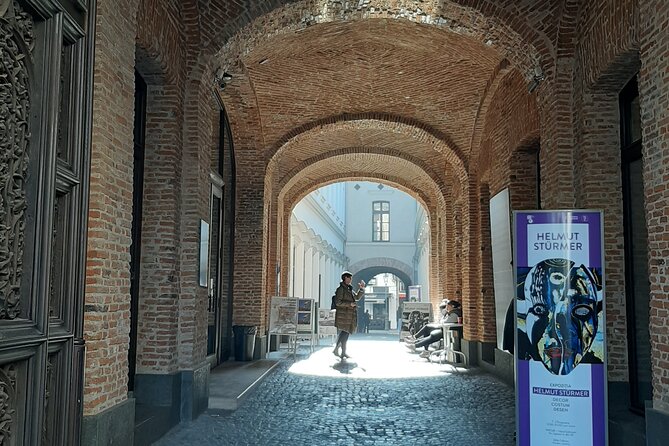
Hanul cu Tei is a historic inn said to be the only old inn in Bucharest to have kept its original shape exactly as it was at the beginning. The stop lasts about 10 minutes.
This is where the walk moves from grand public spaces to the practical world of merchants, lodging, and trade. Old inns were more than places to sleep. They served as commercial compounds where people could meet, store goods, and conduct business. A guide’s explanation helps you picture that earlier role.
The stop is brief, so do not expect a full museum presentation. Its value comes from seeing the surviving form and understanding what that kind of building meant in nineteenth-century Bucharest. I would pay attention to the layout and structure rather than rush through for a single photograph.
Manuc’s Inn, the oldest operating hotel building
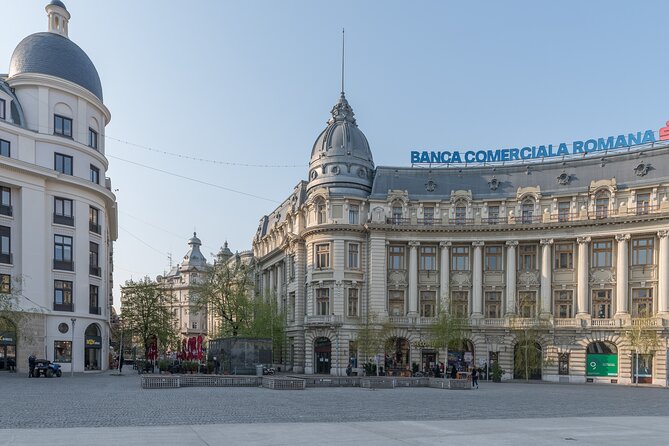
The next stop is Manuc’s Inn, also called Hanul lui Manuc. It is described as the oldest operating hotel building in Bucharest and as the most important commercial complex in the city during the middle of the nineteenth century.
This is one of the strongest stops for understanding how Bucharest once connected merchants and visitors from different places. Its identity as an inn links accommodation, trade, and city life in one location. The building helps explain why the Old Town developed as a commercial center rather than only a residential quarter.
The planned visit is about 10 minutes. Again, the tour does not state that accommodation, a meal, or an extended interior visit is included. You are seeing the site as part of a walking explanation. If you want to return for longer, note its location during the tour and make a separate visit later.
I like having both historic inns on the same route. Hanul cu Tei and Manuc’s Inn are close enough in theme to compare, but they give the Old Town a fuller sense of purpose. The guide’s job here is not just to name old buildings. It is to explain how people used them.
Constitution Square and the Palace of Parliament
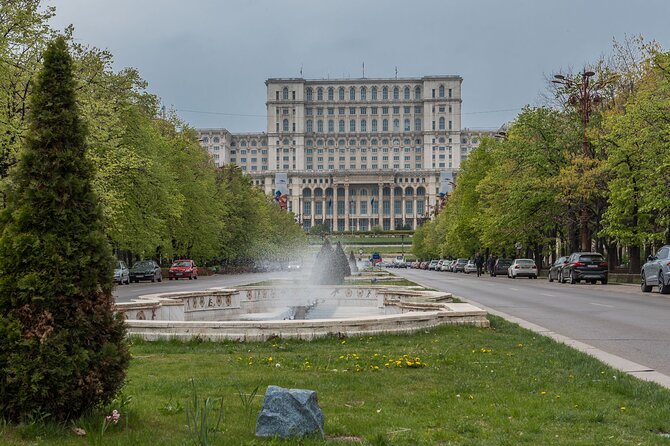
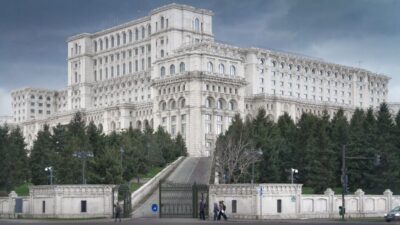
The final stop is Constitution Square, about 15 minutes from the end of the walk. The square faces the Palace of Parliament, described as the second-largest administrative building in the world.
This ending gives the tour a powerful visual contrast. You begin with the 1989 revolt against communist rule and finish before one of the most imposing symbols of the communist period. The route therefore creates a loose arc: political power, public resistance, older city life, and the monumental architecture left behind by the regime.
The square is a good place to stop because the scale changes again. The Old Town’s passages and inns feel close and human. Constitution Square opens out toward a building designed to project authority. Even without entering the Palace of Parliament, the view helps you grasp its size and political meaning.
The tour ends here rather than returning to Revolution Square. That matters for planning. You will need to arrange your next activity from Constitution Square, but you also finish near a major Bucharest sight that you may want to explore separately. The experience does not list an interior visit to the Palace, so book a separate entry if seeing the inside is a priority.
What the guide adds to a low-cost walk
At $16.87 per person, this is priced as an affordable orientation walk. You are not paying for museum admissions, meals, transportation, or a long private tour. You are paying for roughly three hours of guided sightseeing through central Bucharest.
That is good value if you want a clear introduction before exploring alone. The route covers eight stops, and every stop has a different role. You get modern political history, a major avenue, university architecture, a covered passage, an Orthodox monastery, two old inns, and a monumental communist-era square.
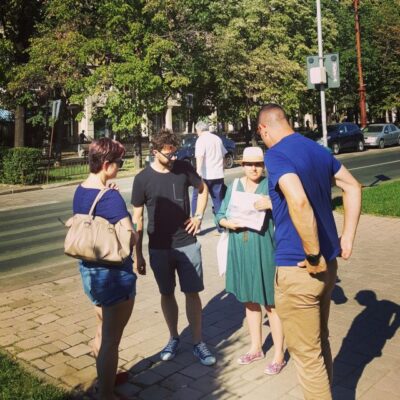
The small group limit of 10 is important. A guide can usually speak to a compact group more naturally than to a large crowd, and you have a better chance of asking about details that catch your eye. The guide names associated with the experience include Doina and Dorin. Doina is described as especially willing to spend extra time, answer questions, and help with practical needs. One account also describes a tour that lasted about four hours rather than the advertised three. That extra time may depend on the guide, the group, and the day, so I would regard it as a pleasant possibility, not a promise.
The strongest guide quality is enthusiasm paired with local knowledge. The information provided describes guides explaining the history of each stop, pointing out additional churches, buildings, and attractions, and answering questions well. That is exactly what you want from a first walk in a city where the most useful details are often just beyond the headline sight.
Timing, walking, and who should book
The experience is offered in English and begins at 10:00. Morning is a sensible choice for a city walk. You can use the afternoon for a museum, a separate visit to the Palace of Parliament, or a return to the Old Town.
Most people can take part, and the tour is near public transportation. The route is outdoors and moves through city streets, so I would wear comfortable shoes and avoid treating the three-hour estimate as a tightly timed appointment afterward. The tour may run longer, especially if the guide answers questions or adds nearby sights.
Families can consider this walk too. A stroller was used successfully on one booking, and the guide helped with a restroom stop through local connections. That does not turn the route into a specially designed family tour, but it suggests some flexibility for parents with young children.
The walk suits you best if:
- You are visiting Bucharest for the first time.
- You want historical context before visiting museums or major buildings.
- You prefer a small group to a large bus tour.
- You want to see the Old Town without spending the day indoors.
- You are comfortable walking between several central stops.
- You value a guide who can answer questions and adjust the pace.
It may be less suitable if you want extensive interior access, a food tasting, transportation between sights, or a private experience. None of those are included in the supplied details.
Booking value and cancellation terms
The $16.87 price is easy to justify for a first-day city walk, especially with up to eight stops and a small group capped at 10 people. The tour offers more than a simple list of photo locations because the route connects Romania’s communist past with its older religious and commercial traditions.
You receive confirmation at booking, and cancellation is free up to 24 hours before the 10:00 start time for a full refund. Changes or cancellations made inside that 24-hour window are not refunded. The experience requires good weather, and if poor weather causes cancellation, you are offered another date or a full refund.
Should you book Explore Bucharest Step by Step?
I would book this if you want an affordable first look at Bucharest with a local English-speaking guide. The route is particularly useful because it does not stay in one period. It explains the 1989 revolution, follows the city’s grand avenue, enters the Old Town’s smaller historic spaces, and ends with the giant political statement of the Palace of Parliament.
The best reason to choose it is the guide-led context. Doina and Dorin are associated with the experience, and the available information points to guides who are generous with explanations and sometimes with time. The main limitation is simple: this is an outdoor overview, not a detailed interior tour.
Book it early if your dates are fixed, since the experience is commonly reserved about 18 days ahead. Choose it for orientation, local stories, and a compact introduction to central Bucharest. Skip it only if you already know the city well or want a specialized tour focused on food, communist architecture, museums, or the inside of the Palace of Parliament.
FAQ
Where does the tour begin?
The tour begins at Revolution Square, Piața Revoluției, in Bucharest.
Where does the tour end?
The tour ends at Constitution Square, Piața Constituției, facing the Palace of Parliament.
What time does the tour start?
The scheduled start time is 10:00 am.
How long does the experience last?
The tour lasts approximately three hours. Some previous bookings describe the guide spending longer with the group, but extra time is not guaranteed.
Is the tour offered in English?
Yes. The experience is offered in English.
How many people can join the tour?
The maximum group size is 10 travelers.
Recently added around Bucharest
- 6h Communism Tour in Bucharest with Ceausescu Mansion★ 4.5 · 6 reviews
- From Bucharest : Day Trip to Peles, Dracula’s Castle, Brasov★ 4.7 · 6 reviews
- Bears Sanctuary, Dracula Castle and Brasov City – Full Day Trip from Bucharest★ 5.0 · 6 reviews
- Dracula Private Tour★ 5.0 · 6 reviews
- Transfagarasan Road Private Day Trip from Bucharest / The Best Road in the World★ 5.0 · 6 reviews
- Bucharest : Wednesday, Dracula & Peles 3 Castles Tour 1 Day★ 4.7 · 6 reviews
- Hiking thought the best mountain villages in Romania-Private tour from Brasov★ 5.0 · 6 reviews
- Bucovina Painted Monasteries & Transylvania Tour: 4-Day Private★ 5.0 · 6 reviews
Guided, compared.
Bucharest to Dracula Castle, Peles Castle and Brasov Guided Tour
Read our review →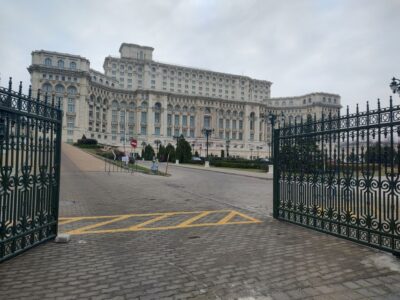
Palace of Parliament in Bucharest – fast-track tickets and guide
Read our review →
Dracula Castle, Peles Castle & Brasov Guided Tour
Read our review →