

Reviewed · DRACULA & BRAN CASTLE TOURS
Real Dracula Princely Court and Real Dracula’s Fortress
Vlad the Impaler’s real world is far more interesting than the vampire story. This private day from Bucharest links his princely court in Târgoviște with Poenari Castle, the mountain fortress tied most closely to his name. I like the contrast between palace ruins, royal churches, a huge dam, and a steep medieval climb. I also like that guide Nicolas leaves room for photos, lunch, and extra conversation instead of rushing you from one stop to the next.
The main drawback is the length: 11 hours in a car, with a demanding climb of 1,480 stairs at Poenari. Entrance fees and food are extra, and you should confirm the castle’s operating status before booking, since it has sometimes been closed. Still, if you want serious Wallachian history rather than a quick Dracula-themed photo stop, this is a strong private day trip.
In This Review
- Key points to know before you book
- Why this day trip is about more than Dracula
- Târgoviște, where Vlad’s court took shape
- Curtea de Argeș and the old royal center
- Poenari Castle and its 1,480 steps
- Vidraru Dam, a modern pause in a medieval day
- The Wallachian setting on the return route
- Nicolas and the private-car advantage
- What to budget and what to bring
- Who should book this experience
- Should you book this private Dracula day trip?
- FAQ
- Where does the tour start and finish?
- How long does the experience last?
- Is the tour private?
- Who is the named guide?
- Is transportation included?
- Are meals and drinks included?
- Are entrance fees included?
- How many stairs are there at Poenari Castle?
- Can I cancel for a full refund?
Key points to know before you book
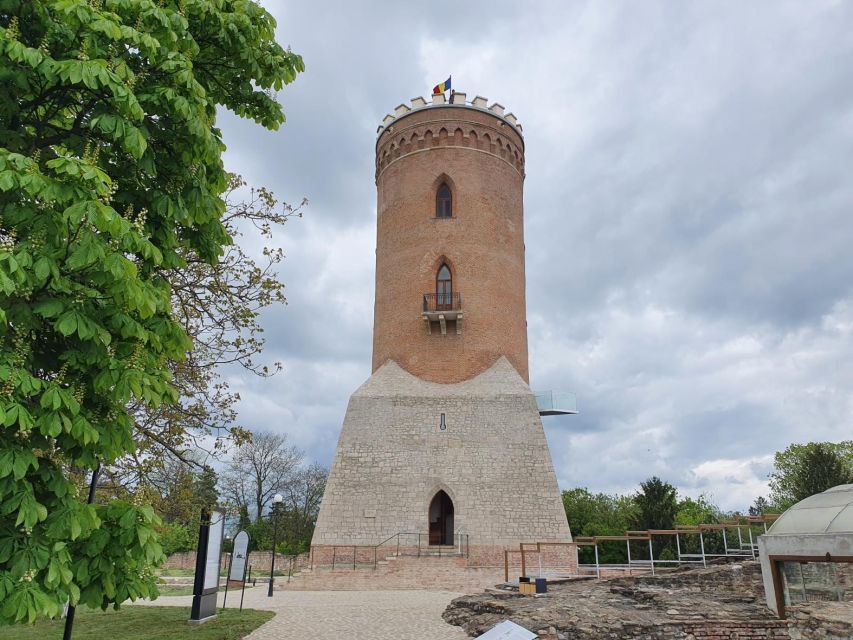
- Vlad’s court in Târgoviște: Explore the former princely residence, including Chindiei Tower and the surviving 15th-century church.
- Poenari means a real climb: Reaching the fortress involves 1,480 steps, so sturdy shoes and reasonable fitness matter.
- Nicolas is the named guide: He serves as your private English-speaking guide and driver, with Italian, Romanian, French, and Spanish also available.
- Curtea de Argeș adds royal context: See the old princely court, the 13th-century Royal Church, and the monastery connected with Romania’s kings.
- Vidraru Dam breaks up the history: The one-hour stop gives you time for photographs, a break, and a look at one of Romania’s major engineering works.
- Flexible private travel: Hotel pickup, fuel, parking, road tolls, and a flexible start time are included, while meals and admission charges are not.
Why this day trip is about more than Dracula
The useful thing about this experience is its broad view of Wallachia. You are not simply driven to a castle with a spooky name. You follow the political world of medieval princes, see the religious buildings that survived them, and then move into the mountains where Poenari offered a defensive refuge.
I like that the day begins with Târgoviște. It gives you the setting for Vlad the Impaler’s rule before you reach the more dramatic fortress. You can see where a prince governed, worshipped, and displayed power. By the time you reach Poenari, the story has more weight than a legend printed on a souvenir.
The private format matters here. Nicolas can spend more time on a question, adjust the pace for photographs, or make room for lunch without coordinating a large group. One previous booking specifically praised the relaxed timing and the chance to explore without pressure. That is important on an 11-hour day, when a rigid schedule can make every stop feel like a race.
Still, keep your expectations sensible. Târgoviște is a historic ruin complex, not a restored royal palace. Poenari is also not an easy castle visit. Its appeal comes from the climb, the setting, and the connection to Vlad, not from furnished rooms or a polished museum display.
More Dracula and Bran Castle trips:
- Bucharest: Dracula’s Castle, Peles Castle, & Brasov Old Town
★ 4.5 · 17,858 reviews - Bucharest: Dracula Castle, Peles Castle & Brasov Old Town
★ 4.6 · 10,891 reviews - Bucharest: Dracula’s Castle, Peleș Castle & Brașov Day Trip
★ 4.5 · 5,919 reviews
Târgoviște, where Vlad’s court took shape
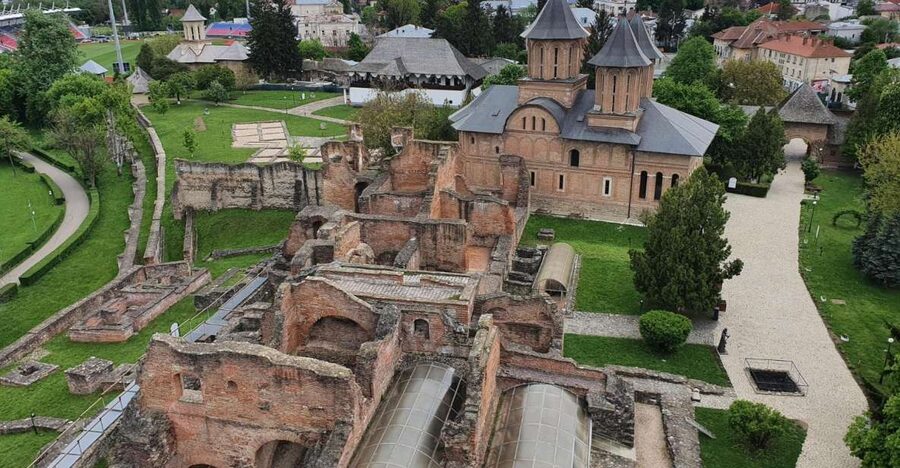
The first major stop is the Royal Court of Târgoviște, a site with a historical record reaching back to 1417 or 1418. The complex began as a fortress and grew into a princely residence. Several rulers of southern Romania used it, including Constantin Brâncoveanu and Vlad the Impaler.
This is the place to focus on power rather than horror stories. You can walk through the remains of the court and picture Târgoviște as a center of government. The buildings are ruined, but the layout helps you understand that Vlad was a ruler with administrative duties, military concerns, and a court, not simply the character later turned into Dracula.
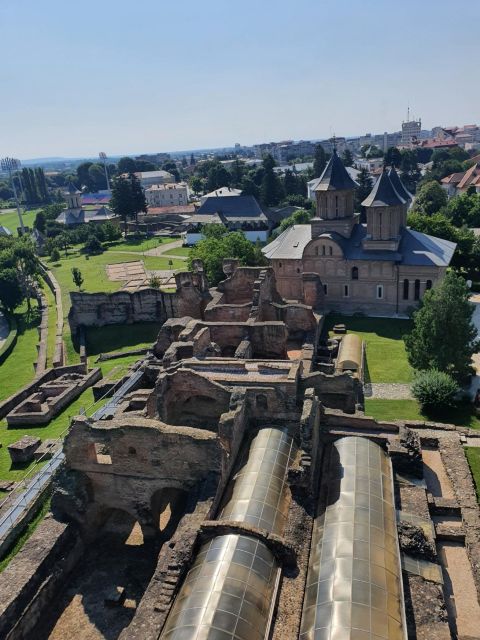
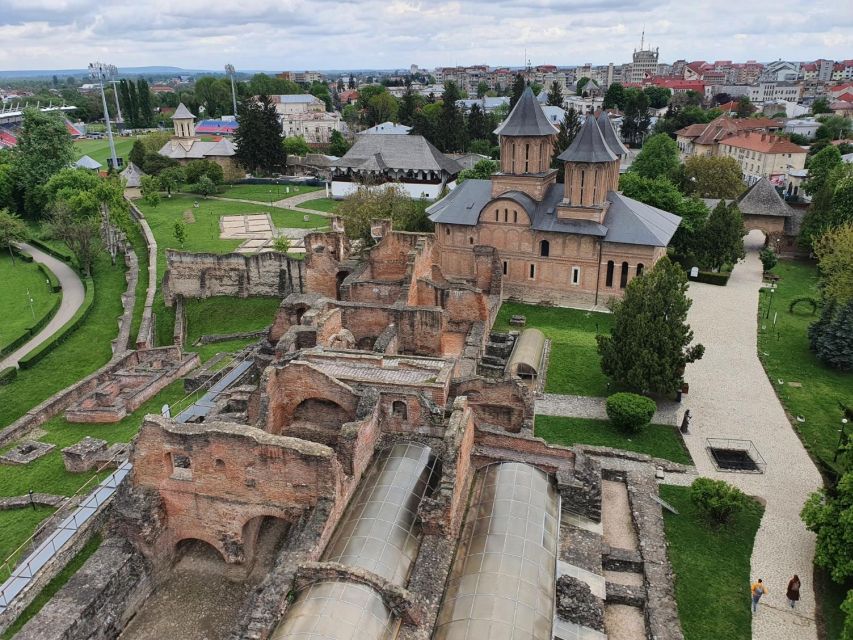
The highlight is Chindiei Tower, the symbol of the site. Vlad is associated with its construction, and climbing the tower gives you a view across the court. From the balcony, you can look down toward the remains of two princely palaces and see the silhouette of a church dating to 1415.
I would give this stop your full attention even if you are mainly here for Poenari. The tower connects the physical remains to the story being told. It also gives you the kind of broad view that ground-level ruins cannot provide.
The schedule allows about an hour and a half for the guided visit, followed by around 30 minutes for more walking, photographs, and free time in Târgoviște. That division is helpful. You can listen while Nicolas explains the site, then slow down and look at the details that interest you.
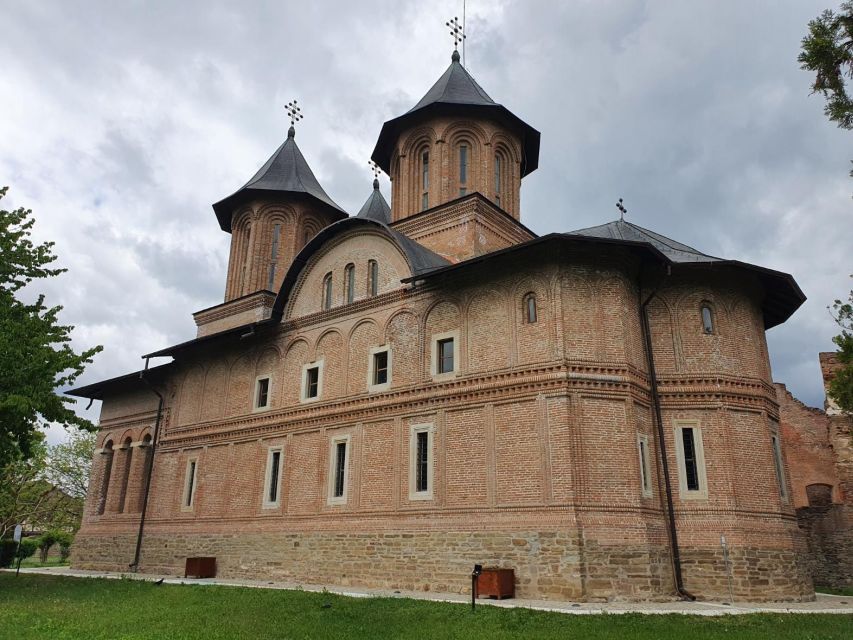
Two churches remain in the court area. The small Holy Friday Church offers a quieter stop, while the Great Princely Church is especially important because it is described as the only monument built in the 15th century in southern Romania still preserved in its original form.
That detail gives the court more meaning. You are not looking only at broken walls. You are also seeing one of the buildings that carries the medieval site into the present.
Curtea de Argeș and the old royal center
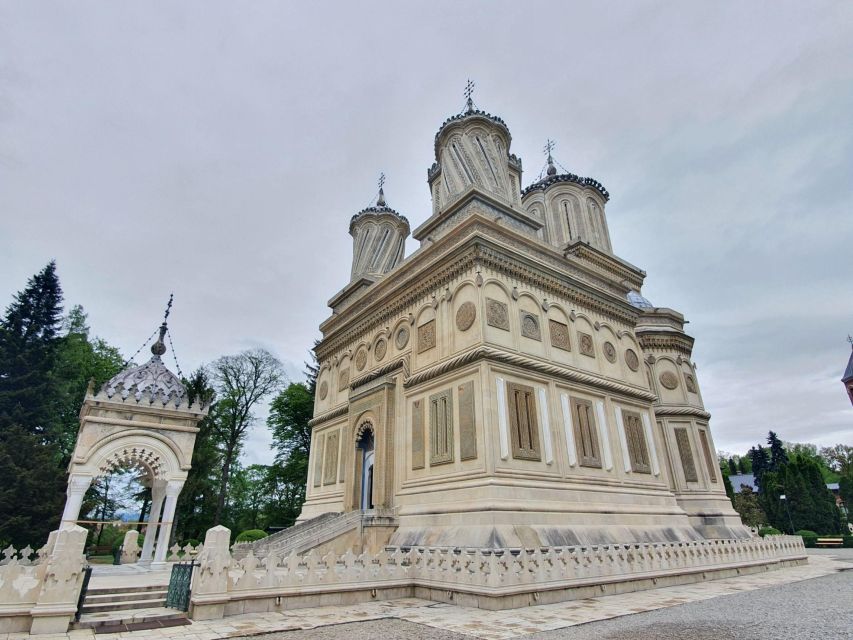
Curtea de Argeș changes the tone of the day. The town was the first capital of Romania, and its old center contains remains of the Wallachian princely court, the 13th-century Royal Church, and the famous Curtea de Argeș Monastery.
The stop lasts about 45 minutes, so plan on a focused visit rather than a slow architectural study. Your guide can explain the difficult events connected with the sites, which adds human detail to the stone buildings and royal monuments.
The monastery is especially important for understanding Romania’s monarchy. The graves of Romanian kings are located there, so the visit links medieval Wallachia with the later royal family. I find that connection useful because it widens the story beyond Vlad. You get a sense of how political and religious importance continued to gather around Curtea de Argeș long after the medieval princes were gone.
The old princely court and Royal Church provide an earlier layer. Together with Târgoviște, they show how authority moved through Wallachia and how churches preserved the memory of rulers. You should not expect a long stop, but the combination is well chosen for a single day.
If you prefer spending hours inside one major monument, this pace may feel short. If you want several meaningful sites without adding a second day, the 45-minute visit is a practical compromise.
Poenari Castle and its 1,480 steps
Poenari is the physical challenge of the tour and the stop most closely tied to the Dracula image. The fortress is in Poenari village, and the experience involves climbing 1,480 stairs to reach it.
That number is not a decorative detail. It determines how you should plan the day. Wear shoes suitable for a long stair climb, take your time, and do not treat the stop as a quick walk from the parking area. You will want energy left for the descent and for the rest of the day.
The fortress has a different character from Târgoviște. Târgoviște explains princely life and government. Poenari is about defense, elevation, and escape. Its association with Vlad the Impaler makes it essential for anyone interested in the historical man behind the Dracula legend.
The scheduled time is about an hour and a half for photographs and sightseeing. That should give you room to climb at your own pace, spend time at the site, and take in the mountain setting. The description also connects the fortress with the story that Vlad used the area to hide the country’s gold, adding another layer to the stop.
I would check current access before setting your heart on the climb. One account describes Poenari as closed on a particular day, with Nicolas using the time for other nearby places and traditional food. That is a useful sign of how a private tour can adapt, but it also shows why opening conditions matter.
Do not book this part expecting a Dracula attraction with theatrical effects. The value is the real place, the climb, and the chance to think about how a medieval ruler used remote terrain. If you dislike stairs or have limited mobility, Poenari may be the deciding drawback.
A different side of the city, same short trip:
- Bucharest: Palace of Parliament Tickets and Guide
★ 4.3 · 3,182 reviews - Bucharest: Day Trip to Dracula Castle, Peles Castle & Brașov
★ 4.4 · 3,049 reviews - Bucharest to Dracula Castle, Peles Castle and Brasov Guided Tour
★ 4.5 · 2,933 reviews - Bucharest: Palace of Parliament Tickets and Guided Tour
★ 4.4 · 1,877 reviews
Vidraru Dam, a modern pause in a medieval day
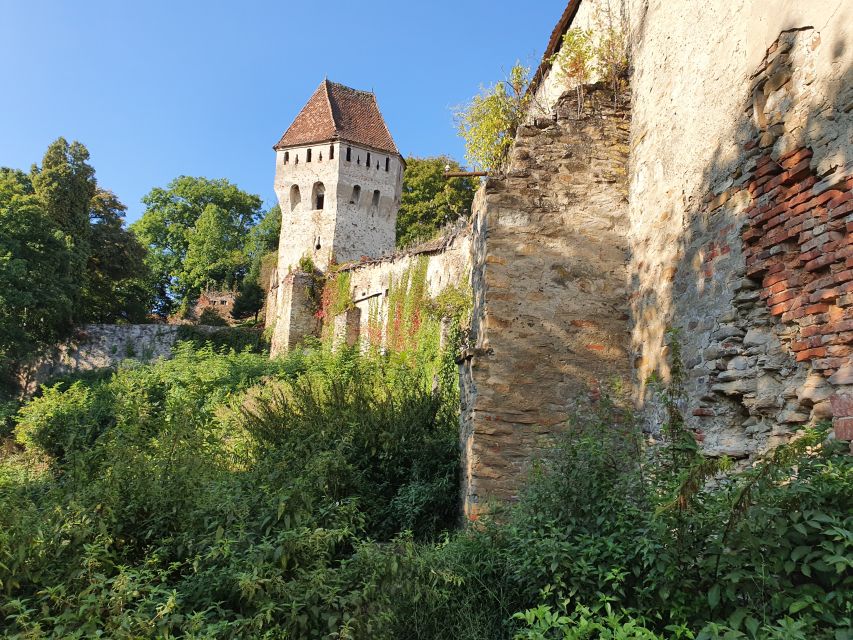
Vidraru Dam gives the schedule a welcome change of subject. After churches, ruins, and princely stories, you stop at one of Romania’s biggest dams and learn about its construction and history.
The visit lasts about an hour and includes time for photographs, a break, sightseeing, and shopping. That makes it more than a roadside glance. You can stretch your legs, take pictures, and let the earlier history settle before the return drive.
I like this stop because it shows another side of Romania’s past. A medieval fortress tells you how rulers defended power. Vidraru Dam tells you how a modern state reshaped its environment through major engineering. The contrast keeps the day from becoming a string of similar ruins.
The available information does not promise a detailed technical tour or a full museum visit, so keep your expectations modest. Think of Vidraru as a scenic and historical pause with guide commentary, not a separate half-day attraction.
The Wallachian setting on the return route
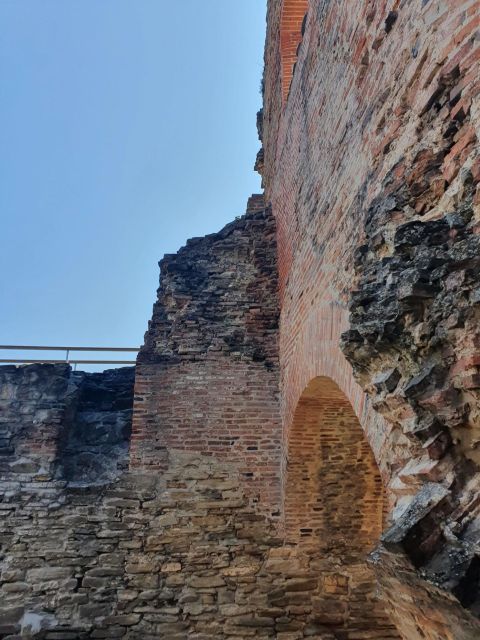
The final portion includes time in Wallachia, with another guided visit, photographs, and sights passed along the route. The schedule gives this section about an hour, though the exact experience can depend on traffic, road conditions, and how much time you spend at the earlier stops.
This flexibility is one reason a private car works well. Nicolas can keep the day moving while allowing extra time at a stop that interests you. A large coach group usually has less room for that kind of adjustment.
The driving itself is part of the experience. You move from Bucharest into historic Wallachian towns, then toward the mountain fortress and dam, before returning to the capital. It is a full day, but the route has enough variety to prevent the trip from feeling like one long transfer.
I would avoid scheduling an important evening activity in Bucharest. The stated duration is 11 hours, and the return time can vary with the pace of the day. Give yourself a little breathing room.
Nicolas and the private-car advantage
Nicolas is the named guide and driver, and the available feedback gives him particular credit for clear historical explanations, friendly conversation, professionalism, and a guest-first pace. You can expect him to guide the sites rather than simply drop you at the entrance.
That distinction matters in Târgoviște and Curtea de Argeș. Without context, ruins and old churches can blur together. A good explanation helps you understand why each place matters and how Vlad fits into the wider story of Wallachia.
The private group format also means you are not sharing the day with a busload of strangers. Hotel pickup and drop-off are included, along with fuel, parking, and road tolls. You wait in your hotel lobby five minutes before pickup, with the driver holding a sign showing your last name.
Start times are flexible, which is useful if you want to match the outing to your Bucharest plans. The tour is offered with English, Italian, Romanian, French, and Spanish support. Nicolas is specifically identified as an English-speaking guide and driver, so select the language you need when booking.
A private day trip at $323 per person is not cheap, especially before food and entrance fees. Its value depends heavily on your group size and priorities. For a couple, the price is a serious splurge. For a small private group, it buys door-to-door transport, a dedicated guide, and flexibility across several far-flung sites.
I would not choose it if your main goal is the lowest possible cost. I would consider it if you want to cover Târgoviște, Curtea de Argeș, Poenari, and Vidraru Dam in one day without working out complicated transport.
What to budget and what to bring
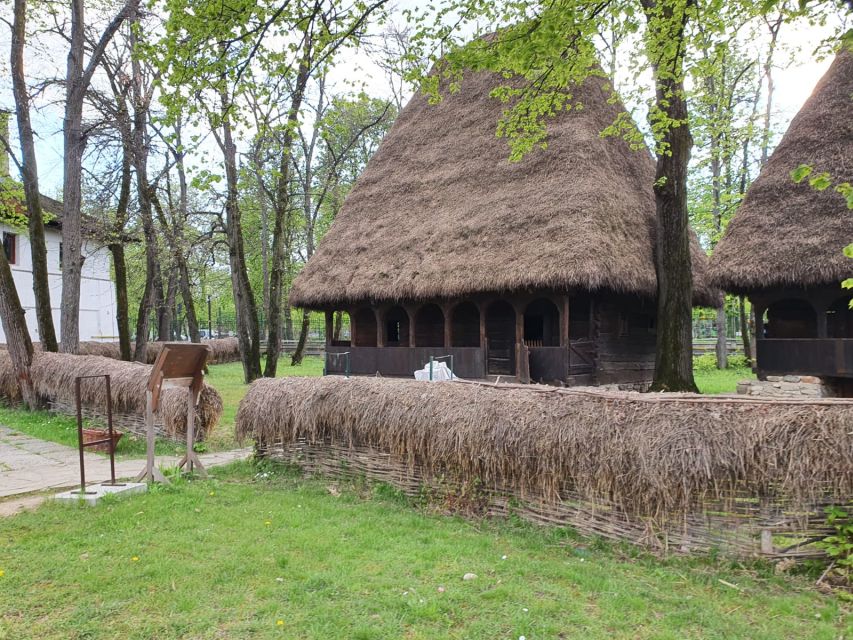
The price includes the private driver and guide, vehicle costs, parking, road tolls, and hotel pickup and drop-off. Food, drinks, and entrance fees are not included, so allow extra money beyond the advertised $323.
Wear comfortable shoes, with special attention to the Poenari stairs. Bring water and a camera, since Chindiei Tower, the monastery, Poenari, and Vidraru Dam all offer clear reasons to stop for photographs.
You should also dress for a long day outdoors. The schedule includes walking and sightseeing at several separate sites, not just visits from the car. A light layer is useful because the town and mountain portions may feel different.
The cancellation policy allows a full refund when you cancel at least 24 hours in advance. You can also reserve and pay later, which helps if your Bucharest plans are still taking shape.
Who should book this experience
I would recommend this day to anyone who wants the historical Vlad the Impaler, not just the fictional Dracula. It suits people who enjoy medieval courts, churches, royal history, and a little physical challenge.
It is also a good match for a private group that values conversation and flexible timing. Nicolas has already shown that the day can be adjusted when Poenari is unavailable, with extra places and traditional food used to fill the time.
I would think twice if you want a relaxed day with very little driving. Eleven hours is a long commitment. I would also reconsider if 1,480 stairs are beyond your comfort level, since Poenari is one of the central attractions rather than an optional footnote.
The tour has received a perfect score from five submitted ratings, with Nicolas repeatedly praised for his historical explanations, friendly manner, and relaxed approach to timing. That is a small sample, so I would treat it as encouraging rather than conclusive. The practical point is clear: the guide can make a packed route feel more manageable.
Should you book this private Dracula day trip?
Book it if you want one ambitious day that connects Vlad’s court, his mountain fortress, Romania’s royal past, and a major modern dam. The route is unusually varied, and the private format gives you far more control than a standard group excursion.
Skip it if you want an inexpensive outing, dislike long drives, or cannot manage the Poenari climb. Before booking, confirm the castle’s current access, check the extra admission costs, and ask yourself if you are comfortable giving the entire day to the excursion.
For the right person, this is not a costume-dracula outing. It is a demanding but well-shaped journey through Wallachian history, with Chindiei Tower and Poenari providing the strongest moments.
FAQ
Where does the tour start and finish?
The tour includes hotel pickup in Bucharest and returns you to Bucharest at the end of the day.
How long does the experience last?
The tour duration is 11 hours.
Is the tour private?
Yes. It is a private group experience with a private driver and guide.
Who is the named guide?
Nicolas is the named guide and driver. The tour also offers live guiding in English, Italian, Romanian, French, and Spanish.
Is transportation included?
Yes. Car expenses, gasoline, parking, road tolls, hotel pickup, and hotel drop-off are included.
Are meals and drinks included?
No. Food and drinks are not included in the price.
Are entrance fees included?
No. Entrance fees for the sites on the route are paid separately.
How many stairs are there at Poenari Castle?
The climb to Poenari Castle involves 1,480 stairs.
Can I cancel for a full refund?
Yes. You can cancel up to 24 hours before the experience for a full refund. You can also reserve now and pay later.
Recently added around Bucharest
- From Bucharest: Discovery at Europe’s Largest Salt Mine★ 5.0 · 3 reviews
- RiverCruise Exclusive – Private Transfer from or to Giurgiu Port/Bucharest Hotel★ 3.5 · 3 reviews
- Cluj Napoca: Climbing or Hiking Experience in Turda Canion★ 5.0 · 3 reviews
- Private-Red Patrol Bucharest Flea Market Tour with a Romanian car★ 5.0 · 3 reviews
- Bucharest: City Highlights Guided Walking Tour★ 5.0 · 3 reviews
- Probably the Best Restaurant and Wine Cellar near Bucharest★ 4.5 · 3 reviews
- Private 8 Day Romania UNESCO Tour★ 5.0 · 3 reviews
- Bucharest in a nutshell – half day private walking tour★ 5.0 · 3 reviews
Dracula & Bran Castle Tours, compared.
Dracula’s Castle, Peles Castle, & Brasov Old Town
Read our review →
Dracula Castle, Peles Castle & Brasov Old Town
Read our review →
Dracula’s Castle, Peleș Castle & Brașov Day Trip
Read our review →
Day Trip to Dracula Castle, Peles Castle & Brașov
Read our review →
Bucharest to Dracula Castle, Peles Castle and Brasov Guided Tour
Read our review →
Dracula’s Castle, Peles Castle and Brasov Day Trip from Bucharest
Read our review →
Transylvania and Dracula Castle Full Day Tour from Bucharest
Read our review →
Browse the lists this tour appears in