
Reviewed · CITY TOURS
City Tour Sighisoara Legends & Landmarks A Walk Through Time
Sighișoara’s medieval citadel is small enough to walk, yet full of stories that are easy to miss on your own. This tour links the Clock Tower, Dracula’s Birth House, and the Church on the Hill into one clear route, with local guides such as Peter, Charles, Carol, Andrea, and Jacob bringing the old streets and guild towers into focus.
I like the way the tour goes beyond the Dracula connection, and I like the climb up the 164-step Covered Staircase to the Gothic church and German Cemetery. The guide also explains Romanian history, local traditions, architecture, and daily life, not just dates and monuments.
The main drawback is the physical effort. The route includes cobbled streets, stairs, and a hill, so it is not suitable for people with mobility impairments. Entrance fees are also separate from the $45 price.
In This Review
- Key points to know before you book
- Why this Sighișoara walk works so well
- Meeting at Piața Muzeului
- The Citadel’s Market Place and the first stories
- Dracula’s Birth House, with the legend in context
- The Clock Tower and the city from above
- The Covered Staircase and School Hill
- The Church on the Hill and the German Cemetery
- Guild towers and medieval defenses
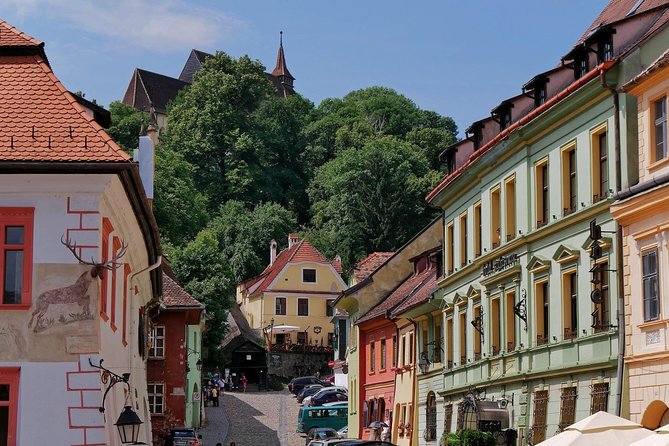
- Venetian House and the House with the Deer Antler
- What the $45 price includes
- Who should take this tour
- Timing, weather, and practical comfort
- Should you book City Tour Sighișoara?
- FAQ
- How much does the tour cost?
- How long does the tour last?
- What time does the tour depart?
- Where does the tour meet?
- What is included in the tour?
- Are entrance fees included?
- Can I cancel for a refund?
- Is the tour suitable for people with mobility impairments?
Key points to know before you book
- A history-first walk: The tour puts Vlad the Impaler in context instead of treating Sighișoara as a Dracula theme park.
- A serious uphill section: The 164 wooden steps to School Hill are a central part of the route.
- Excellent local guidance: Peter, Charles, Carol, Andrea, and other guides are praised for clear English, patience, humor, and broad knowledge of Romania.
- A useful first-day activity: The route helps you understand the citadel before exploring its lanes, towers, and museums alone.
- Two hours, with possible flexibility: Guides have adjusted routes, started early, or continued longer when circumstances required it.
- Bring light luggage only: Large bags and oversize luggage are not allowed, and you should carry a passport or ID card.
Why this Sighișoara walk works so well
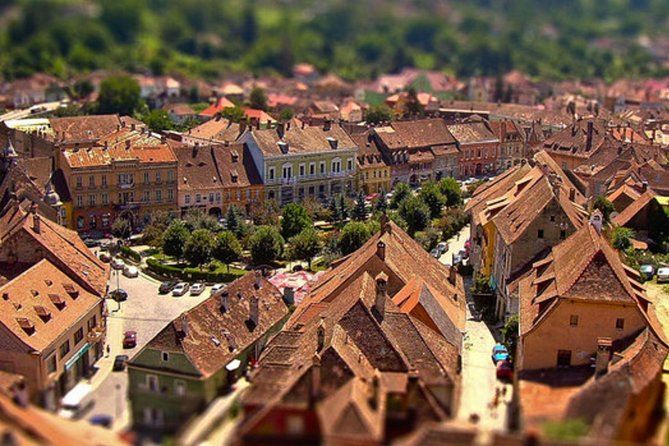
Sighișoara is one of Europe’s best-preserved medieval citadels and a UNESCO World Heritage Site. Its appeal is visual at first: colored houses, steep lanes, timber details, stone walls, and towers rising above the town.
But the place makes more sense once you understand how it worked. Sighișoara was shaped by Saxon settlers, guilds, defensive walls, churches, schools, merchants, and families who lived and worked inside a compact fortified town. This walking tour gives you that framework.
I would book it early in your stay. The route covers the main sights, but its real value is orientation. After two hours with a guide, you know which streets lead to the market place, why the towers have different names, and how the upper church connects with the lower citadel.
The guides also appear to adjust their style to the group. Peter is noted for using old photographs and explaining everyday life. Charles is praised for clear descriptions and sensitivity to physical needs. Carol is described as a local teacher who brings in stories about the town and the wider region. Those details matter because Sighișoara rewards questions. A short answer about a building can easily lead into Romanian customs, Transylvanian history, or the way the citadel changed over time.
More walking tours in Bucharest:
- Bucharest: City Highlights Guided Walking Tour
★ 4.9 · 1,482 reviews - Bucharest Highlights Walking Tour
★ 5.0 · 469 reviews - Free walking tour of Brasov in English
★ 4.9 · 302 reviews
Meeting at Piața Muzeului
The tour begins at Piața Muzeului 5, in front of the Monastery Church. The booking information also gives Piața Muzeului 6 as an alternative starting or finishing point, so check your confirmation carefully before setting out.
The square places you right in the historic center. This is a good meeting point because you do not need transport once you arrive in the old town. The tour is a walking experience from beginning to end, with no vehicle transfers.
The scheduled departure is 11:00 each day. That morning timing gives you a useful way to shape the rest of your day. You can follow the tour with lunch, museum visits, or a second look at the lanes and viewpoints that caught your eye.
Bring a passport or ID card. Leave large suitcases and oversize bags elsewhere. You will be walking on old paving and climbing stairs, so comfortable shoes are more useful than anything stylish but stiff.
The Citadel’s Market Place and the first stories
The route moves through the Citadel’s Market Place, the social heart of medieval Sighișoara. Colorful burgher houses frame the square, and the buildings help you see the town as a place where families lived, traded, and guarded their interests.
This opening section is valuable because it gives the tour a human scale. You are not only looking at a pretty row of facades. You are learning how the houses fit into the town’s social order and how the market connected the people inside the walls.
The guide can also help you separate old fabric from later restoration. Sighișoara’s charm depends on small architectural details, and a good explanation makes those details easier to notice. Look up at rooflines, upper stories, doors, and decorative features rather than treating the square as one broad photo stop.
The compact layout makes the walk manageable in distance, but the surface is still uneven in places. I would not expect a fast-paced route. The strongest part of this experience is the explanation at each stop, and the guides have a record of taking time for questions rather than rushing from one landmark to the next.
Dracula’s Birth House, with the legend in context
Dracula’s Birth House is one of the most famous stops. Vlad the Impaler, the historical figure linked to the Dracula legend, was born here. Today the building contains a restaurant and a museum connected with Sighișoara’s past.
This is where the tour can correct an easy mistake. Vlad the Impaler and the fictional Count Dracula are not the same person. The connection is real enough to be interesting, but the wider story involves politics, power, violence, and medieval life rather than only vampire folklore.
I like that the stop is woven into the town’s broader story. You see the house, learn why it matters, and then continue through a citadel whose importance does not depend on Dracula. If that is the only subject you care about, the tour may feel too broad. If you want to understand why the legend took hold in this part of Romania, the wider approach is a benefit.
Entrance fees are not included, so you should expect to pay separately if you enter attractions along the way. The exact interior access can depend on opening arrangements, so treat the guided walk itself as the guaranteed core of the activity.
A few more Bucharest tours worth a look
- Sighisoara: Candlelight Tour of Dracula’s Home Town
★ 4.6 · 83 reviews - From Cluj: Sighișoara and Church of Biertan Guided Tour
★ 4.8 · 36 reviews - Sighisoara Fortress Quest: Exploration Game and Tour
★ 4.5 · 33 reviews - City Tour Sighisoara Legends & Landmarks A Walk Through Time
★ 5.0 · 11 reviews
The Clock Tower and the city from above
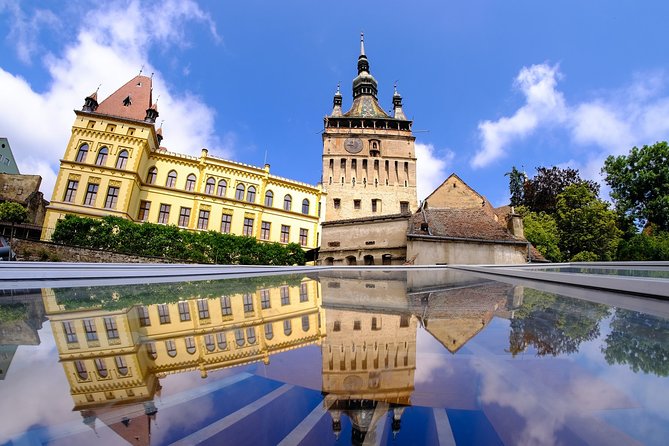
The Clock Tower is Sighișoara’s main landmark and one of the clearest symbols of the citadel. It rises 64 meters and includes a distinctive clock mechanism and historical artifacts.
The tower gives you two different experiences. Outside, it helps explain the town’s defenses and civic importance. Inside, the exhibits and clock mechanism add mechanical and historical detail. From the upper level, the panoramic view shows how the citadel sits above the lower town.
You should check whether the tower entrance is part of your chosen route on the day. Entrance fees are not included in the tour price, and the supplied information does not promise admission to every interior.
Even without going inside, this is an important stop because the tower helps you read Sighișoara’s layout. From the streets below, it is a landmark that keeps you oriented. From above, if you pay to enter, the town becomes easier to understand as a fortified settlement rather than a collection of attractive lanes.
Photography is easy here, but do not let the tower become only a picture stop. Ask about its clock, the artifacts, and the role of the citadel’s towers. Those details are part of what separates a guided visit from a quick walk around town.
The Covered Staircase and School Hill
The Covered Staircase is one of the most memorable sections of the tour. Built in the 17th century, its 164 wooden steps sheltered schoolchildren from harsh weather as they climbed toward School Hill.
The staircase is practical history. It tells you something about the town’s climate, education, and steep terrain all at once. You are walking through a structure made for daily use, not a monument designed only to impress.
The climb is also the clearest physical challenge. You may want to pause, especially if the weather is warm or the steps feel crowded. One useful feature of this tour is that guides have adjusted routes for people with limited time or physical concerns. One group avoided the hill because they had already made the climb, while another guide adapted the pace and route to suit the group.
Still, do not book this walk expecting a fully flat route. The Church on the Hill is one of the central highlights, and reaching it requires effort. Wear shoes with a good grip, carry water, and avoid bringing a heavy day bag.
The Church on the Hill and the German Cemetery
At the top of School Hill, you reach the Church on the Hill, a Gothic church with a notable interior and medieval frescoes. The setting gives the church a quieter feel than the lower citadel, and the climb makes the arrival feel earned.
The church is also called the mysterious church on the hill in the tour description, but the mystery is best understood through its age, location, art, and connection to the people who lived here. Your guide can add context that is difficult to get from a quick look at the exterior.
Nearby, the German Cemetery provides a different kind of historical record. The cemetery helps show the role of German-speaking families in Sighișoara and gives you a more personal view of the town’s past. Tombstones and family names can reveal social patterns that grand buildings do not.
This is one of the strongest parts of the route for anyone interested in people rather than just architecture. The cemetery connects the citadel to actual families, while the church shows how religion and community life shaped the upper town.
Opening conditions and entrance charges are separate matters, so do not assume every interior will be available or included. The walk remains worthwhile even when you need to view some places from outside, since the guide’s explanation adds much of the meaning.
Guild towers and medieval defenses
Sighișoara’s towers were linked to the town’s craft guilds and defense system. The Butchers’ Bastion and Tower introduce the role of a specific trade in protecting the citadel. The Tailors’ Tower and Furriers’ Tower show how different guilds held responsibility for parts of the fortifications.
The Tin Moulders’ Tower adds another piece to that system. These names are not random labels. They point to a town where work, trade, and military duty were closely connected.
I find this part especially useful because defensive walls can blur together when you look at them without context. A guide explains who maintained each section and why the towers were built as they were. You begin to see the citadel as an organized town with assigned responsibilities.
The route may not include an interior visit to every tower. Since admission is not included, plan to pay separately for any sites you want to enter. The benefit of the tour is that you learn which structures deserve a closer look later.
Venetian House and the House with the Deer Antler
The Venetian House adds a change of style to the route. Its Renaissance appearance and unusual history make it a good reminder that Sighișoara was not frozen in one medieval moment. Buildings changed as owners, tastes, and outside influences changed.
The House with the Deer Antler provides a memorable finish. Its facade is recognized by the mounted deer antlers, an odd and distinctive detail that rewards careful observation.
These stops are small but useful. They keep the tour from becoming a march between only the largest landmarks. Sighișoara’s character is often in the details: an unusual facade, an old house, a guild name, or a story attached to a doorway.
By the end, you have seen the citadel’s major public spaces, religious buildings, defenses, and private houses. The return point is at Piața Muzeului 5 or Piața Muzeului 6, depending on the arrangement.
What the $45 price includes
At $45 per person, the tour is priced as a guided cultural walk rather than a simple orientation stroll. The price includes an English-speaking specialized guide for two hours. It does not include food, drinks, attraction entrance fees, or souvenir photographs.
That distinction matters in Sighișoara because the most worthwhile paid experiences may be inside the Clock Tower, church, or other historic buildings. If you want to enter several attractions, your total cost will be higher than $45.
Still, the price can be good value if you care about context. You are paying for a route that connects the citadel’s major sights, explains the Dracula story without letting it take over, and gives you access to local knowledge about Romania and Transylvania.
The strongest value comes for first-time visitors and history-minded people. If you prefer to wander silently and take photographs, you can see the exteriors without booking a tour. If you want the town to make sense, the guide adds a great deal.
A private tour costs an additional EUR 20 per person. That may suit couples, families, or small groups who want to ask many questions or set a slower pace. The regular experience is a group tour, though it may become a very small group depending on bookings.
Who should take this tour
I would recommend it to first-time visitors, history fans, architecture lovers, and anyone who wants a clear introduction to Sighișoara. It also works well for families because the route combines legends, towers, unusual houses, and a physical adventure up the covered steps.
The guides have worked well with children and have adapted the route for people with time limits or physical concerns. Even so, the tour is not suitable for people with mobility impairments. The hill, stairs, cobbles, and walking time are real considerations.
It is also a good choice if you want to learn about Romania beyond the usual Dracula image. The guiding style described by the activity is broad, covering local traditions, national history, architecture, and everyday life.
You may want something else if your priority is entering every museum or monument. The tour does not include entrance fees, and the main focus is the guided walk. You can use the route to decide which interiors deserve your own time afterward.
Timing, weather, and practical comfort
The scheduled start is 11:00, and the duration is two hours. That is long enough to cover the principal route without taking over your entire day. Some guides have spent a little longer when questions, weather, or group interests called for it, but you should plan around the stated two-hour duration.
Rain does not necessarily stop the activity. A guide has met a group on time in light rain and continued the tour, even adding time. Bring weather protection rather than assuming the walk will be canceled.
The route includes outdoor streets, exposed viewpoints, a covered staircase, a church, a cemetery, and defensive towers. Conditions can change from one section to the next. A small bag, water, and comfortable shoes are the sensible combination.
You can cancel up to 24 hours before the start for a full refund, and you can reserve now and pay later. Those options are useful if your Romanian itinerary is still changing.
Should you book City Tour Sighișoara?
Book this tour if you want Sighișoara explained, not just photographed. The best parts are the local guidance, the Church on the Hill route, the guild defenses, and the way the Dracula story is placed inside a larger account of the town.
At $45, it is most worthwhile near the start of your stay, when the route can help you plan the rest of your time. Just budget separately for admission fees and prepare for the 164 steps.
If you have limited mobility, dislike hills, or want a self-guided stroll, skip it. For most first-time visitors who enjoy history and do not mind a steady walk, this is a practical and personable way to meet Sighișoara.
FAQ
How much does the tour cost?
The listed price is $45 per person. A private tour requires an additional EUR 20 per person.
How long does the tour last?
The scheduled duration is two hours.
What time does the tour depart?
The listed departure time is 11:00, daily.
Where does the tour meet?
The main meeting point is Piața Muzeului 5, in front of the Monastery Church. Piața Muzeului 6 is also listed as a possible starting or finishing point.
What is included in the tour?
An English-speaking specialized guide is included.
Are entrance fees included?
No. Entrance fees for attractions are not included. Food, drinks, and souvenir photographs are also separate.
Can I cancel for a refund?
Yes. You can cancel up to 24 hours in advance for a full refund.
Is the tour suitable for people with mobility impairments?
No. The tour is not suitable for people with mobility impairments because the route includes walking, cobbled streets, stairs, and the climb to School Hill.
Recently added around Bucharest
- 6h Communism Tour in Bucharest with Ceausescu Mansion★ 4.5 · 6 reviews
- From Bucharest : Day Trip to Peles, Dracula’s Castle, Brasov★ 4.7 · 6 reviews
- Bears Sanctuary, Dracula Castle and Brasov City – Full Day Trip from Bucharest★ 5.0 · 6 reviews
- Dracula Private Tour★ 5.0 · 6 reviews
- Transfagarasan Road Private Day Trip from Bucharest / The Best Road in the World★ 5.0 · 6 reviews
- Bucharest : Wednesday, Dracula & Peles 3 Castles Tour 1 Day★ 4.7 · 6 reviews
- Hiking thought the best mountain villages in Romania-Private tour from Brasov★ 5.0 · 6 reviews
- Bucovina Painted Monasteries & Transylvania Tour: 4-Day Private★ 5.0 · 6 reviews
City Tours, compared.


Bucharest Panoramic Sightseeing – Private City Tour
Read our review →
SB01 – City Tour Sibiu: Exploring the Heart of Transylvania
Read our review →
Black Sea and Constanța City – Private Tour from Bucharest
Read our review →Browse the lists this tour appears in