
Reviewed · WALKING TOURS
Bucharest Walking Tour with a Native Italian Speaking Guide
Bucharest reveals its character through sharp contrasts: a quiet Orthodox monastery, lively old-town streets, grand Belle Époque buildings, and the vast concrete bulk of Parliament. This small-group Italian walking tour connects those pieces in about two and a half hours, with guides such as Giuseppe Spadaro and Filippo Dicataldo bringing local experience and humor to the route.
I like the clear historical arc, from the medieval princely court to the fall of Ceaușescu in 1989. I also like the personal touch: the guides are praised for making complicated history easy to follow and for keeping children and less attentive family members involved.
The main drawback is the pace. Eight stops in 150 minutes means some visits are brief, and the tour includes outdoor walking rather than interior admissions. At $36.76 per person, it is a sensible orientation to central Bucharest, but not a substitute for detailed museum visits.
In This Review
- Key points at a glance
- Why this walk is a useful first look at Bucharest
- Stavropoleos Monastery and the old center
- Curtea Veche, Saint Anthony Church, and Manuc’s Inn
- Lipscani, BNR Palace, and Villacrosse Passage
- Calea Victoriei and the umbrella street
- Revolution Square and the story of 1989
- Constitution Square and the outside of Parliament
- What the $36.76 price really buys you
- Who will get the most from this tour
- Practical details before you book
- Should you book the Bucharest Italian walking tour?
- FAQ
- How long does the Bucharest walking tour last?
- Where does the tour start?
- Where does the tour end?
- Is the tour conducted in Italian?
- Does the tour include admission to the Palace of Parliament?
- What is the cancellation policy?
Key points at a glance
- Start with Stavropoleos Monastery: See one of central Bucharest’s most delicate examples of Brâncovenesc architecture.
- Walk through the city’s oldest core: Curtea Veche, Saint Anthony Church, and Manuc’s Inn bring medieval Bucharest into view.
- Follow the 1989 revolution: Revolution Square gives the tour its strongest modern historical moment.
- See Parliament from Constitution Square: The tour explains the political setting behind Europe’s largest administrative building.
- Travel in Italian: Giuseppe Spadaro and Filippo Dicataldo are named as certified guides with long experience in Romania.
- Expect a compact group: The maximum is 15 people, with all admissions and personal spending outside the tour price.
Why this walk is a useful first look at Bucharest
Bucharest can be hard to read at street level. One block may show a quiet church with carved stonework, while the next opens onto a large avenue lined with banks, hotels, and formal public buildings. Communist-era planning also changed the center on a huge scale, so a guide helps connect buildings that otherwise seem unrelated.
This route does that in a practical way. It begins in the old center, moves through the commercial heart of the city, follows Calea Victoriei, then ends with the royal and communist-era landmarks around Revolution Square and Constitution Square.
I would use it on a first morning in Bucharest. The 10:00 a.m. start gives you a full afternoon afterward for a museum, a meal, or a visit inside the Palace of Parliament if you arrange that separately. It also gives you a basic map of central Bucharest before you set out on your own.
The group limit of 15 matters. You are not getting a private tour, but you should have a better chance of hearing the guide and asking questions than you would on a large coach outing. The experience is conducted on foot, so comfortable shoes and protection from sun or rain are sensible choices.
More walking tours in Bucharest:
- Bucharest: City Highlights Guided Walking Tour
★ 4.9 · 1,482 reviews - Bucharest Highlights Walking Tour
★ 5.0 · 469 reviews - Free walking tour of Brasov in English
★ 4.9 · 302 reviews
Stavropoleos Monastery and the old center

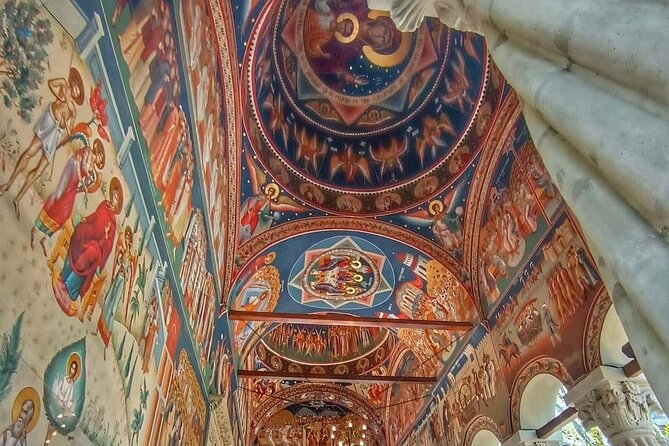
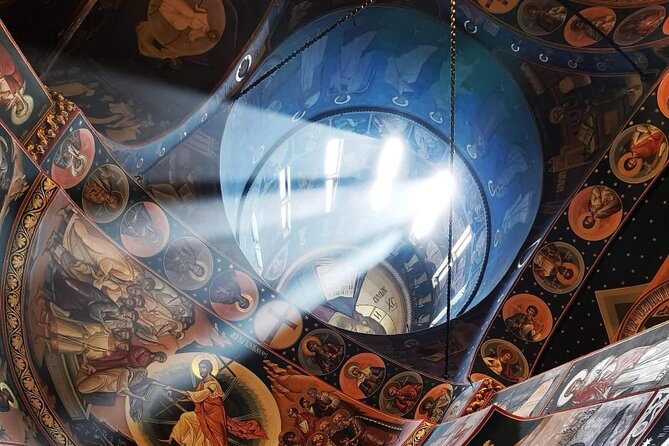
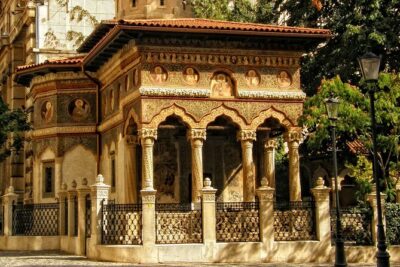
The first stop is Stavropoleos Monastery on Strada Stavropoleos. You receive about 20 minutes here, enough to look closely at the courtyard, architectural details, and painted decoration without turning the stop into a long religious-art visit.
The monastery is associated with the Brâncovenesc style, a Romanian architectural tradition known for combining local, Byzantine, Ottoman, and Western influences. The result is more intimate than monumental. In the middle of central Bucharest, the monastery offers a quiet visual break from the surrounding streets.
I would pay attention to the frescoes and the carved details rather than rushing through for a photograph. Admission is free, and the monastery is included as a sightseeing stop, so you do not need to budget an additional ticket.
As with any active religious site, respectful clothing and behavior are wise, although the tour information does not set out a formal dress code. The stop is short, so anyone wanting a detailed look at the church’s art may want to return independently.
Curtea Veche, Saint Anthony Church, and Manuc’s Inn
The next 20-minute stop brings you to a small square with several layers of Bucharest’s early story. You see Biserica Sfântul Anton, the ruins of Curtea Veche, and Manuc’s Inn.
Curtea Veche refers to the old princely court, closely linked with the medieval development of Bucharest. The remaining ruins do not offer a complete palace experience, but they help you picture the city before its grand avenues and financial buildings were built.
Saint Anthony Church adds a living religious site to the ruins. Manuc’s Inn gives the area a commercial angle. Its caravanserai design recalls a time when merchants and goods moved through the city along overland routes. Together, these places explain why the old center became a meeting point for rulers, traders, and ordinary city life.
This is one of the most useful stops for understanding Bucharest as a former crossroads. The guide’s storytelling matters here because the remains are easy to overlook if you do not know what you are seeing.
Lipscani, BNR Palace, and Villacrosse Passage
The walk continues along Lipscani Street, traditionally one of Bucharest’s central commercial arteries. The scheduled stop is only about 10 minutes, but the street itself helps you sense the change from old market district to modern nightlife zone.
Lipscani is not presented as a museum piece. It is a working entertainment area, with places to eat and drink among older façades. During the day, you can focus on the street pattern and buildings. Later, the same area becomes one of the city’s main evening gathering spots.
Next comes the BNR Palace, the historic headquarters of the National Bank of Romania. The building sits among other structures that reflect Bucharest’s Belle Époque period, when the capital adopted grander European styles and developed a more formal financial center.
The 10-minute timing means you will mainly view the exterior. That is enough to place the bank in the city’s economic story, but you should not expect an interior tour.
Macca Villacrosse Passage follows with another 10-minute stop. Its covered, curved gallery has a very different mood from the broad avenues outside. The passage once served several roles and now contains elegant bars and cafés.
This is a good place to notice how Bucharest reuses older spaces. You get architecture, city life, and a possible coffee setting in one compact stop. If you want to sit down, order something, and study the passage slowly, you may need to return after the tour because the group schedule keeps moving.
A few more Bucharest tours worth a look
- Bucharest: Dracula’s Castle, Peles Castle, & Brasov Old Town
★ 4.5 · 17,858 reviews - Bucharest: Dracula Castle, Peles Castle & Brasov Old Town
★ 4.6 · 10,891 reviews - Bucharest: Dracula’s Castle, Peleș Castle & Brașov Day Trip
★ 4.5 · 5,919 reviews - Bucharest: Palace of Parliament Tickets and Guide
★ 4.3 · 3,182 reviews
Calea Victoriei and the umbrella street
Calea Victoriei is the longest section of the tour, with about 20 minutes set aside for the avenue. It is Bucharest’s most polished central street, lined with historic buildings, fashion shops, and refined bistros.
The avenue helps explain Bucharest’s nickname as a city of contrasts. The buildings here present a more formal face than the old lanes around Lipscani. You might find the route especially useful if you want to compare the city’s medieval core with its later royal and commercial ambitions.
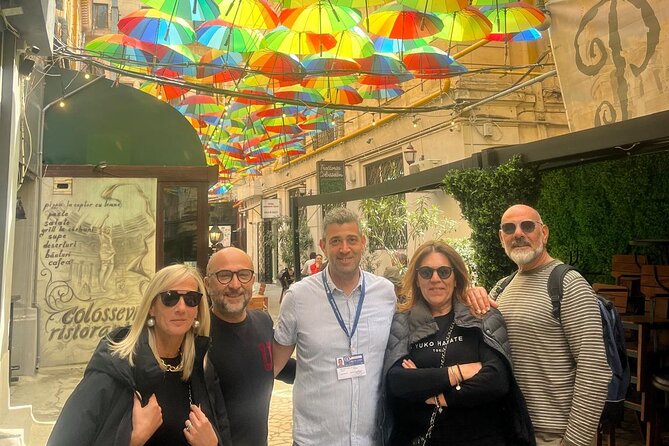
The tour also stops at the popular umbrella-covered street for a group photograph. This is a lighter moment in a route that otherwise carries a lot of political and architectural history. It gives you a clear photo opportunity, but it is also a reminder that modern Bucharest creates new visual attractions alongside its older monuments.
Because the walk remains outdoors, the weather can shape this section. The tour requires good weather, and the schedule may be changed or canceled if conditions are poor. On a sunny day, the avenue should be pleasant. In strong heat, the lack of an extended indoor break may be tiring.
Revolution Square and the story of 1989
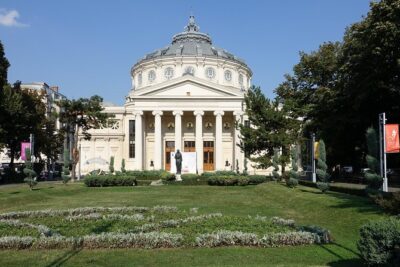
Revolution Square is the emotional center of the route. You have about 20 minutes to see the Romanian Athenaeum, the former Royal Palace, and the National Library, while the guide explains the final events that brought down Ceaușescu’s dictatorship in December 1989.
This is where a local guide can add real value. The square is attractive, but its importance goes well beyond architecture. It became the setting for the collapse of the communist regime, and the surrounding buildings give the story a physical frame.
I appreciate that the tour does not treat Bucharest as only an old-town destination. Understanding the 1989 revolution changes how you view the avenues, public squares, and monumental buildings elsewhere in the city.
The guides are repeatedly described as clear, serious, and entertaining when discussing difficult subjects. Giuseppe and Filippo are both associated with the experience, and Filippo Dicataldo is described as having lived in Romania since 1991. That kind of long-term connection can help place recent events in a personal and local context, though the exact guide for your departure may vary.
You should expect an overview rather than a full study of communist Romania. Twenty minutes allows for a strong introduction, not every political detail or every location connected to the uprising.
Constitution Square and the outside of Parliament
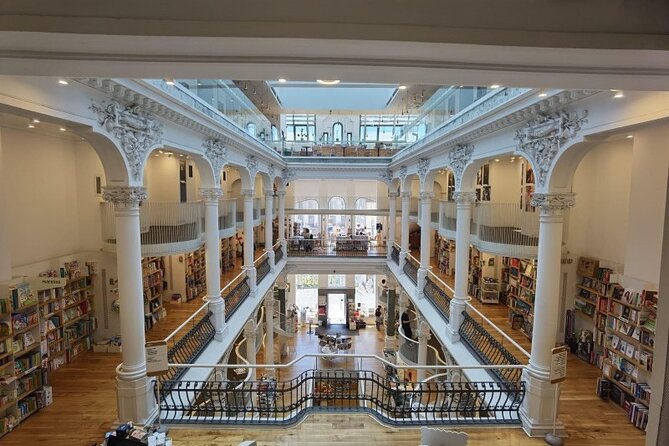
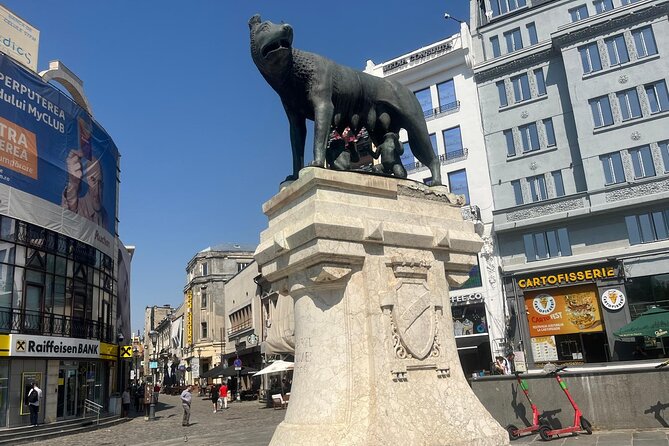
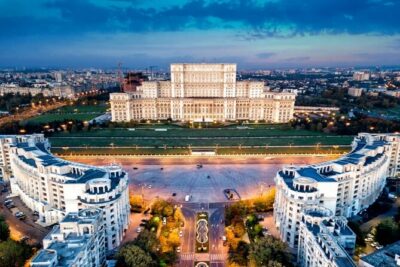
The route ends in Piața Constituției, or Constitution Square, after another 20-minute segment. From here, you view the exterior of the Palace of Parliament, described as the largest administrative building in Europe and the heaviest building in the world.
The building is hard to grasp from photographs alone. Its scale is the point, and the square gives you room to consider how much of central Bucharest was reshaped to create this monumental government district.
The guide explains the political setting in which the building was constructed, connecting its size and location to Ceaușescu’s regime. That context prevents the stop from becoming a simple photo opportunity. You see not only a huge structure, but also the cost and ambition behind it.
This tour does not include entry to Parliament. That is important when comparing it with dedicated Parliament visits. If you want to go inside, you will need to arrange a separate experience, and this walking tour will at least give you the background needed to make sense of what you see.
Ending here is practical. You are finished with the main central landmarks and can continue exploring from Constitution Square. The tour does not provide transport back to your hotel, although one account describes a guide helping with a hotel transfer. I would not count on that as a standard inclusion, since transport is not listed as part of the experience.
What the $36.76 price really buys you
At $36.76 per person, the cost is higher than a self-guided stroll through the same streets, since all eight stops are public spaces or exterior viewpoints with no admission fee. The value comes from the guide’s language, structure, local context, and ability to turn scattered buildings into one coherent story.
You are paying for roughly 150 minutes of guided time in a group capped at 15 people. That works out to about $14.70 per hour, before considering the convenience of having the route planned and the history explained as you walk.
I think the price is fair for visitors who want a quick, focused introduction in Italian. It is less compelling if you already know Bucharest well, speak Romanian or English comfortably, and prefer to spend an hour at each site.
The strongest value comes from the guide’s role. Giuseppe Spadaro and Filippo Dicataldo are presented as authorized or certified Italian guides, and the feedback about them repeatedly emphasizes preparation, professionalism, warmth, and humor. The praise is unusually consistent around those points, including the ability to keep children engaged.
There are tradeoffs. No food, drinks, entrance fees, or transport are included. The brief stops also mean you are buying orientation rather than extensive site visits.
Who will get the most from this tour
I would recommend this walk to Italian-speaking visitors on a first Bucharest visit, especially those with only a few hours to understand the center. It is also a good choice for families because the storytelling includes funny anecdotes rather than relying only on dates and names.
The experience suits people who prefer history explained in plain language. The route covers medieval Bucharest, commercial development, Belle Époque architecture, royal buildings, communist power, and the 1989 revolution in one sitting.
It may not suit you if walking in direct sun is difficult, if you want a slow photographic tour, or if your main goal is to enter monuments. The tour spends most of its time outside and moves at a schedule designed to cover many landmarks.
A compact group helps, but the maximum is still 15. For a private pace, longer photo stops, or a custom route, you would need a different format.
Practical details before you book
The meeting point is Strada Stavropoleos 5, near the first stop, and the start time is 10:00 a.m. The tour ends at Piața Constituției, not back at the starting point.
A mobile ticket is provided, and confirmation arrives at booking. The route is near public transportation, and service animals are allowed. Most people can participate, but the experience requires walking between several central locations.
Plan for weather. The tour requires good conditions, and poor weather can lead to a different date or a full refund. You can cancel for a full refund up to 24 hours before the local start time. Cancellations or changes within 24 hours are not refunded or accepted, so avoid booking it too tightly around a flight or train.
The tour requires a minimum number of participants. If that minimum is not reached, you are offered another date or experience, or a full refund.
Should you book the Bucharest Italian walking tour?
Book it if you want Bucharest explained by an Italian-speaking guide, need a strong first orientation, and enjoy mixing architecture with personal stories and humor. The route is well chosen, the group size is controlled, and the historical range is impressive for two and a half hours.
I would be especially comfortable recommending it to families, couples, and short-stay visitors who want the city’s main central sights without spending time planning a route. Giuseppe Spadaro and Filippo Dicataldo are the names to look for, though the assigned guide should be confirmed at booking.
Skip it if you want interior visits, a private tour, or a leisurely pace. For everyone else, $36.76 buys a useful introduction to a city that makes much more sense once someone explains how its monastery, royal avenue, revolution square, and enormous Parliament building fit together.
FAQ
How long does the Bucharest walking tour last?
The tour lasts approximately 2 hours and 30 minutes.
Where does the tour start?
It starts at Strada Stavropoleos 5, București 030167, Romania, at 10:00 a.m.
Where does the tour end?
The tour ends at Piața Constituției in Bucharest.
Is the tour conducted in Italian?
Yes. The experience includes a native Italian-speaking tour guide. Giuseppe Spadaro and Filippo Dicataldo are named as guides associated with the tour.
Does the tour include admission to the Palace of Parliament?
No. The tour views the Parliament building from outside. Anything not specifically stated as included is excluded.
What is the cancellation policy?
You can cancel at least 24 hours before the start time for a full refund. Cancellations or changes within 24 hours are not accepted or refunded. If poor weather or an insufficient minimum group causes cancellation, you are offered another date or experience, or a full refund.
Recently added around Bucharest
- From Bucharest : Day Trip to Peles, Dracula’s Castle, Brasov★ 4.7 · 6 reviews
- Bears Sanctuary, Dracula Castle and Brasov City – Full Day Trip from Bucharest★ 5.0 · 6 reviews
- 6h Communism Tour in Bucharest with Ceausescu Mansion★ 4.5 · 6 reviews
- Dracula Private Tour★ 5.0 · 6 reviews
- Transfagarasan Road Private Day Trip from Bucharest / The Best Road in the World★ 5.0 · 6 reviews
- Bucharest : Wednesday, Dracula & Peles 3 Castles Tour 1 Day★ 4.7 · 6 reviews
- Hiking thought the best mountain villages in Romania-Private tour from Brasov★ 5.0 · 6 reviews
- Bucovina Painted Monasteries & Transylvania Tour: 4-Day Private★ 5.0 · 6 reviews
Walking Tours, compared.
Ghost Stories & Romanian Mythology Walking Tour
Read our review →
4h Bucharest Private Tour (2h by Car and 2h Walking in Old Town)
Read our review →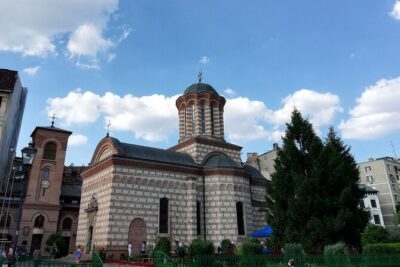
Browse the lists this tour appears in