
Reviewed · WALKING TOURS
Bucharest in a nutshell – Half Day Private Walking Tour
Bucharest makes the most sense when you see its two cities in one: the old commercial town around Lipscani and the grand boulevards, palaces, and communist scars layered over it. This private walk connects both sides, moving from Manuc’s Inn through University Square and Revolution Square to the Romanian Athenaeum.
I like the flexible route and the guide, Razvan Trancu, who adjusts the conversation to your interests. I also like the serious historical focus, especially the treatment of the 1989 anti-communist revolution, Romanian politics, architecture, and Jewish history. The drawback is that this is mainly an outdoor walking tour, so it is not the right pick if you want long interior visits to museums or monuments.
In This Review
- Key points at a glance
- Bucharest’s Two Cities, Explained on Foot
- Starting at Manuc’s Inn and Lipscani
- University Square and Romania’s Education Story
- The National Theatre and Cercul Militar
- Calea Victoriei, Bucharest’s Great Avenue
- Revolution Square and the End of Communist Rule
- The Former Royal Palace and National Art Gallery
- Ending at the Romanian Athenaeum
- What Razvan Adds to the Experience
- Price, Group Size, and Practical Value
- Who Should Book This Bucharest Walk
- Should You Book It?
- FAQ
- How long is the Bucharest walking tour?
- Where does the tour begin?
- Where does the tour end?
- Is hotel pickup available?
- What is included in the price?
- Can I cancel for a full refund?
Key points at a glance
- See Bucharest’s medieval center and grand 19th-century avenue in one walk, from Manuc’s Inn to Calea Victoriei.
- Spend about 40 minutes at Revolution Square, where the former Communist Party headquarters and Revolution Memorial frame the events of 1989.
- Ask for a customized history lesson, including Jewish Bucharest, Romanian education, architecture, or the communist period.
- Finish at the Romanian Athenaeum, one of the city’s most important symbols of music and the arts.
- Book the whole group privately, with a listed price of $216.74 for up to 10 people.
- Use the flexible pickup option if you are staying in central Bucharest.
Bucharest’s Two Cities, Explained on Foot
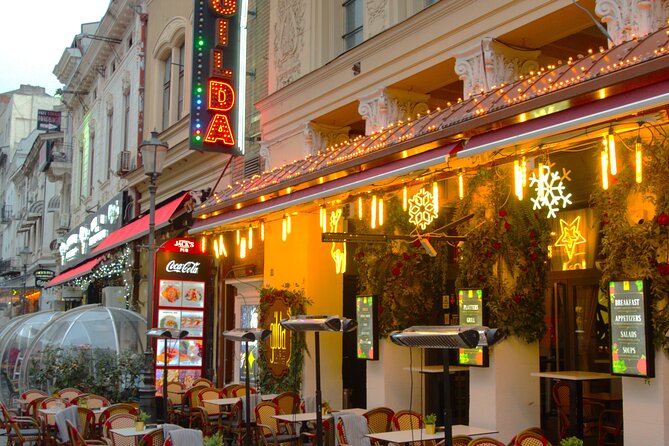
The strongest idea behind this tour is simple: Bucharest is not a single, tidy historic center. It is a city where medieval streets, royal buildings, modern boulevards, communist reconstruction, and post-1989 change sit close together.
Razvan’s route gives that story a clear shape. You begin at Manuc’s Inn, in the Old Town, and end near the Romanian Athenaeum. Along the way, you cross the historic center and the ceremonial heart of the capital. The walk is less about checking off buildings and more about learning why Bucharest looks the way it does.
That approach matters here. The city suffered major wartime damage, earthquakes, rapid modernization, and the massive reshaping ordered under Nicolae Ceaușescu. Some older streets survived. Others were erased or cut through by newer roads and grand state projects. A guide can point out those breaks in the urban fabric, while a map or guidebook may leave them looking like random changes.
The tour is offered in English, and the schedule is listed for every day from 7:00 a.m. to 7:00 p.m. The stated duration is three to four hours. That gives you enough time for context without turning the morning or afternoon into a full-day commitment.
More walking tours in Bucharest:
- Bucharest: City Highlights Guided Walking Tour
★ 4.9 · 1,482 reviews - Bucharest Highlights Walking Tour
★ 5.0 · 469 reviews - Free walking tour of Brasov in English
★ 4.9 · 302 reviews
Starting at Manuc’s Inn and Lipscani
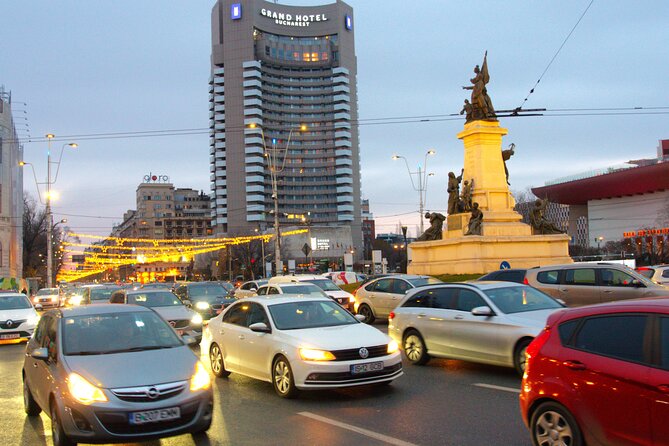
The meeting point is Manuc’s Inn, Hanul lui Manuc, at Strada Franceză 62. This is a useful starting place because it puts you in the Old Town’s historic core rather than on a modern traffic avenue.
The first hour centers on Old Town and the Lipscani area. Here, Razvan introduces Bucharest from its foundation through its modern rebuilding and communist destruction. The point is not only to admire old façades. You learn how this trading district helped give birth to the city of three million people that Bucharest is today.
Lipscani can feel touristy, especially around its restaurants and nightlife streets. A private guide helps you look past the surface. You might notice traces of older commerce, changes in building styles, and the way the district has been recreated for modern use. The tour description specifically promises stories and scars, which is an apt way to think about Bucharest’s center.
This is also the part where you should speak up about your interests. The route is adjustable. If you care about Jewish history, political change, architecture, religion, food culture, or everyday life under communism, tell Razvan at the start. One of the tour’s most useful qualities is that it is not locked into a script for a large group.
University Square and Romania’s Education Story
The walk continues to University Square, with about 30 minutes devoted to the area. This is both an educational center and an important political gathering point.
You’ll hear about Romanian education and the role of the university in the city’s public life. The square also connects to the recent anti-communist period, giving Razvan a place to explain how students and ordinary residents became involved in resistance and protest.
This stop is valuable because it links institutions to street history. Bucharest’s political changes were not only decisions made inside government buildings. Squares, universities, theaters, and boulevards became places where people gathered, argued, resisted, and sometimes faced violence.
The square is an urban setting rather than a formal museum visit. If you prefer exhibits, documents, and long periods indoors, you may find this section less satisfying on its own. If you want a guide to connect public spaces with Romania’s political story, it is a strong part of the route.
The National Theatre and Cercul Militar
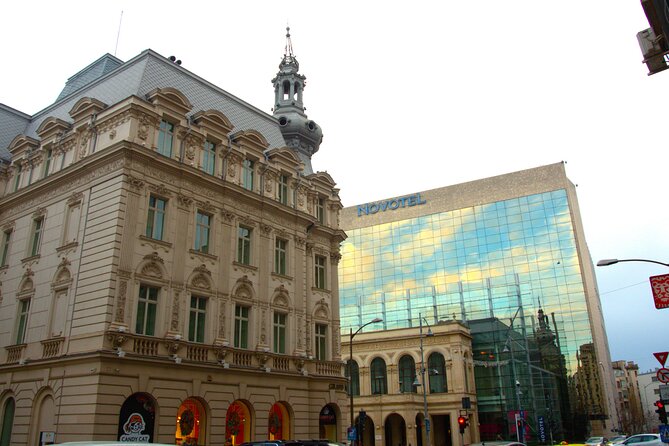
At the Ion Luca Caragiale National Theatre, the tour includes an outside view and details about anti-communist resistance events. The planned stop is about 20 minutes.
The theater gives you another way to understand Bucharest beyond royal buildings and churches. It represents the cultural life of the capital, while its connection to resistance shows how public institutions could become part of political conflict.
Next comes Cercul Militar Național, or the National Military Circle, for roughly 10 minutes. You’ll admire its ornate eclectic architecture and hear the story behind the building. This is a short stop, but it helps vary the pace of the walk. After the heavier political material at University Square, the architectural detail gives your eyes a break.
The main limitation is clear: these are outside views. The tour includes explanations and observation, not guaranteed entry into the theater or military building. You should plan on a walking experience with exterior architecture as the main visual material.
A few more Bucharest tours worth a look
- Bucharest: Dracula’s Castle, Peles Castle, & Brasov Old Town
★ 4.5 · 17,858 reviews - Bucharest: Dracula Castle, Peles Castle & Brasov Old Town
★ 4.6 · 10,891 reviews - Bucharest: Dracula’s Castle, Peleș Castle & Brașov Day Trip
★ 4.5 · 5,919 reviews - Bucharest: Palace of Parliament Tickets and Guide
★ 4.3 · 3,182 reviews
Calea Victoriei, Bucharest’s Great Avenue
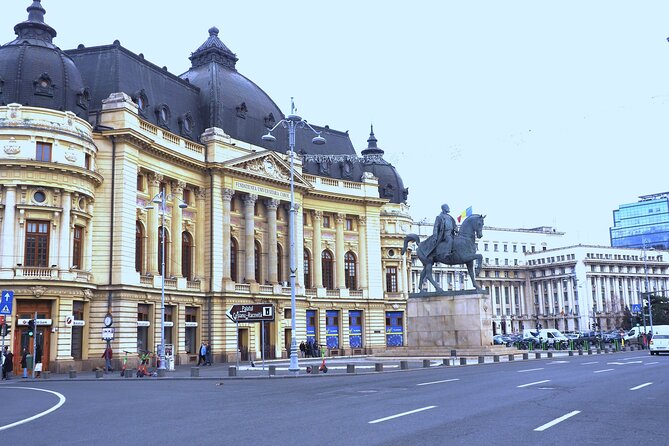
Calea Victoriei receives about 10 minutes in the listed schedule, though you will encounter it as part of the movement between several central stops. It has been Bucharest’s main street for around 300 years and is one of the best places to see how the city’s elite, royal, cultural, and commercial life developed.
Razvan points out stories and less obvious details along the avenue. This is where a private guide can add real value. The street is easy to walk on your own, but the meaning of its buildings and side streets is much harder to spot without local context.
I would pay attention to the changes in scale. The Old Town feels close and irregular. Calea Victoriei feels more formal and outward-looking. Later, the route reaches royal and cultural buildings that express the ambitions of modern Romania. The walk lets you compare those settings within a single afternoon.
Because the scheduled time here is short, you should not expect a full architectural survey of the avenue. The tour uses Calea Victoriei as part of a broader story rather than treating it as a stand-alone sightseeing stop.
Revolution Square and the End of Communist Rule
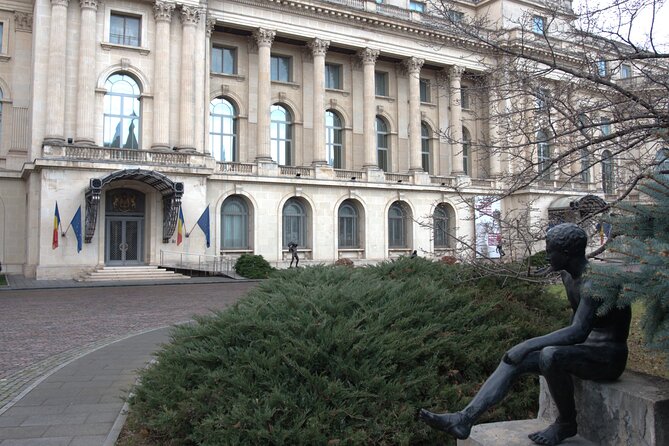
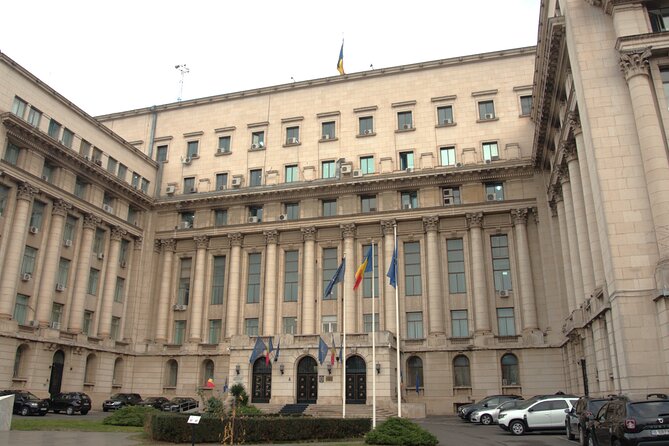
Revolution Square receives the longest single stop, about 40 minutes. That is appropriate. This is the emotional and historical center of the tour.
Here you see the former Central Committee headquarters of the Communist Party, the secret services buildings, and the Revolution Memorial. Together, these sites help explain the final days of Ceaușescu’s rule and the violent collapse of the communist government in December 1989.
A guide’s role is especially important at this stop. A list of buildings cannot explain how fear, public anger, state power, and sudden political change came together in one square. Razvan’s approach, as described through the tour’s material, places the events within a larger story of Romanian and European history.
You can also ask questions about the 1980s, the fall of other Eastern European dictatorships, or the changes that followed the dissolution of the Soviet bloc. The guide’s background in history and politics is likely to be most useful here, particularly if you want more than a simple date-and-name explanation.
This is not light sightseeing. Some of the stories connected with the revolution are disturbing. You should allow time to absorb the setting instead of rushing from one photo stop to the next.
The Former Royal Palace and National Art Gallery
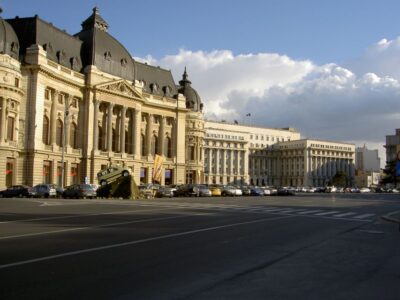
The Muzeul Național de Artă al României occupies Bucharest’s former Royal Palace. The tour allows about 20 minutes for the building and its past.
Even if you do not enter the gallery, the palace adds an important layer to the route. You have already seen the medieval trading center, the university district, communist power, and the revolution. The former royal palace brings the monarchy and the cultural ambitions of the Romanian state into the same sequence.
The supplied details do not promise an included museum admission. All stops are listed without admission charges, while entry fees are excluded from the tour price. Treat this as an exterior and historical introduction unless you arrange something different with the guide.
If art is a major interest, you may want to return independently for a longer visit. A 20-minute stop is enough to understand why the building matters, but not enough for a serious look at a national collection.
Ending at the Romanian Athenaeum
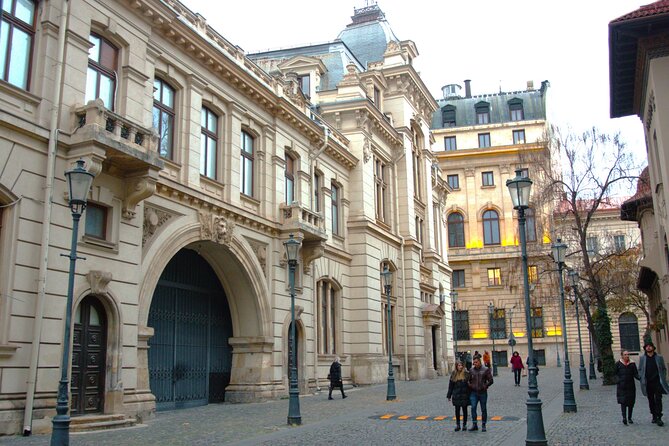
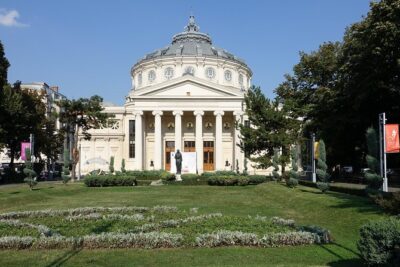
The walk concludes at the Romanian Athenaeum, on Strada Benjamin Franklin 1-3, across from the National Art Gallery and beside the Intercontinental Athénée Palace Hotel. The planned time is about 20 minutes.
This is a fitting finish. The Athenaeum is dedicated to music and the arts, and its symbolism gives the walk a more hopeful final note after the difficult material at Revolution Square. Razvan explains the building’s meaning and symbolism rather than treating it as a quick photograph.
The end point is also practical. You finish in central Bucharest, close to other major sights, hotels, restaurants, and public transportation. The tour does not include coffee, tea, snacks, or taxes, so you can make your own plans after the walk instead of being tied to a group meal.
Again, the information provided does not confirm an interior visit. If you want to see the concert hall inside, ask about arrangements when booking. The tour itself promises the building, its story, and its symbolism.
What Razvan Adds to the Experience
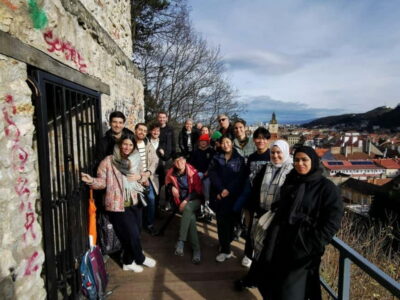
A private walking tour rises or falls on the guide. Here, Razvan Trancu is the main reason to consider booking instead of simply following a self-guided route.
The feedback supplied about his work repeatedly points to clear English, careful listening, warmth, and a strong command of history, politics, and architecture. One particularly useful detail is his ability to adjust the tour to Jewish history when requested. That makes this a good option for visitors researching family connections or trying to understand the Jewish experience in Romania.
He also brings supporting material to help place events in context. That can be useful when discussing the revolution, shifting borders, communist rule, and the changes of the 1980s and 1990s. You are not limited to memorized facts about buildings.
The personal recommendations can extend beyond the walk. Razvan has offered suggestions for bars, clubs, and fine dining, and he has also arranged private countryside outings involving small family wineries, spa time, village visits, and boutique hotels. Those activities are not part of this half-day tour, but they suggest that you can ask for practical help planning the rest of your time in Romania.
One note for language planning: the experience is offered in English. Feedback also describes Razvan speaking excellent Italian, but English is the stated tour language, so confirm your preferred language before booking.
Price, Group Size, and Practical Value
The listed price is $216.74 per group of up to 10 people. For one or two people, that is a significant cost for a three to four hour walk. For a family or group of friends, the price becomes much more reasonable because it is divided across the whole party.
The value comes from privacy and flexibility. You are not paying for transportation, meals, or attraction admissions. You are paying for Razvan’s time, local interpretation, and the ability to shape the conversation around your interests.
For a group of 10, the per-person cost is about $21.67. For four people, it is about $54.19 each. Solo visitors and couples may prefer a less expensive group tour if budget is the main concern, but a private format can be worth it if you want to ask many questions or discuss a specific subject.
The walk covers a lot of ground. Wear comfortable shoes and leave room in your schedule for pauses. Pickup is flexible and optional, and if you stay downtown, you may be able to begin near your accommodation rather than at Manuc’s Inn.
The tour is listed as suitable for most participants, near public transportation, and welcoming to service animals. Confirmation arrives when you book. Free cancellation is available if you cancel at least 24 hours before the local start time. Changes or cancellations inside that window are not accepted for a refund.
Who Should Book This Bucharest Walk
I would choose this experience if you want a first serious orientation to Bucharest and prefer conversation to a fixed audio script. It suits history-minded visitors, families, small groups, and anyone who wants to ask about Romania’s communist period without feeling rushed.
It is also a good choice for a short stay. The route covers the Old Town, University Square, Calea Victoriei, Revolution Square, the former Royal Palace, and the Athenaeum in one compact outing. You can then return to the places that caught your interest.
You may want another option if you mainly want interior museum time, a food tour, or transportation between distant sights. This is a walking tour, and its strength is interpretation of central Bucharest rather than a long list of admissions.
Should You Book It?
Book it if you want a private, flexible introduction to Bucharest’s layered past, especially the communist era and 1989 revolution. Razvan’s ability to discuss history, architecture, politics, Jewish life, and local nightlife makes the experience more adaptable than a standard sightseeing loop.
Think twice if you are traveling alone on a tight budget or want extensive indoor visits. For a group of several people, though, the $216.74 price is easier to justify, and the route gives you a useful framework for exploring Bucharest on your own afterward.
FAQ
How long is the Bucharest walking tour?
The tour lasts approximately three to four hours.
Where does the tour begin?
The standard starting point is Manuc’s Inn, Hanul lui Manuc, at Strada Franceză 62 in Bucharest.
Where does the tour end?
The tour ends at the Romanian Athenaeum, on Strada Benjamin Franklin 1-3, across from the National Art Gallery and beside the Intercontinental Athénée Palace Hotel.
Is hotel pickup available?
Pickup is flexible and optional. If you are staying in central Bucharest, the tour can begin from there.
What is included in the price?
The price includes a private guided walking tour. Snacks, coffee or tea, and all fees and taxes are not included.
Can I cancel for a full refund?
Yes. You can receive a full refund if you cancel at least 24 hours before the experience start time. Cancellations or changes made less than 24 hours before the start are not accepted for a refund.
Recently added around Bucharest
- 6h Communism Tour in Bucharest with Ceausescu Mansion★ 4.5 · 6 reviews
- From Bucharest : Day Trip to Peles, Dracula’s Castle, Brasov★ 4.7 · 6 reviews
- Bears Sanctuary, Dracula Castle and Brasov City – Full Day Trip from Bucharest★ 5.0 · 6 reviews
- Dracula Private Tour★ 5.0 · 6 reviews
- Transfagarasan Road Private Day Trip from Bucharest / The Best Road in the World★ 5.0 · 6 reviews
- Bucharest : Wednesday, Dracula & Peles 3 Castles Tour 1 Day★ 4.7 · 6 reviews
- Hiking thought the best mountain villages in Romania-Private tour from Brasov★ 5.0 · 6 reviews
- Bucovina Painted Monasteries & Transylvania Tour: 4-Day Private★ 5.0 · 6 reviews
Walking Tours, compared.
Ghost Stories & Romanian Mythology Walking Tour
Read our review →
4h Bucharest Private Tour (2h by Car and 2h Walking in Old Town)
Read our review →
Browse the lists this tour appears in