Reviewed · PRIVATE
Private – Romanian Vintage Car Driving Tour of Bucharest 120 min
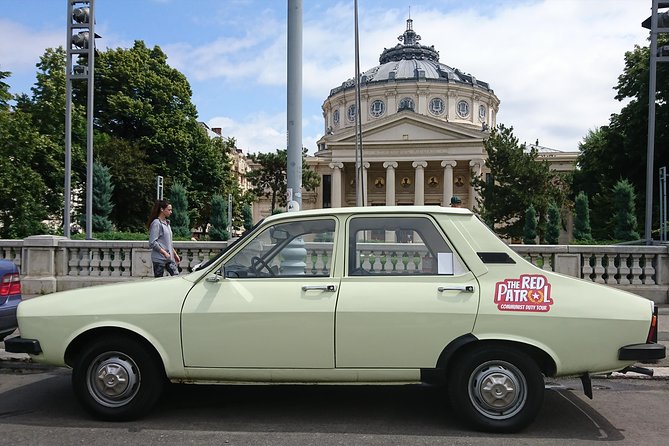
Bucharest becomes more personal when you see it from the front seat of a restored Dacia 1300 or 1310, the plain Romanian car that filled the roads during the communist years. This private two-hour circuit pairs major sights with social history, so you hear not only what a building is, but how ordinary people lived around it.
I like the way the tour uses the car as part of the lesson, and I like the small-group format, with up to three people per car and a convoy for larger parties. The main thing to weigh is the car itself: it is a genuine 1970s and 1980s classic, not a modern vehicle with air-conditioning, automatic gears, GPS, ABS, or power steering.
In This Review
- Key points
- Why an old Dacia changes the Bucharest tour
- Starting at Revolution Square
- Cotroceni and the royal connection
- Parliament from Constitution Square
- Triumph Arch and the northern city
- The panoramic ride through old Bucharest
- What the guide adds to the car
- Driving the Dacia yourself
- How much value do you get for $115.59?
- Who will enjoy this most?
- Timing, meeting point, and booking advice
- Should you book the Romanian Vintage Car Driving Tour?
- FAQ
- Where does the tour start and finish?
- How long does the experience last?
- Is this a private tour?
- How many people ride in each car?
- Can I drive the Dacia?
- What type of cars are used?
- Do the cars have modern features such as air-conditioning or automatic gears?
- Are landmark admission fees included?
Key points
- Drive a Romanian Dacia classic: You may take the wheel if you present a valid EU or international driving license.
- See Bucharest through recent history: The guide links Revolution Square, Parliament, Cotroceni, and Triumph Arch with stories from communist-era Romania.
- Private and small-scale: Your own group takes part, with three people per car and extra cars forming a convoy for larger parties.
- Meet at Revolution Square: The tour begins and ends at Piața Revoluției.
- Comfort varies by season: The cars are heated in winter, but they do not have air-conditioning in warm weather.
- A strong choice for groups: Group discounts and convoy arrangements make this especially appealing for friends, celebrations, and multinational groups.
Why an old Dacia changes the Bucharest tour
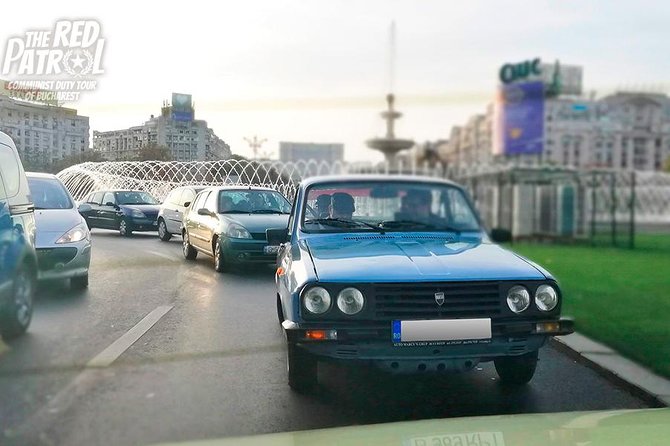
A standard city tour can show you Bucharest’s grand buildings. This one adds the feel of the period. The Dacia 1300 and 1310 were familiar cars in 1970s and 1980s Romania, and riding in one gives the communist-era discussion a physical setting.
That matters because Romania’s recent past is not just a chapter in a textbook. It shaped streets, housing, cars, public buildings, work, and family life. The car helps the guide move from large political events to everyday details.
Serban is named as one of the principal guides, and the experience depends heavily on the person behind the wheel. The guide and driver are expected to explain the city in English while handling the route, and the strongest part of the tour is the social context: stories about how people lived, not just dates and monuments.
The format is private, so you can ask questions without waiting for a large group to catch up. A group of friends can keep the mood light, while a couple or family can focus on the parts of Romanian history that interest them most.
There is one important tradeoff. These are restored classics that meet traffic safety rules, but they retain their original character. You should expect a manual car and old-fashioned controls rather than modern touring comfort.
A few more Bucharest tours worth a look
- Bucharest: Dracula’s Castle, Peles Castle, & Brasov Old Town
★ 4.5 · 17,858 reviews - Bucharest: Dracula Castle, Peles Castle & Brasov Old Town
★ 4.6 · 10,891 reviews - Bucharest: Dracula’s Castle, Peleș Castle & Brașov Day Trip
★ 4.5 · 5,919 reviews
Starting at Revolution Square
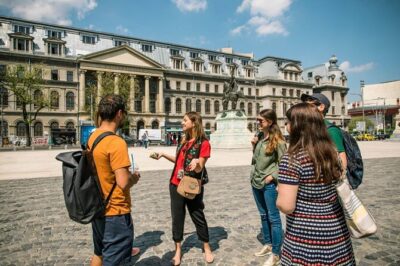
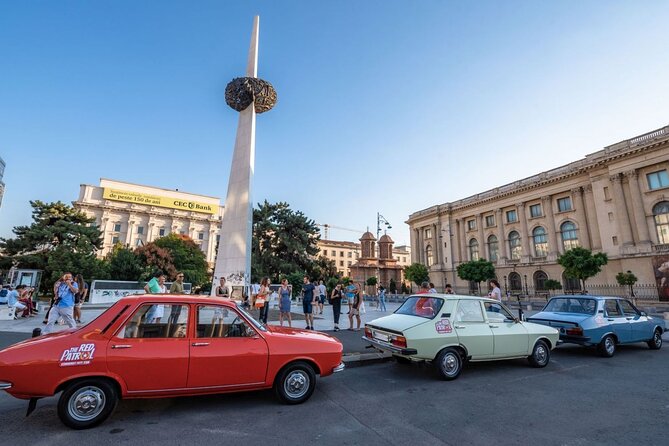
The meeting point is Revolution Square, or Piața Revoluției, in central Bucharest. The first 20 minutes are given to introductions and a presentation of the car.
This is more useful than it may sound. Before the driving begins, you get a chance to look at the Dacia, hear how the tour will work, and settle into the unusual idea of seeing a capital city from inside a preserved communist-era vehicle.
Revolution Square also provides a fitting opening. The square is tied to the political changes that ended Nicolae Ceaușescu’s rule, so the guide can establish the modern Romanian story before the car moves through the city.
If you are driving, this is the time to make sure you are comfortable with the controls. A valid EU or international driving license is required. The supplied information does not promise that every participant can drive, so you should clarify your driving arrangements when booking.
Three people fit in each car. That is a pleasant size for conversation, though a full car will feel more intimate than roomy. Larger parties are split among two or three cars and travel in convoy, which keeps the private-group feel while allowing up to larger celebrations and company outings.
Cotroceni and the royal connection
The next stop is the Cotroceni Quarter, with about 10 minutes dedicated to the area. This neighborhood began to grow around the Royal palace, giving the guide a chance to explain a different layer of Bucharest.
Cotroceni helps keep the tour from focusing only on communism. The route connects royal-era development with the later political and social changes that shaped the city. You get a sense of Bucharest as a place built in stages, rather than a capital defined by one period.
The stop is brief, so think of it as an orientation and storytelling point rather than a full neighborhood visit. Admission to buildings is not included, and the experience is conducted as an outdoor guided circuit rather than a museum tour.
This is one reason to view the activity as a city introduction, not a substitute for Bucharest’s indoor sights. If you want to tour palace interiors or enter landmark buildings, you will need separate time and tickets.
Parliament from Constitution Square
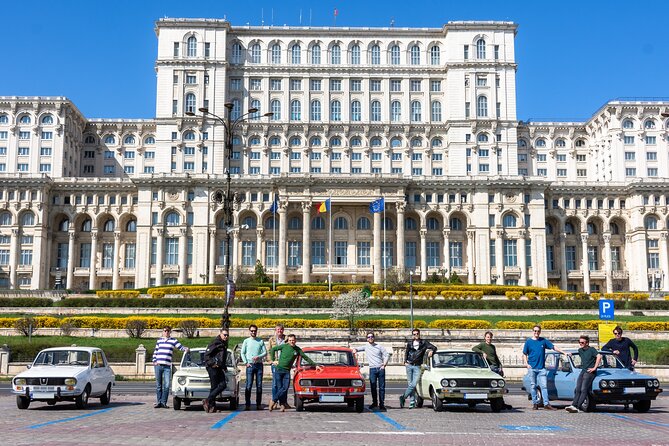
The car then stops in Constitution Square for about 15 minutes, with the Palace of Parliament as the setting for a presentation about the building and Romania in the 1970s and 1980s.
The Palace of Parliament is one of Bucharest’s most imposing sights, and the square gives the guide room to explain the scale and purpose of the project. The useful part is not simply seeing a huge government building. It is hearing how the building fits into Ceaușescu-era Romania and what its construction meant for the city.
A stop here works particularly well with the Dacia. The car represents ordinary transport from that period, while the palace represents the state’s enormous ambitions and demands. That contrast gives the discussion a clear human scale.
The stop is short, so you should not expect an extended interior visit. Admission fees for buildings are not included. If you want to go inside the Palace of Parliament, plan that as a separate activity and check its entry arrangements independently.
A different side of the city, same short trip:
- Bucharest: Palace of Parliament Tickets and Guide
★ 4.3 · 3,182 reviews - Bucharest: Day Trip to Dracula Castle, Peles Castle & Brașov
★ 4.4 · 3,049 reviews - Bucharest to Dracula Castle, Peles Castle and Brasov Guided Tour
★ 4.5 · 2,933 reviews - Bucharest: Palace of Parliament Tickets and Guided Tour
★ 4.4 · 1,877 reviews
Triumph Arch and the northern city
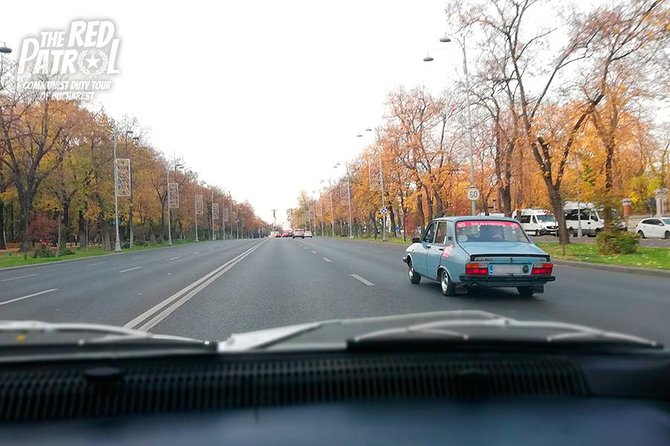
The 10-minute stop at the Triumph Arch, or Arcul de Triumf, is mainly for photographs and a presentation. It gives the route a change of mood after the monumental scale of Parliament.
The arch is a useful marker for Bucharest’s northern side and its ceremonial avenues. You will have time to take pictures and hear the guide place the structure within the wider story of the capital.
Again, the short timing is both a strength and a limit. You can see several key parts of Bucharest in two hours, but you are not spending long periods at any one landmark. I would bring a phone or camera ready to use and listen during the presentation rather than treating each stop as a long independent visit.
Admission to the landmark is not included. The supplied details do not promise entry, so expect an exterior stop and photo opportunity.
The panoramic ride through old Bucharest
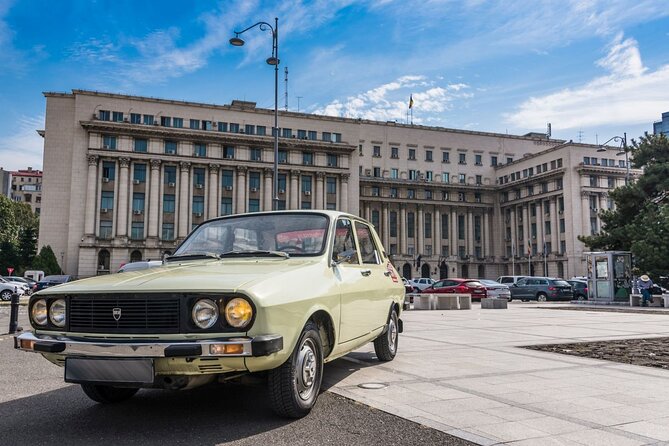
Between the stops, the route includes a panoramic ride along the famous promenade area associated with Bucharest in the 1940s. The exact road sequence is not specified, but this moving section is important because it lets you see the city as a whole rather than as a series of parked stops.
A guided circuit can show you how grand avenues, royal-era quarters, communist monuments, and ordinary streets sit alongside one another. You are also seeing the city at road level, where the Dacia feels most at home.
The ride is where the experience becomes less like a checklist. The guide can point out architecture and neighborhoods while you watch the city pass by. Since the tour lasts about two hours, the panoramic portion helps fill in the spaces between the named stops.
The tradeoff is that you may not get a precise route map in advance. If a particular street or building matters to you, ask the guide about it during the tour. The private format makes that sort of request more practical than it would be on a large coach excursion.
What the guide adds to the car
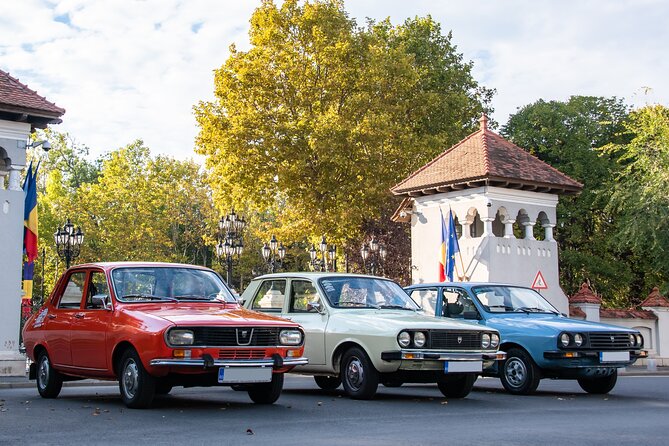
The strongest reason to book this is not simply the novelty of an old vehicle. It is the combination of firsthand social stories and a period car.
The guide presents the history of communist Romania in an accessible way, with attention to ordinary life. That can include the difference between official projects and daily experience, the role of the Dacia, and the changes that followed the 1980s. The supplied information does not provide a fixed script, so your questions can help shape the conversation.
Serban is specifically praised in the supplied material for his professional manner, clear English, relaxed approach, and strong grasp of communist-era stories. Other drivers work with him for larger groups. For a group of 18, the cars operated as a convoy, with drivers helping coordinate the route and accommodate group needs.
That makes the tour suitable for people who already took a conventional city tour. A basic sightseeing tour may cover the historical outline. This experience adds social context and a more personal way to understand the same places.
The guide may also provide printed material. One reported feature was a newspaper-style handout with facts about what the group saw and learned. Since this detail is not listed as a formal inclusion, treat it as a possible extra rather than something guaranteed on every departure.
Driving the Dacia yourself
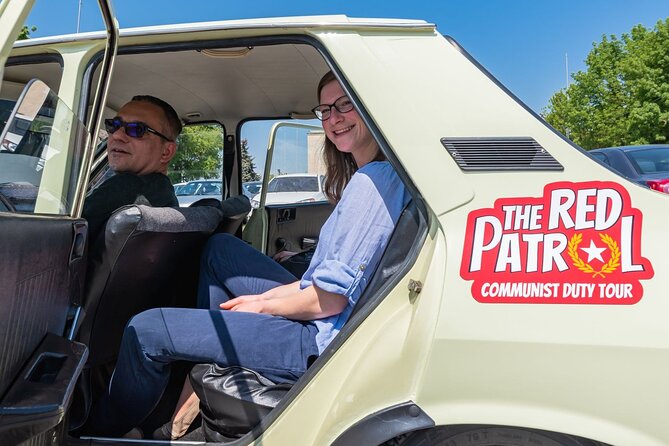
You may drive the Dacia if you present a valid EU or international driving license. This turns the outing from a ride into a more hands-on activity, especially for anyone interested in classic cars.
You need to be comfortable with a manual transmission. The car does not have automatic gear drive, servo-direction, GPS navigation, ABS, or air-conditioning. Those omissions are part of the period experience, but they also affect comfort and ease.
In winter, the cars are heated. That is a useful detail for a chilly morning, when the car can provide a warm shelter between outdoor stops. In hot weather, the lack of air-conditioning is more significant, so consider the season and your tolerance for a warm cabin.
The cars are fully restored and meet current traffic safety regulations, according to the supplied information. That should reassure you about basic road use, but restoration does not turn a 1970s design into a modern touring vehicle.
If you prefer to sit back, the professional local guide can drive. If you want the driving element, confirm the arrangements in advance. The details do not state how long each person may drive or whether every member of a group can take a turn.
How much value do you get for $115.59?
At $115.59 per person, this is not the cheapest way to see Bucharest. You are paying for a private activity, a restored classic car, a local English-speaking guide and driver, and a two-hour guided circuit.
The value is strongest for people who would otherwise pay for both a city tour and a special car experience. You receive a compact introduction to major sights while also getting the unusual Dacia setting. A private group can ask questions and move at its own conversational pace, which is harder to achieve on a standard bus tour.
Group discounts may improve the price for larger parties. The convoy system also makes the experience workable for birthdays, friend groups, and company outings. With three people per car, the cost buys a small, personal setting rather than a seat in a large vehicle.
The price does not include admission to buildings. That is fair for a driving circuit, but you should budget separately if you want to enter Parliament or another landmark. The activity also ends back at Revolution Square, so you are not paying for a transfer to another part of Bucharest.
I would call it good value if the Dacia and the social history are central to your interests. If you only want a fast list of sights, a less expensive walking tour may suit you better.
Who will enjoy this most?
I would recommend it to couples, families with children aged 10 or older, and groups of friends who want something more distinctive than a standard sightseeing ride. It also fits a first visit when you want a broad look at the capital in a short window.
It is especially useful for visitors curious about Romania’s communist period. The car, the Palace of Parliament stop, Revolution Square, and the guide’s stories support one clear theme without making the whole experience feel like a formal lecture.
Classic-car fans will appreciate the restored Dacia and the chance to drive. People who remember similar cars from their own family life may find the vehicle especially evocative.
The tour is not suitable for children under 10 or pets. It may also disappoint anyone expecting modern-car comfort, air-conditioning, automatic transmission, or a long indoor visit at each landmark.
Because the cars hold three people each, larger parties should decide how they want to divide up. A convoy is practical, but it is not quite the same as everyone riding together and hearing every comment at the same moment.
Timing, meeting point, and booking advice
The activity starts and finishes at Revolution Square in Bucharest. The listed stops account for roughly 55 minutes, with the remaining time used for driving, presentations, and the panoramic route.
Confirmation is provided at booking, and most people can participate. The experience is private, meaning only your group takes part.
You can cancel for a full refund if you do so at least 24 hours before the start time. Cancellations or changes made less than 24 hours ahead are not accepted for a refund, and the cut-off follows Bucharest local time.
I would book this early if you are traveling with a larger group or want to drive. Ask about the car assignment, driving arrangements, and whether the tour will use one car or a convoy.
Should you book the Romanian Vintage Car Driving Tour?
Book it if you want Bucharest explained through everyday life as well as monuments. The restored Dacia gives the tour a clear identity, and the guide-led stories connect royal Bucharest, communist Romania, the 1989 revolution, and today’s city in a way that a normal photo stop cannot.
The best match is a curious visitor who enjoys conversation, historic vehicles, and a short but focused circuit. I would be more cautious if you need air-conditioning, automatic gears, wheelchair details, long monument visits, or a fully predictable route.
For a couple or small group, the private format makes the $115.59 price easier to justify. For a larger party, group discounts and the convoy setup may make it a particularly memorable shared outing. If the idea of riding, or driving, a Romanian classic while hearing the stories behind Bucharest appeals to you, this is a strong choice.
FAQ
Where does the tour start and finish?
It starts at Revolution Square, Piața Revoluției, Bucharest, and ends back at the same meeting point.
How long does the experience last?
The tour lasts approximately two hours, or 120 minutes.
Is this a private tour?
Yes. Only your group participates in the activity.
How many people ride in each car?
The tour provides space for three people per car. Groups larger than three use a convoy of two or three cars.
Can I drive the Dacia?
You can drive the Dacia if you present a valid EU or international driving license.
What type of cars are used?
The tour uses fully restored Romanian Dacia 1300 and 1310 classic cars from the 1970s and 1980s.
Do the cars have modern features such as air-conditioning or automatic gears?
No. The cars do not include air-conditioning, ABS, GPS navigation, servo-direction, or automatic gear drive. They are heated during winter.
Are landmark admission fees included?
No. Admission fees for buildings at the stops are not included in the tour price.
Recently added around Bucharest
- 6h Communism Tour in Bucharest with Ceausescu Mansion★ 4.5 · 6 reviews
- From Bucharest : Day Trip to Peles, Dracula’s Castle, Brasov★ 4.7 · 6 reviews
- Bears Sanctuary, Dracula Castle and Brasov City – Full Day Trip from Bucharest★ 5.0 · 6 reviews
- Dracula Private Tour★ 5.0 · 6 reviews
- Transfagarasan Road Private Day Trip from Bucharest / The Best Road in the World★ 5.0 · 6 reviews
- Bucharest : Wednesday, Dracula & Peles 3 Castles Tour 1 Day★ 4.7 · 6 reviews
- Hiking thought the best mountain villages in Romania-Private tour from Brasov★ 5.0 · 6 reviews
- Bucovina Painted Monasteries & Transylvania Tour: 4-Day Private★ 5.0 · 6 reviews
Private, compared.

Castles of Transylvania: Private Day Trip from Bucharest
Read our review →
Dracula’s Castle, Peles Castle and Brasov – Private Day Trip from Bucharest
Read our review →
Bucharest Panoramic Sightseeing – Private City Tour
Read our review →
THERME “Take It Easy” Pack: Full Spa Access + Private Transfers
Read our review →
Piatra Craiului National Park Private Hiking Tour from Brasov
Read our review →
4h Bucharest Private Tour (2h by Car and 2h Walking in Old Town)
Read our review →